Wednesday, August 24, 2005

UNC summer reading: controversy in all the wrong places

Not only is D.G. Martin "looking for racial progress in all the wrong places," as Eric Muller observes: he's looking for controversy in all the wrong places, and he's been looking a long time now. His latest column is a virtual repeat of one he published in January--except for the addition of the passage that Eric finds so objectionable, the part where he implies a comparison between the old "solid South" (and its rude come-uppance) and Israel. Compare the two for yourself. What accounts for the gratuitous addition? Was it just something that came to him because of recent events in Gaza?

I don't know. But I do know that the second column comes after Martin has interviewed Tim Tyson, author of Blood Done Sign My Name, on UNC-TV. That interview, in turn, was clearly framed by Martin's initial reaction to the book, as he expressed it in January:

Tyson challenges our thinking. The story he tells shows, whether we like it or not, that it was violent, as much or more as [sic] non-violent, activity that led to changes in Oxford.

This part of our history is going to be hard for some of us to confront, especially at a time when we are committed to a war on terrorism and terrorists, however good the terrorists' long-term objectives may seem to them.


There's a big leap being made here, as well as a couple of disturbing suggestions. The leap is that all political violence is somehow the same (whether it involves bloodshed or not). The truly troubling suggestions are that such violence is at times a necessary means to a desirable end; and that the world will ever be thus.

Martin's interview with Tyson is worth watching. Tyson recounts the riot that broke out after the murder of the young black man Henry Marrow: the torching of $10 million worth of warehoused tobacco in downtown Oxford, followed by a hard-hitting economic boycott. The African Americans were convinced (rightly as it turned out) that the murderers would walk, and they were registering their feelings in the only language that had a hope of being heard: economic coercion. Especially interesting is this exchange:

MARTIN: These people made history. What you've taught us in your book is that they made history by doing a lot of property damage, by being what we might call terrorists, in the sense that they were throwing fire bombs, things like that. You came to believe, it's not fair to say that you came to believe these people were heroes, but you certainly persuaded me that they were essential to accomplishing the objectives, that that's been a hard lesson to accept.

TYSON: Well, that's a hard lesson to accept, but the truth is that power responds to power, and gasoline's very cheap and so are matches. Martin Luther King said a riot is the language of the unheard, and if you let pools of social misery accumulate in the system and you oppress them, you can expect this. You call them terrorists: if you let pools of misery gather in Beirut, Lebanon, where people have no hope, where their children cannot go past where they are, where they have no hope of advancement, and they look up at TV and they see the glitter of American opulence, bad things are gonna happen, that's all I'm saying. I'm not saying it's right, and I want to be clear that I don't advocate violence or admire it; in fact, I think violence creates chasms between people that are often hard to bridge. The violence of slavery and segregation and lynching has created that too, and we had problems, but I will say that it happened.


"History," Tyson continued, "doesn't always happen in morally pristine ways that we can look back on and be comfortable. But I think it's essential that we look back in a clear-eyed way and say, This is what we've been through. Now: where do we want to go?"

For Martin, the violence was "essential." For Tyson, "it happened." Although I don't think he is naive enough to claim that it won't happen again and again given the right circumstances, he does not hold it out as a historical inevitability, surely not as a necessity. And for anyone who has read the book--which, as far as I can tell, is every book club in the region--there's a lot more going on than the fire-bombing. This brings us to the other non-controversy surrounding the book.

On how Blood Done Sign My Name has been received in Oxford, Tyson said to Martin,

It's broken what people felt was an unhealthy silence. There are really a lot of black and white people having interracial reading groups and prayer groups and working together and trying to make something redemptive, which is just the greatest thing that I could have dreamed about this. . . . The distinctive thing is not the trouble we had there. . . . The distinctive thing about Oxford is that they are turning to try to find a redemptive path out of that trouble together, and that's remarkable.


The committee charged with selecting the UNC summer reading almost caved in to fears that the book would be too highly charged, but they listened to Reg Hildebrand, who insisted that the conversation was "worth the risk."

Yesterday on The State of Things, Bill Ferris was asked about the role of African Americans today in shaping the story of the South. "It's central," he said. "One of the exciting new chapters of southern studies is the field of contested memory, which Fitz Brundage has pioneered. The idea is, whose memory are we going to honor, the white or the black? We increasingly have civil war trails that parallel civil rights trails." He spoke of "a kind of diversification of memory, not only black and white but ethnic memory, Jewish, Irish, Hispanics: these are many threads that shape in a quiltlike way what we think of as southern culture."

Contrary to Martin's suspicion that "People who might otherwise object to the book will probably keep quiet, knowing that they might be labeled 'racists' if they speak up," my sense is that people--and remember, we're talking mainly about Carolina freshmen--are hungry for the truth. The discussions that will take place in small groups on campus on Monday are as good an introduction as I can think of to a world in which, as Tyson believes, there is "special promise. We're having a larger migration than has ever happened before from north to south, black folks, brown folks, the demographics are changing, and if we find a way to move forward together, it's going to be wonderful."

UPDATE 8/29: Tim Tyson responds in the comments below, and he also responds to Eric's subsequent post. Says Ed Cone: "The most interesting debate of the week in North Carolina is happening on a Chapel Hill weblog."

Urban space and the "sittability" factor

Twenty-five years ago, William H. Whyte published a landmark book on the design of public urban space: The Social Life of Small Urban Spaces. It was based on a study of New York City. Turns out it's very important to have many choices of places to sit.

Ideally, sitting should be physically comfortable--benches with backrests, well-contoured chairs. It's more important, however, that it be socially comfortable. This means choice: sitting up front, in back, to the side, in the sun, in the shade, in groups, off alone.

Choice should be built into the basic design. Even though benches and chairs can be added, the best course is to maximize the sittability of inherent features. This means making ledges so they are sittable, or making other flat surfaces do double duty as table tops or seats. There are almost always such opportunities. Because the elevation changes somewhat on most building sites, there are bound to be several levels of flat space. It's no more trouble to make them sittable than not to.

It takes real work to create a lousy place. . . .


But it can be done!

Whoa there!

My mother, a professional Texan, is going to burst out of her body brace when she reads this: Cowboys may well have come from the Carolinas.

Carolina also became the preeminent cattle country in the English empire, as the Carolinians pioneered many practices later perfected on a grand scale in the American West, including cattle branding, annual roundups, cow pens, and cattle drives from the interior to the market in Charles Town. Many owners entrusted the roaming cattle to the care of black slaves, who had previous experience as herdsmen in Africa. In Carolina the black herdsmen became known as "cowboys"—apparently the origin of that famous term.


Makes sense when you think about the longleaf pine savannahs before their sad destruction: "Human exploitation of the longleaf forest began in the 18th century, when settlers loosed millions of grazing cattle and foraging hogs beneath the canopy," writes Lawrence Early in Looking for Longleaf.

Further than that, I sayeth not.

Monday, August 22, 2005

A public apology

Shortly after Airport Road was renamed Martin Luther King Jr. Boulevard, one of the new street signs was vandalized. Recently Mayor Kevin Foy received the following letter:

Michael Clay
817 Klyce Street Apt. D
Eden, NC 27288

August 10, 2005

Dear Mayor Foy:

My name is Michael Clay and I am writing you this letter to apologize on behalf of myself and my former roommate Brandon Pegram. On May 10, 2005, we were out celebrating our last night together as students in Chapel Hill, a night in which we both made wrong decisions that caused personal embarrassment and pain among the entire community. We were residents of 142 E. Longview Street and after one last night on the town with all of our roommates and friends, we decided to take the Longview and Martin Luther King Blvd. street signs as souvenirs of our place of residence during our time in Chapel Hill.

While I know it may be extremely difficult to understand our motivation, I hope that by the end of this letter that it will be clear that our actions were not racially motivated and we are both sincerely sorry for any pain that our actions caused the community.

While I understand that I cannot erase any pain that resulted from that day, it is my dire hope that my apology will not fall onto hardened hearts and our actions that day will be seen as what they were; two college kids who went about remembeering their time in Chapel Hill the wrong way. To us, both of those street signs represented a memory of our time living at the corner of Longview and MLK Blvd, but to the community, the MLK Blvd street sign represented something more. When we attempted to take those memories for ourselves, we were actually robbing the community of a symbol of change and a source of hope. Our goal was never to do anything to hurt the community, but our stupidity and lack of consideration did just that. I understand that there were those who opposed the name change and I am saddened that my actions have been misconstrued into a form of racially motivated opposition. I am sorry that I was responsible for a decision that broke the law, but more importantly, I am sorry that my actions hurt the entire community. Thank you for your time and once again I am truly sorry for any pain that my actions have caused.

Sincerely,

Michael Clay

Name that nostril

I know two for sure (but that's all). How about you?

Destiny calls their name

I love the name "Terry Teachout." For a critic, what instant authority! For years I've meant to keep a list of hyperappropriate names, like Elaine Scarry, author of The Body In Pain, Marshall Brain, author of How Stuff Works, John Cloud, historian for the National Oceanic and Atmospheric Administration, or my friend Betty Twiggs, landscape architect. One from yesterday's Times is over the top: Louise Mirrer, owner of a house of mirrors.

He's been there, done that

In May, Michael Bérubé said:

You know, I bet “About Last Night” would be a really good name for a blog about art, music, and cultural events of one kind or another.

Michael, meet Terry Teachout.

Sunday, August 21, 2005

Texas two-step; or, telling the dancer from the dance

I don't understand why Ed Cone's perfectly sensible take on Cindy Sheehan provoked so much vitriol in his comments. All he did was to scoop Frank Rich.

"The Prevention of Literature"

George Orwell on the fate of literature under totalitarianism (1946).

In our age, the idea of intellectual liberty is under attack from two directions. On the one side are its theoretical enemies, the apologists of totalitarianism, and on the other its immediate, practical enemies, monopoly and bureaucracy. Any writer or journalist who wants to retain his integrity finds himself thwarted by the general drift of society rather than by active persecution. The sort of things that are working against him are the concentration of the press in the hands of a few rich men, the grip of monopoly on radio and the films, the unwillingness of the public to spend money on books. . . .

Of course, print will continue to be used, and it is interesting to speculate what kinds of reading matter would survive in a rigidly totalitarian society. Newspapers will presumably continue until television technique reaches a higher level, but apart from newspapers it is doubtful even now whether the great mass of people in the industrialized countries feel the need for any kind of literature. They are unwilling, at any rate, to spend anywhere near as much on reading matter as they spend on several other recreations. . . .

It would probably not be beyond human ingenuity to write books by machinery. But a sort of mechanizing process can already be seen at work in the film and radio, in publicity and propaganda, and in the lower reaches of journalism. The Disney films, for instance, are produced by what is essentially a factory process, the work being done partly mechanically and partly by teams of artists who have to subordinate their individual style. Radio features are commonly written by tired hacks to whom the subject and the manner of treatment are dictated beforehand: even so, what they write is merely a kind of raw material to be chopped into shape by producers and censors. . . .

But however it may be with the physical sciences, or with music, painting and architecture, it is — as I have tried to show — certain that literature is doomed if liberty of thought perishes. Not only is it doomed in any country which retains a totalitarian structure; but any writer who adopts the totalitarian outlook, who finds excuses for persecution and the falsification of reality, thereby destroys himself as a writer. There is no way out of this. No tirades against ‘individualism’ and the ‘ivory tower’, no pious platitudes to the effect that ‘true individuality is only attained through identification with the community’, can get over the fact that a bought mind is a spoiled mind. Unless spontaneity enters at some point or another, literary creation is impossible, and language itself becomes something totally different from what it is now, we may learn to separate literary creation from intellectual honesty. At present we know only that the imagination, like certain wild animals, will not breed in captivity.

Friday, August 19, 2005

Adventures with Eustace Tilly

You'll find Target in The New Yorker, but you won't find The New Yorker in Target.

The goodliest land

The world does not possess any where a more quiet, peaceable, honest and frugal population, than the people of this State. Notwithstanding the devastation, ruin and demoralization of the late civil war, our people are rapidly returning to their old customs and labors. A more law-abiding people cannot be found. Foreigners and strangers who come among us to engage in the industrial and business professions of life and to pursue the arts of peace, are everywhere hailed with joy, and the aim and desire of our people generally, is to promote peace and quietude, enterprise and prosperity among all classes, and to encourage and support wise laws and a good government, which give the greatest security and protection to life, labor and property.


From a publication of the North Carolina Land Company (1869), "established . . . for the purpose of aiding in the transportation and location of Northern and European settlers coming to North Carolina, and for the sale of lands of all descriptions . . ."

Thursday, August 18, 2005

BL on OBL

Our friend and fellow parishioner Bruce Lawrence (sample sermon here; scroll down), in the New Yorker, talks about editing Osama bin Laden's prose.

Color me functional

At the Smithsonian: Breuer lite.

Wednesday, August 17, 2005

Atlanta: Handling the panhandlers

Maybe you've heard that Atlanta just passed some kind of ban on panhandling in its downtown area. Most of the stories start out something like this:

Atlanta Mayor Shirley Franklin says she expects to sign a measure to ban aggressive panhandling in parts of downtown Atlanta by week’s end.


Or this:

The measure was pushed by business owners who say the area is awash in aggressive beggars . . .


Who wouldn't favor outlawing obnoxious, unruly panhandling? The trouble is, that's not what it's about. Laws already exist, even in Atlanta, to handle aggressive panhandling, fraudulent solicitation, public drunkenness, and other types of street misbehavior.

The Atlanta ordinance (.pdf from Aug. 15 City Council agenda) prohibits--among other things--all panhandling in a large central area designated the "Tourist Triangle." The Tourist Triangle includes a new state aquarium funded by Bernie Marcus, the founder of Home Depot. At the 11th hour it was augmented to include the area near the MLK Center "after some critics said the original proposal was neglecting tourist areas of interest to blacks." In many ways the ordinance resembles Chapel Hill's nighttime panhandling ban, which I opposed.

Let's call a spade a spade. This is an ordinance designed to get panhandlers out of sight. The preamble to the ordinance couldn't be more clear about it, actually:

WHEREAS, the City of Atlanta wants to protect and enhance the City’s attractions to citizens, tourists and visitors; and

WHEREAS, the City of Atlanta wants to continue to attract businesses to, and retain the current businesses in, Downtown Atlanta; and

WHEREAS, commercial solicitation causes a sense of fear and intimidation, particularly at night or in confined areas; and

. . .

WHEREAS, commercial solicitation in Downtown Atlanta impacts tourism and retail and causes a decrease in generated revenues to the City and its business community; and

WHEREAS, commercial solicitation has a negative impact on the retention of businesses in Downtown Atlanta and discourages businesses from locating in Downtown Atlanta; and

WHEREAS, commercial solicitation in Downtown Atlanta contributes to the negative perceptions of the City of Atlanta, which discourages tourism and retail and contributes to the lack of enjoyment of public places; and

WHEREAS, commercial solicitation throughout Downtown Atlanta is a common presence and disturbance to residents and businesses;

WHEREAS, commercial solicitation drives customers away from businesses in Downtown Atlanta, therefore affecting business transactions and threatening potential economic growth . . .


Panhandling has been recognized as a form of speech. In Loper v. New York City (1993), the 2nd Circuit held that beggars were engaging in protected speech, going on to note that “[e]ven without particularized speech, . . . the presence of an unkempt and disheveled person holding out his or her hand or a cup to receive a donation itself conveys a message of need for support and assistance.” And a sidewalk is a "quintessential public forum." So, restrictions on first amendment rights on downtown sidewalks are subject to "the highest scrutiny." The city "must show that its regulation is necessary to serve a compelling state interest and that it is narrowly drawn to achieve that end."

Until recently, the "compelling state interest" that cities claimed was public safety. Ordinances restricting aggressive panhandling are designed to keep the peace, and by definition--since they focus on behavior--they don't impinge on the panhandlers' speech rights. So they are usually upheld. On the other hand, bans that reach beyond aggressive behavior can be stricken down if the court perceives them as broader than necessary for the given "state interest" of public safety.

In 1993, the City of Fort Lauderdale tried something different. It banned panhandling along a 5-mile strip of beachfront development, claiming as its "compelling state interest" not public safety but the protection of the recreational tourist trade. The argument was persuasive in the 11th Circuit: "Without second-guessing that judgment, which lies well within the City's discretion, we cannot conclude that banning begging in this limited beach area burdens 'substantially more speech than is necessary to further the government's legitimate interest.'" The city has a legitimate intertest in protecting its tourist trade, panhandlers are bad for said trade, therefore all is well. We don't know whether the court would have liked to second-guess the city's judgment, but it doesn't matter. The courts give a wide berth to city leaders.

Protestors of the Atlanta ordinance have vowed to appeal. But--this was not lost on the city--Atlanta too is in the 11th Circuit. The Atlanta ordinance is modeled on Fort Lauderdale's. Indeed, the preamble, jarringly out of synch with the PR spin, reads more like an argument to the court.

Meanwhile, here's the news from Fort Lauderdale:

A dozen years later, the sun-bleached city, with its palm trees and house-sized yachts, still attracts hordes of homeless people who hope for an easier life — and, presumably, still pose a threat to tourism.

Yet the panhandling ban goes unenforced.

In recent interviews, it was clear that many didn't even know of its existence, including police officers and those who work with the homeless.

"I'm not really sure we have a panhandling ban," said Laura Hansen, a leading advocate for the homeless in Broward County, which contains Fort Lauderdale.

Although the city fought in court for six years to keep the ban — battling all the way to the 11th U.S. Circuit Court of Appeals in Atlanta — it ultimately proved of little use as a tool to control beggars and homeless people, said Scott Walker, the assistant city attorney in charge of prosecuting nuisance crimes.

Walker found that traditional laws, such as prohibitions on trespassing, were more helpful for controlling the homeless population. "I don't really go out of my way to enforce panhandling anymore," he said.


Panhandlers, beggars, whatever you call them--and whether they are homeless or not--are a serious problem in our communities. But fearfully legislating them out of sight is not the solution.


I'm Brave New World


by Aldous Huxley

With an uncanny ability for predicting the future, you are a true psychic. You can see how the world will change and illuminate the fears of future generations. In the world to come, you see the influence of the media, genetic science, drugs, and class warfare. And while all this might make you happy, you claim the right to be unhappy. While pregnancy might seem painful, test tube babies scare you most. You are obsessed with the word "pneumatic."

I would quibble with the last point. I haven't particularly thought about pneumantics since reading Edward Bellamy's Looking Backward (which I recommend).

You too can take the Book Quiz at the Blue Pyramid.

Tuesday, August 16, 2005

Arms and the mom

Cindy Sheehan and her supporters were gathered in a Sunday morning prayer service. The owner of the adjoining land was annoyed. He had to let off a little steam about it.

The McLennan County Sheriff's Department said Mattlage had broken no laws. A man has a right to fire a gun on his own property, the authorities said, as long as he didn't point it at anyone or issue any threats.


Only in Texas.

Monday, August 15, 2005

Oil in due time

"[W]hy aren't high prices bringing new supplies to the market?" asks the Economist.

Patience, says the President.

Sunday, August 14, 2005

Poets bare breasts; radio waves tremble

One of the surprises of being in East Texas was to her Garrison Keillor's voice on the radio at odd times of the day, of the week, talking about literature. The area NPR station carries The Writer's Almanac. It's Keillor the English major straight up. It's a treat, a break from the bad news.

A couple of weeks ago (via Romenesko), WKUY in Lexington pulled the plug.

WUKY managers decided to stop carrying the Almanac after a recent spate of language advisories, although they were tracking the content for about a year, [station manager] Godell said.

The warnings, issued by the program’s production company, came about Curse of the Cat Woman by Edward Field, which contained violent themes and the word “breast”; Thinking About the Past by Donald Justice, which also used the word “breast”; and Reunion by Amber Coverdale, which contained the phrase “get high.”


This is paranoid self-censorship, something we've seen in these parts before. But within two weeks, in response to criticism the station reversed itself. "The FCC says any potential complaint has to be measured against community standards," Godell said. "I've now learned what Central Kentucky's standards are."

Friday, August 12, 2005

Where credit is due

You loved North by Northwest, but can you remember how it opened? That and other credit sequences for the great movies of second half of the 20th century were created by Saul Bass. I especially like the way West Side Story moves from sound bars to the sand bar called Manhattan. If only it had the audio.

Via Kottke.

What's in a name?

Branding the university for fun and profit.

Thursday, August 11, 2005

Field trip: Carrollton, Mississippi

On my way home from Texas I took a detour north of Jackson to Carrollton, Miss. I wanted to see the little town that has preoccupied my imagination for so long.

Courthouse

The courthouse where, in 1886, more than a dozen black men were gunned down in cold blood still stands. At the time of what quickly became known as the Carrollton Massacre, it was less than 10 years old. According to a WPA history, the prior courthouse had been burned in 1875 by a Republican out of anger that the Democrats had "redeemed" the state from the political control of the Republicans, part of the infamous "Mississippi Plan": "Our great triumph [at the polls] compensated us for the loss of our principal edifice." (The next year, Carroll County residents contributed to the delivery of the state in the presidential election to Samuel Tilden.)

Local journalist Susie James wrote up a nice summary of what happened. Reduced to essentials: A white man, James Liddell, an attorney and newspaper editor from nearby Greenwood, ran into the brothers Brown (black Indian "half-breeds" with a reputation for trouble), molasses was spilled, "a fracas" ensued. The Brown brothers were thrown in jail. But before they could be tried (a lynch mob would have made quick work of them, but they plucked the wrong prisoner), they had the nerve to file charges against Mr. Liddell. This, when you get down to it, was their great offense.

On March 17, 1886, the trial commenced. The black men in pursuit of justice were not even given a prosecutor. Only their black friends were on hand to watch, for the whites had been warned away. They knew that the trial would not get very far before a particularly severe kind of order would be imposed on the court.

Courthouse entry

Minutes into the trial, a cloud of men on horseback arrived from the west (the direction of Greenwood). From all four doors of the beautiful, symmetrical courthouse they entered: 50-100 white men "armed with every conceivable fiream," according to the New Orleans Picayune. They bounded up the stairs to the courtroom. Although it was said in the regional white press that the black men were armed and that the intruders shot in "self-defense," there is conflicting evidence on whether any of the blacks had guns. No white men suffered injury.

With the entrance to the courtroom blocked by the assailants, some of the black men took the only exit they could find: the windows.

Courthouse
From New Orleans Times Democrat,
March 19, 1886


Some escaped that way with their lives; others were not so lucky. From the Picayune:

There was a general stampede of those who would escape the missiles of the crowd, thinking to reach the window, thirty feet high, and jump to safety; but alas! The crowd around the courthouse, all being strangers, supposed each man trying to escape one of the Browns.

One man, Amos Matthews, who plunged through the eastern window, nearest the jury room, when equidistant in and out had the whole left side of his head blown off by one or more loads of buckshot, or a Winchester rifle, thus falling, breast on the window-sill, dead, and his brains streaming to the ground thirty or forty feet below, where it remained to-day. His wound was found to be as long as an ordinary man’s arm, and the weight of the blood striking the ground was heard across the street. It fell with such force and in such quantity, quite two gallons, that it spattered two or three feet up on the courthouse wall.

Peyton Hemingway, a confederate in all the plot and one of the leading backers of the Browns, jumped from the second story of the courthouse, and running toward Mrs. Aldure, had twenty-five to forty shots fired at him, but only received one slight wound and escaped.

A young negro jumped from the second story jury-room, striking the ground without injury and ran away with several guns turned on him, only one shot striking him anywhere, and that in half of his shoe sole.


Exactly how many died is not known. Susie James puts it at 23, higher than contemporary accounts, but possibly closer to right. One of her sources was Mildred Cain, granddaughter of Jake Cain, a survivor. ("They didn't want us to hate," she said.)

Carrollton is in the bluff hills region of Mississippi, right next to the fertile plantation-land Delta. Many more blacks lived in Carroll County than whites. Keeping them from gaining political power was what this game was all about: a couple of uppity blacks, yes, but more than that. At least, that's how the black and northern Republican press saw it. "The colored voters are duly intimidated by the wholesale slaughter of their fellows. And the solidity of the South is strengthened by the cement of innocent blood."

Newspaper editorials of the time (the Jackson Clarion for one) suggest that this horrific event was too much even for the white estsablishment. Since the overthrow of Reconstruction, keeping blacks from the voting booth had been accomplished by an uneasy, steadily escalating combination of fraud and violence. “[I]t is no secret . . . that we have been preserving the ascendancy of the white people by revolutionary means,” wrote one contemporary. “No man can be in favor of perpetuating the election methods which have prevailed in Mississippi since 1875 who is not a moral idiot.”

There had to be a better way. And so a way was found. In 1890 a new state constitution was adopted, one with a trick: you had to demonstrate your "understanding" of the constitution through an easily manipulated literacy test. This now infamous strategy, picked up by states across the South, was the brainchild of Carrollton's own Sen. J.Z. George. (George's son was rumored to have taken part in the massacre.)

You'll find no hint of the Carrollton Massacre on the courthouse square. There's a nice plaque commemorating the restoration of the courtroom in 1990-91. My visit happened to be on a Saturday morning, which was too bad, because the courthouse offices were closed. Indeed, the square itself was like a ghost town. I would have asked to see the courtroom. And I would have not been surprised to be refused: I'm told that such a thing has happened.

According to the Picayune, "Balls were lodged in all the walls, ceiling, doors, window sash, piercing the glass, mutilating the benches, etc." Amazingly, the damage was not fully repaired until that early 1990s renovation. From her childhood, Elizabeth remembers bullet holes in the walls. But she could get no explanation. All she could discover was that something terribly wrong happened to some black men a long time ago--an uncle told her it was unfortunate but necessary. Relevant issues of the Carrollton Conservative can't be found.

Newspaper office

In 1999, Carrollton was listed by the Mississippi Heritage Trust as one of the state's most endangered historic places.

A quintessential nineteenth century town, Carrollton survives relatively intact with a courthouse square surrounded by beautiful homes and downtown buildings. Carrollton could be to Mississippi what Salem is to North Carolina and Williamsburg is to Virginia. One of two county seats in Carroll County, drastic measures will be necessary to save this amazingly special Mississippi town.


Some progress has been made. They've enacted a historic preservation ordinance. They kept a Dollar General Store out of the historic area. They're renovating the old Town Hall. But whether this renewed sense of history will be expansive enough to include the Carrollton Massacre is very much an open question.

In his Turn in the South, V.S. Naipaul detected a distinctly southern sense of the past "as a wound." He felt it in the old plantations around Charleston, "many of them still with physical mementoes of the old days, the houses, the dependencies, the oak avenues. The past of which the more-black-than-white city now spoke, the past of slavery and the Civil War." Fitz Brundage pushes the notion: "ongoing contests over the meaning of that history will ensure that the southern past remains an open wound."

Now I still have to imagine the inside of that courtroom. In my mind's eye it is bright, well polished, smoothly plastered. Old wounds are sealed over. Or so it would seem.

UPDATE: Here's my article, "Spencer's Voice at the Back Door and the Legacy of Reconstruction" (.pdf), from the Winter/Spring 2005-06 issue of the Mississippi Quarterly (Vol. 59 Nos. 1-2), which was published in summer 2007.


Monday, August 08, 2005

Home again, running to catch up

When I left my mother on Friday she had gained "room independence," meaning she can right herself out of bed (assuming her brace is on) and get in her wheelchair and tool around. Though I have always been confident she's going to make it, I could tell that this made a real positive difference for her. She still has a long way to go. I'm sorry I couldn't stay longer, but I know she is in good hands. My brother deserves special thanks for his part in helping out.

While I was down there, I developed a bad habit of staying up very late watching cable TV, which I'm not used to. And I got practically no exercise. How nice, then, to find Jacob Stein's latest column in the stack of mail on my desk--just before I went to the gym for the first time in three weeks.

For years when I awakened in the morning I had the feeling that this may be the day I was to receive a unique thought, an epiphany that would tell me what life is all about. I felt the long-awaited event would occur if only I remained in bed and induced the proper state of wakeful repose.

One day I did receive the epiphany. It was that I was one of those destined to use the same feeble flicker of light that guides the generality of the populace.

When this happened I decided to get out of bed and start moving around. I was influenced in my decision by a physician with a staggering array of legal problems involving himself and his family. I asked him how he gathered the strength to get out of bed in the morning. He said he felt terrible every morning, but he knew it was only because his endocrine system worked at a low level while he slept. That, he said, explains early morning depression. He knew it would disappear once he was hopping around the office and seeing patients.

Impressed by the common sense of this theory, I decided to get up and drive over to American University and run around the track. What the physician said was true. No matter how bad it is, things change for the better after a run, no matter how slow the run is. . . .

Friday, August 05, 2005

Secrets of the newspaper business

A letter in the May 2005 issue of Publishers Auxiliary:

I'm collecting typographical errors that have appeared in newspapers and would appreciate receiving any and all kinds of them.

I'm more interested in the deliberate typo than in the accidental ones. Most typos, I believe, were not intentional. They were caused when a person simply hit a wrong key and the error was missed by a proofreader or editor.

It's the typo that was intentionally made that intrigues me: mistakes made deliberately in the letterpress days by an operator who wanted to have a little fun. Aware of this danger, experienced editors learned carefully to watch for certain words, such as public, which is easily converted to pubic ("local singer making her first pubic appearance"); the critical distinction between lie and lay; and the awful possibilities of dropping the "r" out of shirt, to name just a few.

Any contribution would be appreciated.

Robert M. Shaw
6216 Oriole Lane
Edina, MN 55436
bobnbuff@aol.com

Tuesday, August 02, 2005

Farther along Martin Luther King

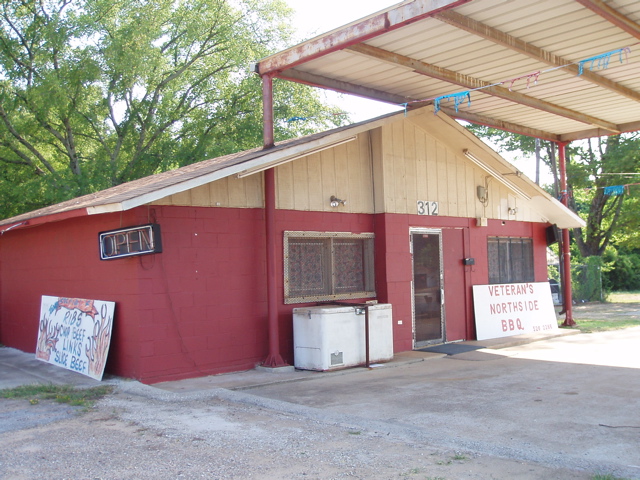
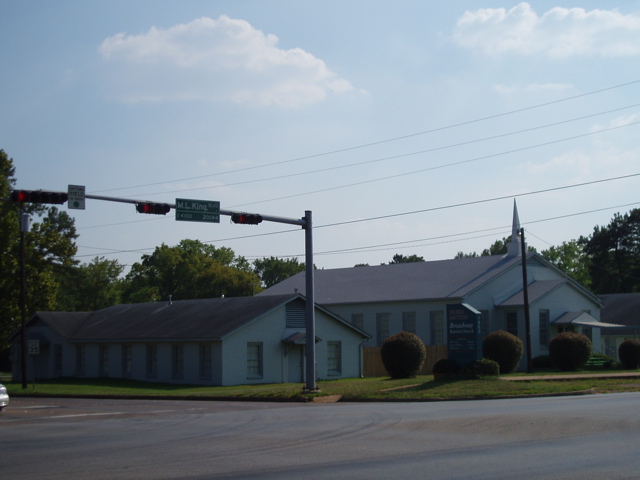
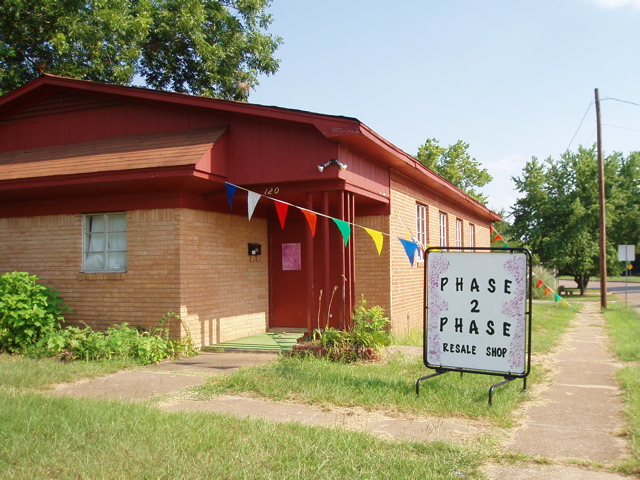
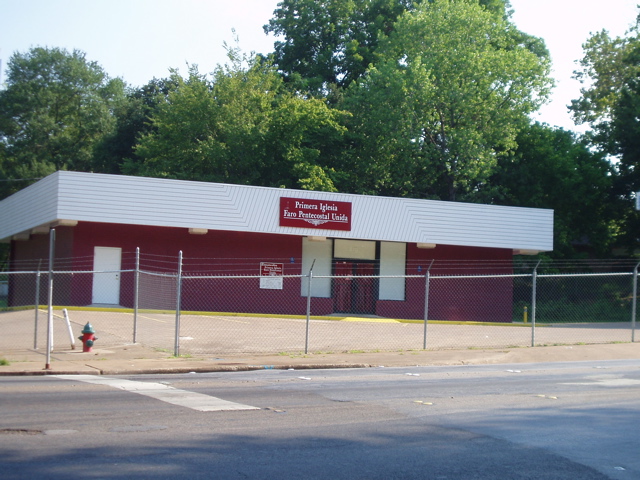
I don't remember whether Jonathan Tilove and Michael Falco made it as far into northeast Texas as Tyler as they traveled along Martin Luther King, but if they had, they would have found an MLK Boulevard much like most of the others. Tyler's MLK Boulevard is no Airport Road. But like the others, it embodies the hopes and dreams of many--in this case, it seems, as many Hispanics as African Americans.

bbq

Baptist church
Iglesia Bautista/Broadway Baptist Church

Baptist church

Baptist church
Primera Iglesia Faro Pentecostal Unida

I'd like to be in Durham tomorrow night to see this film, which I learned about from Erica Rothman.

Wednesday, August 3, 7 p.m.
FILM SCREENING WITH MARCO WILLIAMS
"MLK Boulevard: The Concrete Dream" (60 min)
Marco Williams: Writer/Director/Producer
Center for Documentary Studies Auditorium

In the United States, there are more than 680 boulevards, avenues,
streets, drives, and lanes in towns, counties, and cities named in
honor of slain civil rights leader Martin Luther King Jr. In fact,
there are more streets named for King than for any other American,
except for presidents Lincoln and Washington (even more than for JFK or FDR). Why?

"MLK Boulevard: The Concrete Dream" (2003) takes the viewer on a
journey to thirty of these locations, from Eugene to Muncie, from
Atlanta to Memphis, seeking to determine whether these streets
recognize an African American icon or commemorate an America hero.

Winner of the National Association of Black Journalists 2004 Salute to
Excellence Award: First Place, Discovery Times Broadcast


Filmmaker and film educator Marco Williams is a guest instructor at
this summer's Documentary Video Institute at the Center for
Documentary Studies at Duke University (July 30 - August 6).
Williams is a member of the faculty in the Undergraduate Film and
Television Department at New York University. Prior to joining NYU, he taught in the School of Filmmaking at the North Carolina School of the Arts. He has also been a Visiting Lecturer at Duke University, teaching a video production course exploring diversity on campus. He teaches screenwriting, documentary, fiction, and television production.

Williams is co-director and co-producer of the award-winning and nationally acclaimed seminal documentary "Two Towns of Jasper," winner of the Center for Documentary Studies Filmmaker Award in 2002. The film, a feature-length documentary about the 1998 racially motivated murder of James Byrd Jr. in Jasper, Texas, was broadcast on P.O.V. on PBS, featured on the Oprah Winfrey Show and on Nightline with Ted Kopple.

For more information about Center for Documentary Studies Institutes and other learning opportunities, check the Web at
http://cds.aas.duke.edu.

Barbie talk

Barbie

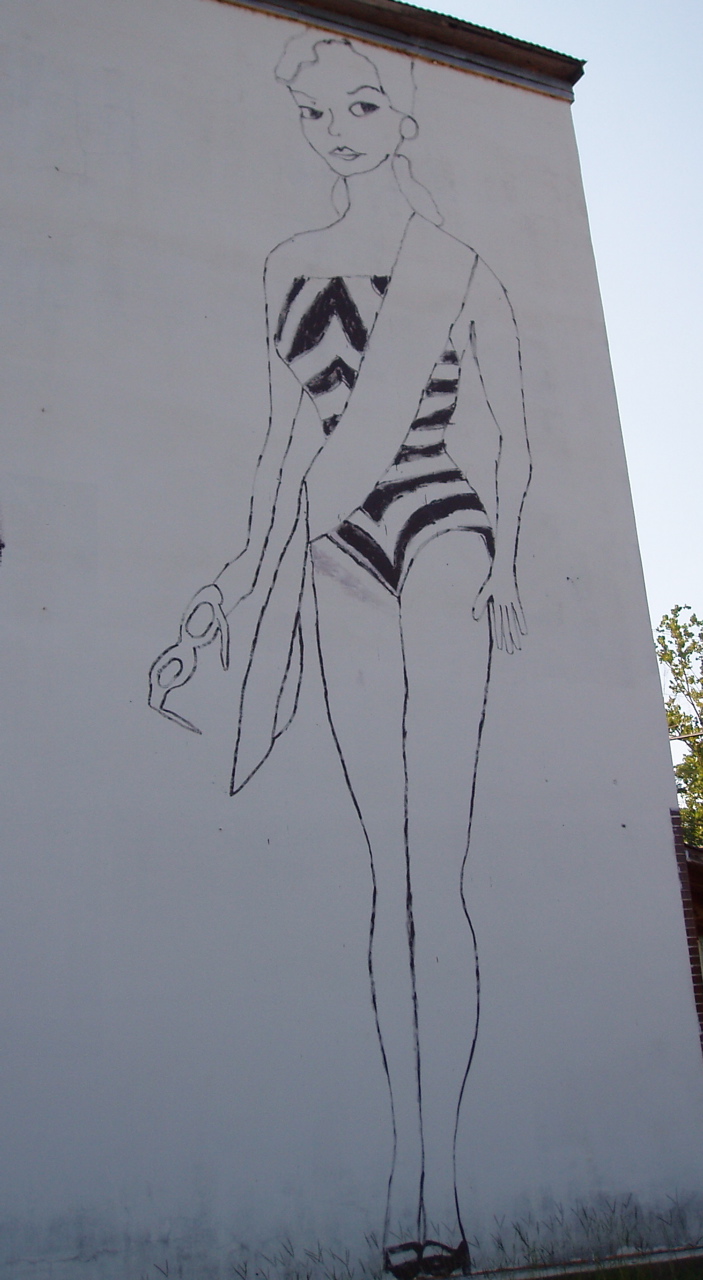
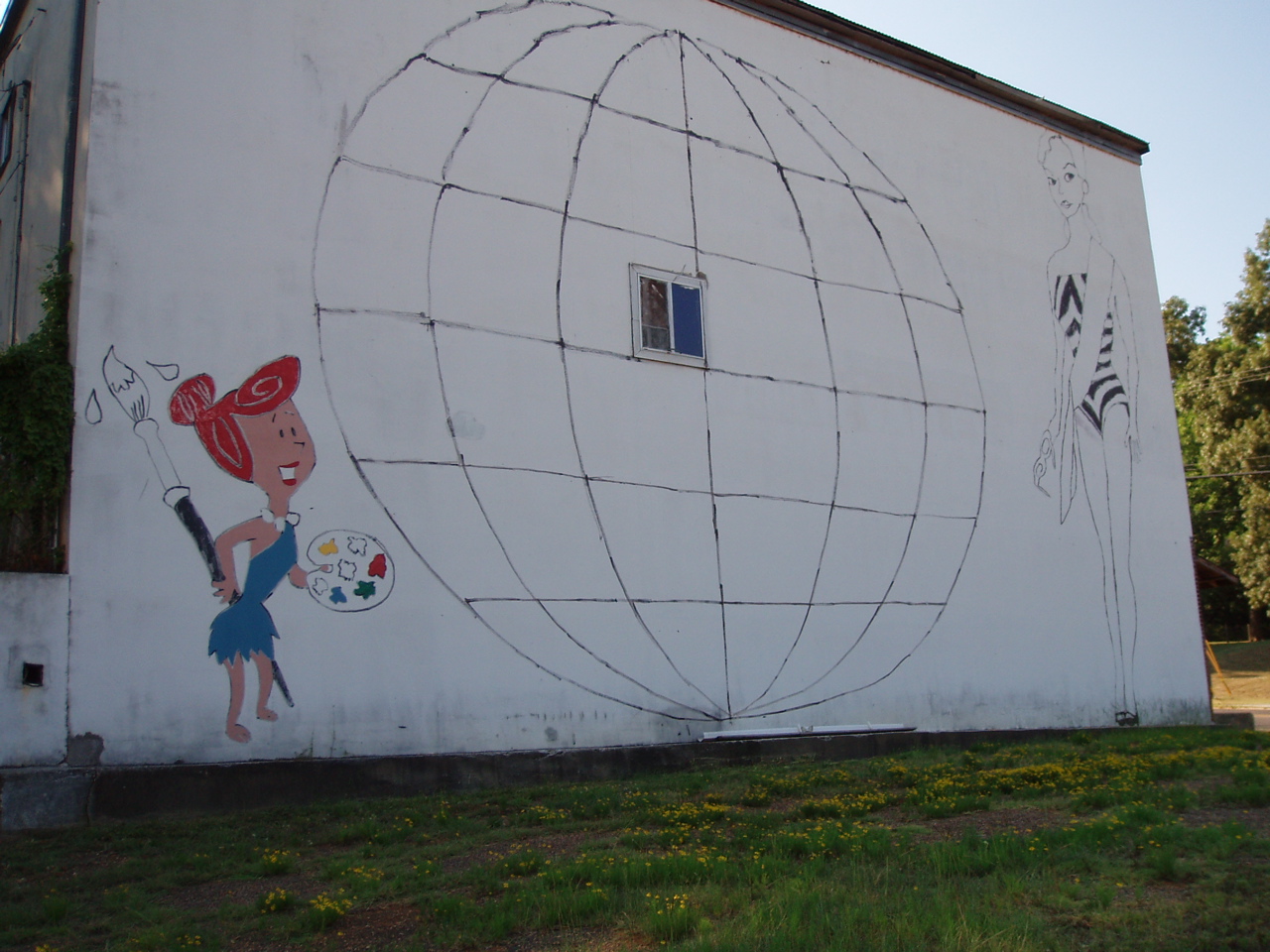
Whatever Wilma is saying to Barbie down in Winona, I'm more interested in Barbie's response. Here we have a pretty good rendering of the original Barbie, the one with the "strong, fierce, vampish face." What this Barbie has seen has left her wise beyond her apparent years.

"Go climb trees," she said. "You don't want to be like me, pinched and pointed and curled."

"Don't envy me my ornaments, Barbie said. Forget matching luggage, the sports car, and Ken. Travel light, little sister, why gild a lily? Try white ankle socks and some sensible shoes."

"Don't you mention my martyred hair. I denounce this lacquered, preternatural lid.  Wear goofy bangs, get a crewcut, devolve."

"And spread out, Barbie said. Why go through life shaped like a railroad spike? Use your elbows, make shade, take up space."

"I'm sad, Barbie said, sad and smiling, smiling and sad. I'm a mental-health squeeze play, don't try this at home."

"It's too late for me, but you, you're still young, play Hamlet, bet the farm, tell the truth."


From Laura Costas, "Experience," in Mondo Barbie.

Road to recovery

My mother is getting steadily better. The feeding tube is history. She's up doing therapy morning and night. But if you've ever known anyone who had back surgery, you know it'll be a long slow road to recovery. When she comes home in probably a couple of weeks, here are a few of the things she might see along the way.

Wilma & Barbie
City block, off Hwy. 155, Winona, Tex.

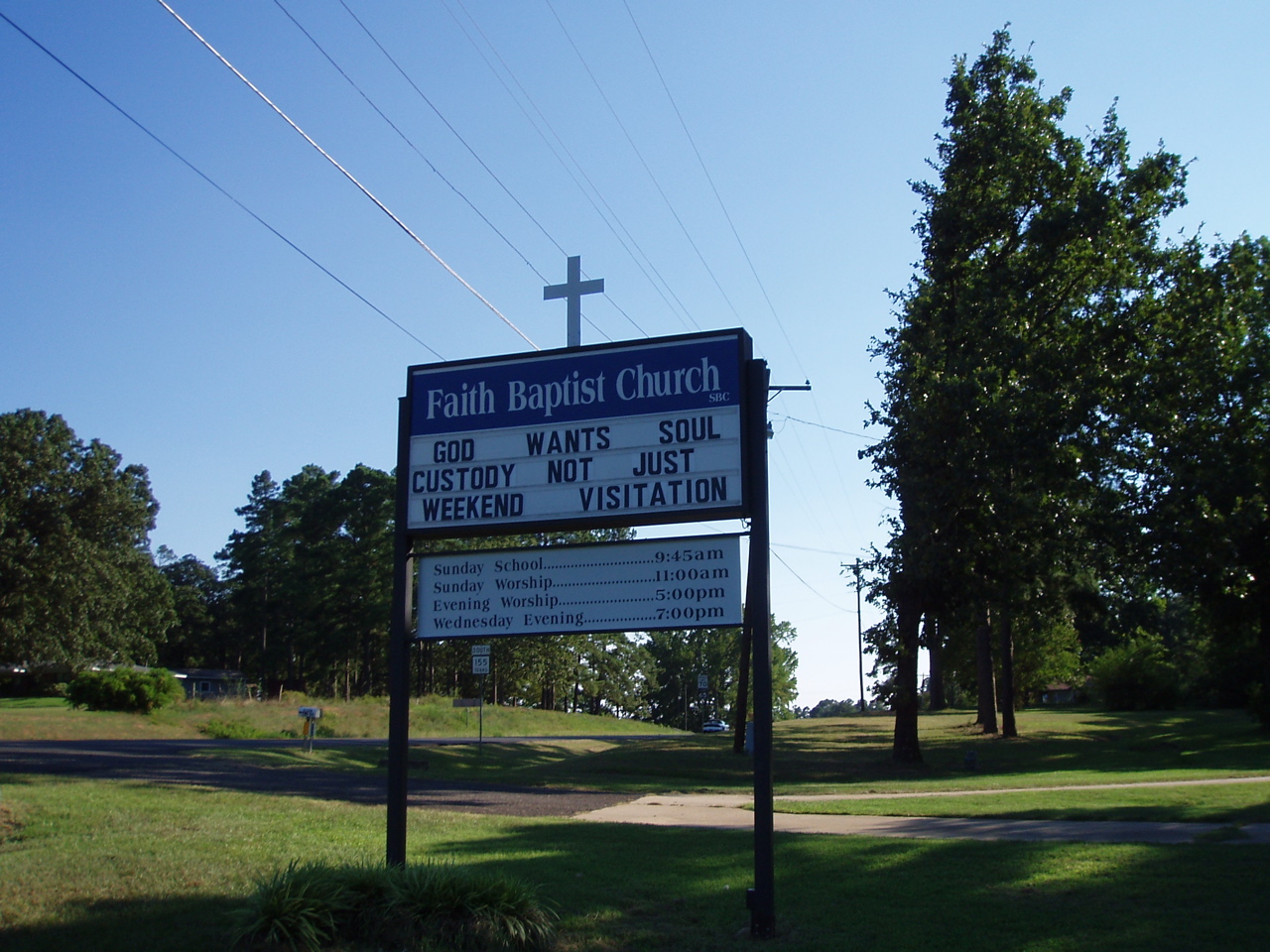
church
Faith Baptist Church, Hwy. 155, Gilmer.

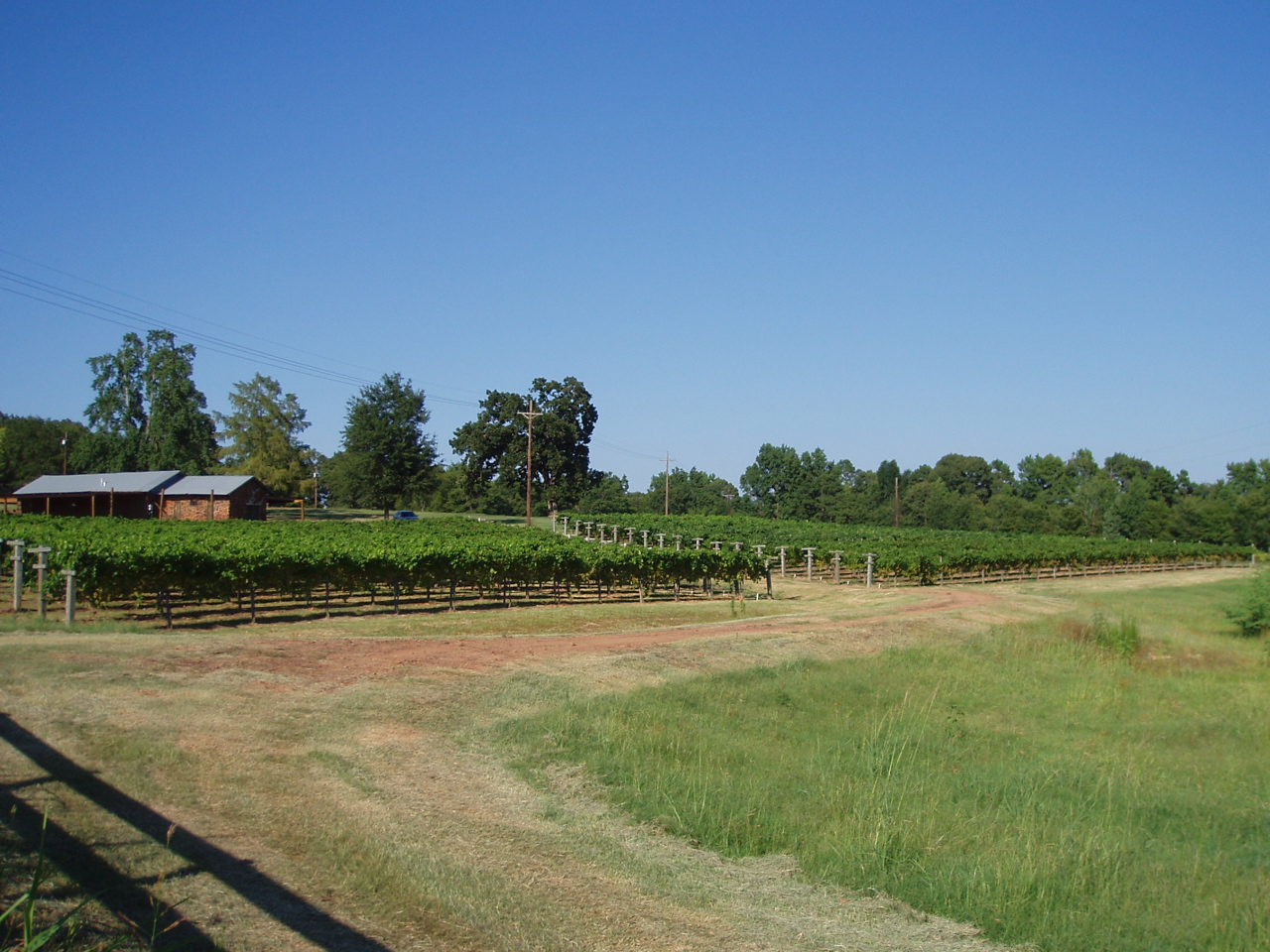
vineyard
Barton's vineyard, S. Montgomery St., Gilmer.

Monday, August 01, 2005

Jesus in the schools: Texas skirmish

Ed Cone cites news of the recent inroads of the Greensboro-based National Council on Bible Curriculum in Public Schools into the school system at Odessa (Ector County), a Bushcountry oil town in West Texas where more than 50 percent of the 26,000 students are Hispanic.

As I've said before, this organization is dangerous.

They rely on such august authority as the Creation Evidence Museum. If you're ever in the neighborhood of Glen Rose, Tex., perhaps to see the real evidence of dinosaurs walking the earth, check it out.

Elsewhere in Texas somebody has their number. Dr. Mark Chancey, professor of biblical studies at SMU, has published a study of the Greensboro group. "Dr. Chancey’s report shows how the curriculum advocates a narrow sectarian perspective taught with materials plagued by shoddy research, blatant errors and discredited or poorly cited sources." But alas, he's merely an academic.

Saturday, July 30, 2005

Into temptation

Chicken fried steak finger baskets are on special at the DQ for $2.99. But I resisted.

The call of beef is hard to resist in Texas, especially when it smells like barbeque. Tonight I had a plate of chipped beef and fixin's from Bodacious Barbeque in Gilmer. The slaw was fine--chipped cabbage instead of julienned, which is OK--but maybe a little too much mayo. The potato salad was great, mustardy, a bit of German influence. The bread, on the other hand, was unforgivable: two slices of white bread. The meat was moist, juicy, scarlet red on the inside and charred on the outside, just as it should be. But there's no getting around it: it's the wrong animal.

Futuro info

Faithful GreeneSpace readers will remember that I have a weakness the artifacts of 20th century futurism, like the Futuro House. Thursday's home section of the NYT had a nice feature on this amazing prefabricated structure.

The interesting thing about this story is that it's basically about a web site: Richard Pisani's futuro-house.net. People contribute to the site with Futuro sitings from all over the world. (Only about 80 of them are known to be left, most, for some reason, in New Zealand.)

My own picture of the one on Hatteras is filed under North Carolina. Along with more pictures is more information.

The Hatteras house, now silver, used to be green. It was on the other side of Hwy. 12, and it was a hot dog stand (scroll down). Paul and I remembered that much. What we didn't know is that it was buffeted about by Hurricane Dennis (1999). That's when it was moved to the other side of the road. But how did it land on Hatteras in the first place, and when? Who owns it now and what is its future?

Much about this Futuro House remains shrouded in mystery.

Thursday, July 28, 2005

Excessive enforcement

Word reaches these parts of an incident in Raleigh: a 73-year-old woman had her doubts about whether a policeman who came to her door after dark was really a policeman. She noted that he wasn't particularly polite, for one thing. So she called 911 to double-check. For her trouble she is charged with obstructing justice!

"Raleigh police officials say when an officer is in full uniform and the car is visible, just cooperate." Or else.

About eight years ago, when we were new in our house, I was home alone with a four-year-old one rainy night when, sometime after 10:00, someone with a flashlight knocked on the kitchen door. The storm had knocked a tree into the street and he was looking for a saw. I would only speak to him through the window, I was so unnerved. I did call 911, and I found out he was a for-real policeman. (But I didn't have a saw, and I still think the request was odd.)

I didn't think twice about calling 911, and fortunately the person on the other end didn't either. As I remember, I was told to call any time I had a suspicion.

Wednesday, July 27, 2005

East Texas is DQ Country.

All my life, or for all of it that I can remember living in Gilmer, there was one Dairy Queen. It was owned by the same family that owned the only (and last) picture show in town. Aimless high school kids up to no good, including me, would spend endless hours cruising a figure 8 from the DQ to the courthouse square and back. Once when an uncle was visiting from Memphis, we were all in a car together and we marveled that there was a new red light at the Dairy Queen. "New light at the Dairy Queen!" we heard him whisper to his wife.

Today there's a new new light (a mast arm no less) on a wider highway, and the DQ has morphed into a forlorn-looking Chinese buffet. The county jail, which began by taking over a Safeway and then colonized the entire block into one big concrete block, looms over it. So much has changed in my little town, not all of it for the good.

Luckily, on the road between Gilmer and Tyler there are at least three Dairy Queens. The other night on the way home from the hospital, I stopped in at one of them for a Blizzard. The Blizzard was invented 20 years ago, which means it is new to me (I left DQ Country well before that). I had no idea--so many choices! Luckily Eric Muller steered me in the right direction: the chocolate chip blizzard. It's kind of like the original DQ soft ice cream cones with the chocolate they would pour on top that would harden to the shape of the ice cream. That was great, but when you had eaten off all of the chocolate, well, you were out of chocolate. The "chips" in the chocolate chip Blizzard are made from taking the hardened chocolate shell and blending it all up with the ice cream. (The chips that keep on giving.) I'd call this an improvement.

Now, there is a whole ritual that goes along with making the Blizzard. I paid careful attention that the chips were the real thing as Eric had described, but I'm not entirely sure that the man who served it to me actually turned it upside-down before he gave it to me to confirm its firmness. I kind of think he did, but I'm going to have to try another one to make sure.

UPDATE: Bottom's up! In Tyler, they do it by the book. Yum.

Evidence

crunch

Note the white mass on the passenger's side. Note how it is missing on the driver's side. Do we have an issue with the makers of the 2003 Mercury Sable? You be the judge.

Sunday, July 24, 2005

The halt and the lame

Well my mother, who is lucky to be alive and without head injury, made it fine through the surgery on her upper back, but she was left with such a swollen throat that she couldn't get anything down without risk of aspiration, which, in addition to being a bad thing itself, can lead to pneumonia. As a last resort for getting food into her, she had another surgical procedure on Friday, the insertion of a PEG tube.

She's in the East Texas Medical Center's rehab unit now. It's new, light and airy with helpful positive people all around. We don't know how long she will be there--a good long time we hope, for she seems far from travel-worthy. She has lots of company there, people lacking limbs or the use of them, people of many colors, all sorts and conditions of men, as the prayer book says, united by trauma and the hope of recovery. And she has a steady stream of visitors--one, even, from his room on the floor above her.

I'm staying at her house, which was never my house, a wonderful house perfectly suited to her. Until now. It is on four levels. One problem at a time. We'll worry about that one later.

I still don't know how long I'll be here. At least through next weekend I think. Weekends are tough at hospitals because of the shift differences. I'm getting the hang of being the patient's advocate.

Monday, July 18, 2005

GTT

My mother's having surgery on her back tomorrow. I'm off to Texas today--driving, so I can stay as long as I need. Limited internet access down there.

Sunday, July 17, 2005

Don't mind me

In my distraction, please check out other worthwhile discussions. I recommend Ed Cone's great reporting on the Greensboro Truth and Reconciliation Commission hearings. I note that the Greensboro City Council is in 100 percent non-attendance. If this kind of event were going on in Chapel Hill, I can guarantee you that at least one council member would be there--probably more than one.

Also recommended is my council colleague Mark Kleinschmidt's new blog. He's up at the Kennedy School of Government for three weeks in a program for state and local leaders. He's off to a great start as a blogger, and the program he's in sounds really wonderful.

This great first lines game is fun too.

Saturday, July 16, 2005

Downtime

My aunt, from Texas, is visiting. Meanwhile on Thursday my mother, in Texas, was pretty badly injured in a car wreck. I'm a bit distracted.

Friday, July 15, 2005

Freedom Tower: Not making sense

David Byrne (scroll down to July 3) is singing my song:

The Freedom Tower, the building proposed to fill the World Trade Center site, or a least the most prominent one on that site, has been redesigned yet again. Apparently all the self-congratulatory design competitions and ceremonies for the site in the years immediately following the attack were just for show, as this most recent proposal has nothing to do with higher ideals of any sort.

The new proposal is a glass tower on a massive fortified concrete base. 20 stories (!!) high almost windowless concrete. Basically, a fortress. Or a prison. It wouldn’t look out of place to have a gun turret or anti-aircraft weaponry on the roof. My daddy’s reaction was, “this says: ‘we have no faith in the future.’” I think he’s right. The site could have stood for all that is good and open and innovative about the United States. The can-do spirit, the possibility of re-invention, tolerance of all kinds of weirdos, mixtures of a multitude of races and creeds, all living together. Sometimes the U.S. is like that anyway. And the site could be a way of saying THIS is what we believe in and what we stand for.

Wednesday, July 13, 2005

Tuesday, July 12, 2005

Wanted: a qualified Supreme Court judge

Michelle Malkin, whose career Eric Muller for some reason can't help promoting, says we need to take care that we find a "wartime Supreme Court justice."

"Wartime" judges are precisely what we do not need. We don't need judges who will suspend us in a state of emergency. More than ever we need judges who dare to act as if things were the same as before--who stand up for freedom and due process and democracy as we thought we knew it.

I'm still amazed at how relevant the spring 2002 issue of the South Atlantic Quarterly is. I pulled it out for Stanley Hauerwas but am drawn now to Archbishop Rowan Williams. This was the point he made then. Yes, it was natural that our first reaction to September 11 was the thought of violent retliation, but we had time. We had time to think better of it. We had time to become more, not less, of what, in our ideal imaginations, we aimed to be.

We have the freedom to think what we actually want, to probe our desires for some kind of outcome that is more than just mirroring what we have experienced. The trouble is that this means work of the kind we are often least eager for, work that will help us so to understand an other that we begin to find some sense of what they and we might recognise as good. It means putting on hold our immediate feelings--or at least making them objects of reflection; it means trying to pull apart the longing to re-establish the sense of being in control and the longing to find a security that is shared. In plainer English, it means being very suspicious of any action that brings a sense of release, irrespective of what it achieves; very wary of doing something so that it looks as if something is getting done.

It means acknowledging and using the breathing space; and also acknowledging and using the rage and revengefulness as a way of sensing a little of where violence comes from. I'd better say it again: this has nothing to do with excusing decisions to murder, threaten, and torment, nor is it a recommendation to be passive. It is about trying to act so that something might possibly change, as opposed to acting so as to persuade ourselves that we're not powerless.


The kind of judge that would meet Archbishop Williams' approval is one who would understand "that the punishment of terrorist crime and the gradual reduction of its threat cannot be translated into the satisfying language of decisive conquest." It is someone who would recognize "the place of risk and even loss in ordinary civil society" while summoning "the moral resources needed to grapple with the continuing problems of shaping a lawful international order."

I know, it's way too much to ask now. We're at war.

As seen on I-40

On a jaunt to the mountains we encountered broadside reminders that North Carolina is "The Nation's Most Military-Friendly State." You can take that to the bank. The Institute for Southern Studies reports, overall, a negative balance.

Also of note: a billboard for Archangel Custom Cycles--with a tie-in to a biker church. God's people are on the move.

Monday, July 11, 2005

Rhetorics of violence, rhetorics of peace

Shortly after the London bombings, John McGowan (elevated to "permanent guest host" every Thursday at michaelberube.org) published a compelling argument for the pacifist stance. As the commentators are variously noting, what he explores is a purposeful nonviolence, something that the very word "pacifism" seems too thin to describe. In his claim that pacifism "insists that violence can never be instrumental, that it never simply produces the ends toward which it aims," John is right there with Martin Luther King in the Gandhian tradition:

[T]hrough violence you may murder a murderer, but you can't murder murder. Through violence you may murder a liar, but you can't establish truth. Through violence you may murder a hater, but you can't murder hate through violence. Darkness cannot put out darkness; only light can do that.


This is a hard argument to make in our country today. And yet a few folks have been making it since September 12, 2001. John's essay returns me to Stanley Hauerwas, to his essay in the special Spring 2002 issue of the South Atlantic Quarterly, "Dissent from the Homeland: Essays after September 11." The entire volume is interesting to revisit, because it was written before we went to war in Iraq; almost quaintly, the bad guy is bin Laden. Hauerwas, who teaches up the road from John and me, is a deeply committed pacifist and the truest Christian I know. He writes,

American imperialism, often celebrated as the new globalism, is a frightening power. It is frightening not only because of the harm such power inflicts on the innocent, but because it is difficult to imagine alternatives. Pacifists are often challenged after an event like September 11 with the question, "Well, what alternative do you have to bombing Afghanistan?" Such a question assumes that pacifists must have an alternative foreign policy. My only response is I do not have a foreign policy. I have something better--a church constituted by people who would rather die than kill. . . .

What a gift bin Laden has therefore given America. Americans were in despair because we won the cold war. Americans won by outspending the USSR, proving that we can waste more money on guns than they can or did. But what to Americans do after they have won a war? The war was necessary to give moral coherence. We had to cooperate with one another because we were at war. How can America make sense of what it means for us to be "a people" if we have no common enemy? We were in a dangerous funk having nothing better to dothan entertain ourselves with the soap opera Bill Clinton was. Now we have something better to do. We can fight the war against terrorism. . . .

Which means Americans get to have it any way they want it. Some that are captured, for example, are prisoners of war; some are detainees. No problem. When you are the biggest kid on the block, you can say whatever you want to say, even if what you say is nonsense. We all know the first casualty in war is truth. So the conservatives who have fought the war against "postmodernism" in the name of "objective truth," the same conservatives that now rule us, assume they can use language any way they please.

That Americans get to decide who is and who is not a terrorist means that this is not only a war without clear purpose, but also a war without end. From now on we can be in a perpetual state of war. America is always at her best when she is on permanent war footing. Moreover, when our country is at war, it has no space to worry about the extraordinary inequities that constitute our society, no time to worry about povery or those parts of the world that are ravaged by hunger and genocide. Everything--civil liberties, due process, the protection of the law--must be subordinated to the one great moral enterprise of winning the unending war against terrorism.

At the heart of the American desire to win endless war is the American fear of death. . . . Americans are determined to be safe, to be able to get out of this life alive. On September 11, Americans were confronted with their worst fear--a people ready to die as an expression of their profound moral commitments. Some speculate such people must have chosen death because they were desperate or, at least, they were so desperate that death was preferable to life. Yet their willingness to die stands in stark contrast to a politics that asks of its members in response to September 11 to shop.


The notion that "no one gets out of this life alive" is classic Hauerwas, central to his ethos. As he puts it in an earlier, shorter version of this essay, "Part of the space Christians can provide at this time is the space given to us as a people who have learned . . . that the worst thing that can happen to us is not death, but dying for the wrong thing."

This is a hard position to take. It's one thing to say it, but who could live it out? Even Hauerwas, who like all of us of a certain cast of mind has a rage to explain, confines himself in this essay to a modest goal: to speak honestly. "Explanation domesticates terror, making it part of 'our' world. I believe attempts to explain must be resisted. Rather, we should learn to wait before what we know not, hoping to gain time and space sufficient to learn how to speak without lying. I should like to think that pacifism names the habits and community necessary to gain the time and place that is an alternative to revenge. But I do not pretend that I know how that is accomplished."

Wednesday, July 06, 2005

Art writ large

In London, observers contemplate "the loneliness of writing," or something.

Chicago footnote 4: NextFest

Paul had an invitation to the pre-opening reception for Wired magazine's NextFest on the Navy Pier, and we liked it so well we went a second time.

Paul

Off into the mists of time . . . somewhere in the future.

Hubo

Many amazements were to be found, for example Hubo,

Philip K. Dick

but none so amazing, or scary, as Philip K. Dick.

Tuesday, July 05, 2005

You heard it here first.

The next Supreme Court justice of the United States.

Chicago footnote 3: Robie House

The Robie House is owned by the University of Chicago and is surrounded by university development. When it was built, it was at the edge of a prairie. The long lines of the house, more massive than I imagined, must have stood impressively against that vista.


Robie House

Now, where the prairie was is the Univeristy of Chicago's new Graduate School of Business, designed by Rafael Vinoly.

Robie House

The horizontal lines do a really nice job of relating to the icon across the street.

The Robie House is in the middle of an $8 million restoration (jump-started by Hillary Rodham Clinton's securing of a Pritzker Foundation award of $1 million). The exterior has been done; the interior has a ways to go. But they'll let you tour the work in progress, partly to encourage you to participate. The house was all that I expected, even down to the low ceilings that are supposed to make you feel suitably coccooned. But there was something you don't get in the picture books, as you mark faded carpets, crumbling foundation walls: "Time, which antiquates antiquities, and hath an art to make dust of all things, hath yet spared these minor monuments," wrote Sir Thomas Browne of some ancient urns that chance had preserved. Not even Frank Lloyd Wright's monumental structures are completely immune from the works of time and chance.

Recruiting problem not inflated

but a good number of recruits are.

(Via WRG.)

Monday, July 04, 2005

Iceworks

Early this Independence Day morning, the Deep Impact spacecraft hit its mark.

comet

Watch one quicktime movie from the fly-by craft and another from the impact probe. Imagine, by the way, that you're going about 23,000 m.p.h. "[T]he resulting blast of icy debris stunned scientists with its size and brightness."

Council update: Happy Fourth, happy summer!

NOTE: The following is my latest Council listserv posting. For GreeneSpace blog readers not subscribed to my listserv, I send out messages like this after most Council meetings. You may subscribe by going to sallygreene.org and following the instructions or by just asking me. I'm grateful to Michael Czeiszperger for hosting the listserv, and I'm as sorry as he is that it's currently down. So as an alternative, I'm posting here.

Dear friends,

At our last Council meeting before our summer break, last Monday night, we finalized the budget. As you know by now, it has been a tough process, complicated by the new Town Operations Center. We ended up with an increase of 2.9 cents per $100 property valuation. With next year's debt payment on the Town Operations Center consuming around 3.8 cents per $100, please note that if it weren't for the TOC project, the tax rate would actually have gone down. The Council very much appreciates the efforts of our citizen budget review advisory committee as well as the work of town staff in helping us reach this result.

Also from Monday's agenda, I want to highlight the inclusionary zoning initiative. In April we resolved to go forward with drafting an ordinance that will be considerably stronger than our existing regulations in requiring developments to include affordable housing. At my suggestion, we are planning to go about this important project by forming a task force of citizens with particular interests in the outcome: developers, affordable housing advocates, bankers, real estate professionals, neighborhood advocates, people who need workforce housing, etc. My sense is that this community is very aware that we need to do better, and that we want to do so. I'm looking forward to the process of coming together to create an ordinance that works.

Please take a look at this item and consider joining us in this effort--or pass it along to a friend or neighbor you think would be interested.

Library Building Committee

Many of you are aware that in 2003, we passed a $16.23 million bond referendum for expanding the public library. It passed with the highest margin of any of the bonds on the ballot, reflecting the fact that Chapel Hillians are the most avid public library users in the state--by far. Because of budget issues when the current building was built, it was too small on the day it opened. The new bond money will enable us to increase the square footage of the library from 27,000 sq. ft. to 70,000 sq. ft.

The Library Building Committee, charged with helping to select a designer for the expansion and seeing the project through, met for the first time Tuesday evening. From library director Kathy Thompson we got a good review of library's master plan and the history of the project so far. We heard from town staff members who outlined various issues and challenges that will be involved in the planning and development of an expansion on this property. The library is in a park! It is situated in the middle of Pritchard Park, which has been waiting patiently to be transformed into a park until the library building's final shape takes shape.

The project will take several years to design and construct. It's exciting to be there "from the creation" (OK, "from the re-creation"). Of course, it will be a very public process, and we will welcome your participation.

Homelessness update

On Wednesday morning I met with the work group for the Orange County Partnership to End Homelessness. Our funding goal was to come up with $60,000--largely to be spent hiring a project coordinator. Orange County, Chapel Hill, Carrboro, Hillsborough, and the Triangle United Way all generously gave what we asked for. Our request to UNC for $10,000 has not met with a response, though, so the funding we have now is $50,000. But we are still able to go ahead and solicit applications for a project coordinator for the process of creating our 10-year plan to end homelessness. By early fall, we hope to have a steering committee in place.

At Wednesday morning's meeting, we accepted an invitation to participate in a class project in UNC's School of Public Health next year. The two-semester class is called "An Action-Oriented Community Diagnosis Including Secondary Data Analysis and Qualitative Data Collection." Despite the name, it promises to be a productive way to get real, meaningful information about our homeless population and to encourage them to become more involved in the community. The best way to understand what we stand to gain from it is to see the results of a similar class conducted in Durham.

This collaboration will help us get off to a good start in achieving a real understanding of who our homeless are, what their needs are, and how those needs can best be met. I thank Kate Shirah of the School of Public Health for her presentation this morning. She said there was a lot of interest among different community groups in participating in the class, that there was only one slot left this year, and that she was saving it to see if we wanted it. I'm grateful for that.

Lot 5 & Wallace deck architecture summit

For two hours on Wednesday afternoon, the Council met again in a work session with members of the Ram Development team for more discussion about architecture. As promised, they presented us with a series of photos of various styles of urban mixed-use developments as a way of trying to get a sense of what we liked. I was not sure this process was going to be very productive--it seemed like a was a good way to ensure that we went down the road of generic, derivative architecture--but I think it was good in that the Ram team now has a clearer sense of our collective aesthetic sense.

We don't agree on everything, but we mainly do agree on the following: we don't want neotraditional, we don't want postmodern, either of which style ends up in fakery. Thumbs down on a building designed to look as if it were once an old warehouse. Many cities have old warehouses that are morphing into condos--Chicago, where I've just been, is full of them--but that's not for us. What we do want is design that is real: exposed steel beams are fine, for example (whereas nonfunctional columns making statements in the neat postmodern way are not). We like texture (wood is a nice complement) and warm colors. As I said to the Ram folks, trying to synthesize what we were hearing, I think that we have a basically modernist sensibility. I've said a little more elsewhere.

Nothing is anywhere near settled yet, but I'm confident that we're headed in the right direction. The team that will be negotiating the development agreement with Ram--which I'm on--will meet over the rest of the summer. The Ram folks will be back in September to the full Council with design sketches for consideration. I've heard from many of you who are as interested as I am in the success of this project; thanks for your comments. Please stay involved, and continue to let me know your thoughts.

Thanks as always for your interest in all that's going on here in Chapel Hill, and happy summer!

Born on the third of July

In 1900, most Americans sincerely believed there was no problem that a little "Yankee know-how" and a dash of common "American" decency couldn't fix. George M. Cohan's writing reflected this jingoistic exuberance, expressing it as no other playwright or songwriter had.


He's been called "American Theater's first mega-star." When it came to his birthdate, he didn't let facts get in the way.


Over There

Sunday, July 03, 2005

Chicago footnote 2: A park that works

The art of the possible in the city of the deal

Now that the early hopes of redevelopment at ground zero that would both honor the dead and speak optimistically to the living have grown dimmer and dimmer, consider Millennium Park.

Millennium Park 1

Crown Fountain: the twin pillars of glass block 50 ft. high are monumental enough to stand up to a "big shoulder" skyline.


Millennium Park 1

The faces change before your eyes. They're the faces of real Chicago people.

As the park turns a year old this month, architecture critic Blair Kamin (reg. req.) can hardly contain himself:

In the national conversation, Millennium Park is being hailed in some quarters as an example of how business and political leaders can pull together -- in sharp contrast to the feuding among powerful interests that has turned the rebuilding of ground zero into a textbook case of civic inertia. "One of the great new models for a new kind of urban park," The New Yorker's architecture critic, Paul Goldberger, told television host Charlie Rose on Rose's show in May.

For those who live with it every day, it may be just as important that Millennium Park has begun to fulfill its social promise, evolving into a widely used public space. . . .

. . .
it is well on its way to achieving its potential as a great democratic space, a mixing chamber for people of different races and classes, who normally live entirely segregated from one another.


Millennium Park 1

Frank Gehry's Pritzker Pavilion encloses and embraces.

Millennium Park 1

But for many, Cloud Gate (under wraps till late summer while the seams between the steel plates are buffed out) is the best thing about the park.

In the years that Millennium Park was under construction all anyone could talk about was the Frank Gehry-designed Pritzker Pavilion. People talked about the signature Gehry style that would move Chicago's architectural sensibilities from the 1970's, firmly into the new millennium. Once the protective bubble surrounding "Cloud Gate" came down, people stopped talking about Gehry as the vision of the future. They talked about the acoustics of his creation. They talked about his ability to capture the feel of the city. They talked about the view he created of the orchestra. But they stopped talking about his art. Anish Kapoor clearly stole the show and in television interviews seemed mildly embarrassed by his success.


Paul and I visited Millennium Park during a heat wave--so we didn't linger. That we stayed as long as we did is another small testament to this great big space.

Saturday, July 02, 2005

O'Connor and feminism

A journalist emailed me yesterday to ask if I knew a good source to talk to on the subject of what Sandra Day O'Connor's elevation to the Supreme Court had meant to women in the law. After I got tired of scraching my head, I came up with Mary Cheh. Professor Cheh has been a role model and a counsellor to many a female law student at GWU, including me, since 1979. I'd be interested to hear her thoughts.

I was in law school when O'Connor was appointed in 1981, but I don't remember thrilling to it. She was a conservative Reagan appointee. Whatever effect she had on the status of women in the law, I would have to say it was uneven. Forty percent of my law school class was female. Yet when I clerked in Dallas in the summer of 1983, I got a message in no uncertain terms: the courthouse would not be a welcoming place. Women don't do well in the courtroom down here, one lawyer told me ("except in domestic relations cases"). It's just the way it is. So I high-tailed it back to Washington and never looked back.

Slate editor Dalia Lithwick, a decade my junior, writes, "Justice O'Connor is a huge mystery to most women of my generation."

Ruth Bader Ginsburg made more sense to my female colleagues. She used her law degree to advance women's rights before she came to the court and continues to do so today. Justice O'Connor always seemed like a fullback in a lacy jabot - testy and aggressive and with the expectation that feminism means stop whining and do for yourself.


Even so, I suspect we'll fondly remember the great feminist judge from Arizona once her replacement is found.

Chicago footnote 1: ultimate Golden Arches

There's nothing as boring as somebody else's vacation stories, so I'm going to dole it out in convenient take-out bytes. Paul did an admirable play-by-play while we were there.


Chicago McDonalds

Maybe you've heard about the 50th anniversary supersized McDonald's. It was not on my destination list, but we ran smack into it one night as we were on our way to dinner at the Frontera Grill. Vastly underestimating how popular the Grill was, we didn't get in. Our second choice, on second thought, should have been this place, if for no other reason than to see the designer furniture. But the food, we're told, is just the same.

Friday, July 01, 2005

"Let me tell you how we do it up north."

The Yankees are coming. No, they have come, with kids. They've come in droves to (of all places) Charlotte. Don't put their kids on a bus. And don't give them any of that racist "baggage." They won't have it. All they want is their comfortable neighborhood schools, among their comfortable neighbors.

I first heard about this phenomenon last year in a speech by Gov. Jim Hunt at the N.C. Bar's celebration of 50 years of Brown. Hunt lamented that the progressivism that North Carolina became known for during the civil rights movement--together with the real gains made--is at risk, a perverse byproduct of "progress." We're about to forget our history, he said. Jonathan Tilove, who covers race for the Newhouse News Service, has just published a great story on how it's playing out down in Charlotte.

Kind of makes you see what Howard Manning is up against.

Homeless people terrorize New Jersey city

Summit, New Jersey, is using the Patriot Act to defend itself for having thrown homeless people out of a train station. This is too much even for the feds. "Kevin Madden, a Justice Department spokesman, said Summit has no business invoking the anti-terrorism law to justify its treatment of the homeless."