Friday, August 25, 2006

Happy Trails Indeed.


Thanks again to Sally for letting me sit-in at Greenespace these past two weeks; it's been a lot of fun. I am excited to have Sally back! Thanks to her, and to you, dear readers, for putting up with me and my posts.

As a modest going away present of sorts, I am posting an mp3 podcast entitled "An Evolutionary History of Country Music." I put this together back in 1997, shortly after purchasing the Smithsonian Institution's History of American Country Music, which was released in the 1990s and featured fantastic the fantastic liner notes of country music historian Sam Malone. This is a "best of" that box set (which clocked in at 6 discs, I believe), but is still quite an enjoyable listen, especially on a sunny Friday. I have broken it into two volumes, 1 and 2, due to the size of these mp3 files (approximately 45 minutes each).

The problem with the phrase "country music" is that it conjures up Toby Keith and Karl Rove and Hummers-- but that style is actually "modern country." This, on the other hand, is "classic country," also known as "roots music"; in fact, Smithsonian probably could have chosen a different name for its collection. This is the "good stuff," the music that is part of what writer Greil Marcus famously called the "old weird America," featuring old timey groups like the Louvin Brothers and W. Lee O'Daniel and his Light Crust Doughboys. It is "country" music, but if you are looking for Alan Jackson, look elsewhere-- most of this stuff was written or recorded in the 30s, 40s, 50s, and 60s.

The tracklist appears below, as does a link to download Volumes 1 and 2. I hope you enjoy it, Greenespace readers, and like Jimmie Davis says, remember to keep on the sunny side!

THE TRACKLIST:
Hard Travelin'-- Woodie Guthrie
Sylvie-- Leadbelly
Blue Moon of Kentucky-- Bill Monroe and his Bluegrass Boys
Hesitation Blues-- Dave Von Ronk
Freight Train-- Elizabeth Cotten
Have a feast here tonight-- Bill Monroe and Doc Watson
Wildwood Flower-- The Carter Family
Waiting on a Train-- Jimmie Rodgers
Just Because-- The Shelton Brothers
My Mary-- W. Lee O'Daniel and His Light Crust Doughboys
South of the Border-- Gene Autry
Walking the Floor Over You-- Ernest Tubb
Born to Lose-- Ted Daffan's Texans
You are my sunshine-- Jimmie Davis
Cattle Call-- Eddie Arnold
Philadelphia Lawyer-- The Maddox Brothers and Rose
It's mighty dark to travel-- Bill Monroe and his Bluegrass Boys
Randy Lynn Ragg-- Flatt and Scruggs
I walk the line-- Johnny Cash
Faded Love-- Patsy Cline
When I stop dreaming-- The Louvin Brothers
Folsom Prison Blues-- Johnny Cash
Mama Tried-- Merle Haggard
El Paso-- Marty Robbins
Kneeling Drunkard's Plea-- The Louvin Brothers
Boulder to Birmingham-- Emmylou Harris
King of the Road-- Roger Miller
Rocky Top-- The Osborne Brothers
The Great Atomic Power-- The Louvin Brothers
Raised by the Railroad Line-- The Seldom Scene
Driftin too far from the shore-- The Seldom Scene
I'm so lonesome I could cry-- The Cowboy Junkies

Download Volume 1:
http://www.yousendit.com/transfer.php?action=download&ufid=B52E763051384E87&rcpt=johnmoye@gmail.com

Download Volume 2:
http://www.yousendit.com/transfer.php?action=download&ufid=8D1906FB58882DB6&rcpt=johnmoye@gmail.com

N.C. Women's Prison Repertory returns to Chapel Hill

A year and a half ago, in the Carrboro Century Center, I saw the most amazing performance: the North Carolina Women's Prison Repertory Company, founded by Judith Reitman. As I blogged it at the time, this project, which involves writing as well as performing, is a lifeline for these women--women who have done terrible things and are paying the price, but who are not beyond hope of redemption. Rather, they desperately need constructive tools for finding their way back through remorse and redemption to wholeness. Ordinary prison life doesn't give them that: far from it.

In the comments to my blog entry, a reader wondered if I was suggesting that they did not deserve their punishment. Not at all, and that's not what I heard them say either. But I do believe that a person can do a terrible thing and be genuinely sorry and that society has an obligation to help such a person on that journey through atonement to forgiveness. As I said in that comment thread, it's as if we've forgotten the root of the word "penitentiary." I realize it's not a view universally held.

You can catch the Women's Prison Reportory Company tomorrow night at the ArtsCenter. You won't be sorry.

Adios, John

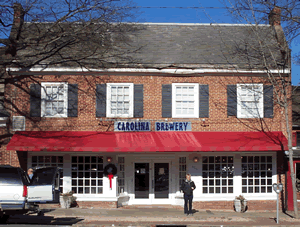
So we have John Moye and Bob Dylan riding off into the sunset together. Don't know what Dylan's up to, but it's a cinch that John is off to a great year honing his legal skills within the corridors of the 11th Circuit Court of Appeals. Better yet, he has a job in Raleigh waiting for him when the year is over, so he's only off on a frolic. Happy trails, John, and thanks for the great blogging! Come back to the Carolina Brewery when you get lonely.

Wednesday, August 23, 2006

6 Days and Counting...


...until the new Bob Dylan record. I am, um, excited about this record. Very excited.

In connection with the forthcoming release, this morning Rolling Stone updated its website and provided an excerpt of its exclusive interview with Dylan, which will be released in full in the September 7 issue of the magazine. The piece is written by Jonathan Lethem, a die-hard Dylan fan who also happens to be a fantastic novelist in his own right. His book, "The Fortress of Solitude," remains-- hands down-- the best work of fiction I have read in the last 10 years. If you're looking for some summer fiction, this is the book to read. It's a novel about, coincidentally, rock n' roll, adolescence, aging, Brooklyn, race relations, and superheroes. The NY Times this summer mentioned in passing that it just barely missed its reader's list of its top 25 works of fiction of the last 25 years. (The prize went to Toni Morrison, who probably deserved it). Not a bad near-miss for Lethem, who is only in his mid-30s...

Anyway, back to the Dylan. It comes out Tuesday and I am eager to hear it. My sole concern at this point is that none of the writers who are publishing articles about the new record seem to be talking about the music itself: does it sound like 2001's "Love and Theft?" Does it have some of the same schmaltzy ragtime that a lot of tracks on that record had? Or is it strictly blues-based? The critics seem to spend all their verbiage waxing poetic about Dylan's iconic, near-God-like status (Lethem included-- witness his line about how Dylan's is "the voice of a rogue ageless in decrepitude"), but not a lot of time describing the actual sound of his new record.

Is that because these critics haven't heard much of it? (Dylan is notorious about keeping his new records top secret). Or is that because there isn't that much to say about it?

Guiliani in '08?

The Atlantic Monthly's Hannah Rosin finds Rudy Guiliani speaking in subtle "evangelese" in an attempt to court the GOP faithful and (perhaps) run for president in 2008. It's an interesting article, definitely worth a read (if, alas, you have an Atlantic subscription)....

I personally remain skeptical about the viability of his candidacy as the GOP nominee in 2008-- "evangelese" or not. I guess I could almost foresee that his exemplary conduct on 9-11 could have such a resonance with the American people that it overshadows his support for gay marriage, abortion, stem cell research, etc.-- especially if, between now and then, there's another terrorist attack on Bush's watch, such that people find themselves longing for a leader with some actual competence and compassion.

But even if you give him 9-11 and his conduct in its wake, Rudy has some flaws as a viable candiate. As Rosin notes, the "old" Rudy (that is, the pre-911, Mayor Guiliani) had a well-deserved tendency to be acerbic, cocky, spiteful, and to harangue those who disagreed with his hammerheaded policies. He's also a brash New Yorker, a divorcee who openly had an affair while his marriage was imploding-- and a Roman Catholic to boot! [Gasp.]

Personally, I don't see the evangelical Christian, Nascar-loving, Red-state GOP faithful falling for him and awarding him the nomination in 2008. But I could be wrong.

Monday, August 21, 2006

Awesome.

The first five-game sweep of the Boston Red Sox by the New York Yankees in 52 years. And at Fenway to boot!

Buh-Bye Boston. Buh-Bye.

Federal Judge Anna Diggs Taylor is Not Having a Very Good Week.

Her recent decision in the eavesdropping case was a headline-grabber, to be sure, but these aren't the kind of headlines that judges like to get. Yikes.

I have only read excerpts of the opinion, so I can't speak to the whole thing, but I did find it odd, as an initial fact, that she based her decision the First Amendment and the theory that eavesdropping could "chill free speech" among those suspected of being terrorists. There seemed like so many other ways to challenge the president's conduct, so I am not sure why she focused on the 1st Amendment-- to the apparent exclusion of the FISA statute and precedent interpreting it...

Friday, August 18, 2006

Flying today.


Not looking forward to it. Not at all.

It would be enough stressful anyway, what with all the bad stuff out there in the world these days, and I suspect will be even moreso given that my travel involves two of the most evil, soulless forces in the modern world: 1) the dreaded Delta Air Lines; and 2) Hartsfield Airport, which is also known as the seventh circle of hell. Both #1 and #2 above make me question from time to time the existence of a benevolent deity.

As to the new liquid restrictions: I have left my shampoo, my toothpaste, my cologne, my hair gel, my mouthwash, my suntan lotion, my liquid benadryl, and my breast milk at home.

I also was forced to leave my flask of Captain Morgan's Spiced Rum, which I suspect is the one item that could actually make the flying experience somewhat more tolerable today.

Joementum?

Last week, in this post, I wondered aloud whether Lieberman might wind up handily winning the Senate seat in November as an Independent, despite losing to Democrat Ned Lamont in the primary. I quoted a few "political commentators" who seemed to think that Joe could win, even by losing.

This post from the Washington Post's Chris Cillizza [full disclosure: he's a friend of mine], in which Chris parses the latest polling out of Connecticut, seems to bolster that theory:

A new Quinnipiac University poll of likely voters in Connecticut shows incumbent Sen. Joe Lieberman (D/I) leading businessman Ned Lamont (D) and former state Rep. Alan Schlesinger. Lieberman won the support of 53 percent of those surveyed. Lamont had 41 percent, while Schlesinger took an amazingly low four percent.

The poll seems to show that Lieberman, who lost the Aug. 8 Democratic primary to Lamont, has become the de facto Republican candidate in the race, scoring incredibly high with GOPers in the state. Lieberman recieved 75 percent among Republicans in the sample as compared to 13 percent for Lamont and 10 percent for Schlesinger. Democrats supported Lamont by a 63 percent to 35 percent margin (Schlesinger did not even receive one percent support). Lieberman also won Independents by a 58 percent to 36 percent margin over Lamont. Schlesinger clocked in at three percent.

Those head-to-head numbers tracked with other measurements of support for the three men in the poll. Overall, 53 percent of likely voters thought Lieberman deserved re-election while 40 percent did not. A whopping 80 percent of Republicans said the incumbent deserved another term compared with just 32 percent of Democrats. Independents favored another term for Lieberman by a 57 percent to 35 percent margin.

What a crazy race this is turning out to be.

Wednesday, August 16, 2006

Cool as beans.

Check this out. Damn, Google just keeps getting cooler and cooler.

Tuesday, August 15, 2006

#4562 of the things I will miss during my year away from Chapel Hill...


Enough vitriol-- on a lighter note, I present to you: #4562 of the things I will miss during my one year stint away from Chapel Hill, the place where my wee daughter was born, where my dad proposed to my mom in 1970, and where my great-grandpa used to play baseball as a Tarheel.

Drumroll, please....#4562:
The Carolina Brewery-- specifically its seasonal summer brew the Firecracker Pale Ale, which was added to the lineup in June and (according to the bartenders, who I have been grilling about it constantly) will run out sometime in September. The Firecracker is a light pale ale, somewhere between Sierra Nevada and sweet tea, and it's perfect for hot weather and bar exam stress. (Take it from one who knows). It's so good that I have started accruing 1 gallon growlers of the stuff, which I plan to transport with me in a giant cooler when I make the drive from Chapel Hill to Atlanta next week. (Tear, tear.).

As Prince might have said, nothing compares 2 this beer. Chapel Hill natives would be well advised to investigate further.

Monday, August 14, 2006

"Yes I am going to Iowa / in my mind."

What is John Edwards doing in Iowa anyway?

The Sunday Raleigh News and Observer writes that Edwards "has been in Iowa so often he has practically taken up residence. Since losing in 2004 as a vice presidential candidate, Edwards has made 12 trips to the state that will hold the nation's first Democratic and Republican caucuses in January 2008. Most presidential wannabes have visited the state multiple times. But it is unlikely that any of the presidential hopefuls -- other than Iowa Gov. Tom Vilsack -- have been to Iowa more than Edwards."

The funny thing is, I thought he was supposed to be running the Poverty Center here in Chapel Hill. Isn't that why my beloved alma mater, UNC Law, hired him and the Center in the first place-- so that he could oversee the operation? How come when I try to reach Edwards at the Center he's never there? Why do my calls go directly to voicemail?

I also noticed that he's been spotted recently in New Hampshire as well. There, Edwards made big news by calling for an immediate troop withdraw from Iraq-- i.e. that we should have pulled out of there yesterday. That strikes me as somewhat strange. What does a speech in New Hampshire about foreign affairs have to do with the Poverty Center, and helping the working class combat poverty?

I suspect the disconcerting answer [maybe not disconcerting to Edwards fans, but certainly to the UNC Law School and faculty, who he is arrogantly using as a stepping stone of sorts] is that the Poverty Center provided a way for Edwards to stay in a temporary "holding pattern" while he contemplated a bid for the White House. His commitment to the Center is negligible, if any. If the Poverty Center were a corporation, you could make a compelling argument that it is little more than a "shell corporation." If we pierced its veil, I can't imagine we would find much in the office-- other than residual traces of Edwards' inflated ego.

There's actually a moral to this story: if all else fails for Lieberman, and he is persuaded to forego another run for the Senate, all hope is not lost! He only needs to find a willing law school (maybe Yale law, his alma mater) that he can cynically hoodwink into sending some funds his way, by establishing some "center" or "policy" think tank or whatever (the subject matter isn't that important), and he will be set until Campaign 2008 (or, in his case, 2012). It's a "win/win" for a candidate: he gets a prestigious, quasi-academic title, a means of keeping his name in the press, and a minimal commitment to the center that he is purporting to front. It's a strategy redolent of Virgin Island tax shelters, or of drug kingpin Tony Montana in "Scarface."

The only losers in the equation, in the case of Edwards? UNC Law School. Oh yeah, and poor people, who are supposedly being helped by Edwards' dozen campaign appearances in Iowa.

Friday, August 11, 2006

"The Tipping Point."

As a rejoinder to those who contend that the war in Iraq is part of the larger war on terror, and that the recent threats somehow prove that terrorism is being effectively rooted out by the Bush Administration--rather than being brought about by its conduct during the last 5 years-- I give you this telling comment from one Magnus Ranstorp, chief scientist at the Center for Asymmetric Threat Studies at the Swedish National Defense College, who spoke last night on the PBS Newshour with Jim Lehrer (emphasis mine):

MARGARET WARNER: Magnus Ranstorp, again, we don't want to speculate here, but all the raids took place -- well, most of them -- in these South Asian neighborhoods in London. And all the authorities are saying, at least on background, that these people were of Pakistani descent. What you can tell us about the strength of and the appeal of this kind of extremism among the second-generation Muslim communities in Britain?

MAGNUS RANSTORP: Well, I mean, I guess it's a very difficult thing to generalize about, but I think that it's very clear that the British authorities have said that, first of all, beyond this, I mean, apart from this news today, that they have thwarted other plots that have been in the making.

And that, since the Iraqi invasion, the threat level and the number of suspects that they have, you know, that they are watching, I think that the official number of individuals that they are sort of quoting is in the ballpark of 1,200 to 1,500 individuals that represent, in their view, you know, potential national security threats that may be engaged in direct terrorist activity. And then, of course, they have approximately 70 live, ongoing investigations of potential, you know, pieces of the puzzle in which they are, you know, launching surveillance on individuals.

In terms of the sort of the mood in the U.K., it is not very positive. You had not only the U.K. involvement in the Iraq conflict that had become the tipping point for certain individuals to move from being radical into violent radicalization, and of course you had, you know, a number of -- you know, you had the ongoing conflict between Israel and Lebanon that certainly doesn't help the general environment.

And so I think that, you know, this is a special problem case, I think, in the U.K., in that not only is the U.K. very close to the U.S. in foreign policy terms -- and that, of course, makes it even more of a hated country, a likely target.

But hey, bring 'em on.

Ain't it funky now, indeed.


Bap! Boom! Bam! Today is August 11th, and what does that mean for North Carolinians? Sharon Jones and the Dap Kings, Brooklyn New York's finest soul and funk revue, will be landing in the fine state of North Carolina shortly. Niether rain, sleet, hail, nor rumors of explosive liquid devices could keep this group away from their absolute duty-- nay, their life mission-- to bring the funk.

The Dap Kings are a fabulous 8 piece outfit featuring a full horn section and the delectable bass lines of band leader Bosco Mann. As Tina Turner might have put it, they are funkier than a mosquito's tweeter. The band plays '60s-'70s soul and funk music a la James Brown in his glorious prime: lovely ballads, smooth grooves, and frentic funky beats that will keep you dancing all night. They are fronted by the lovely Ms. Jones, the damsel of dance, the sister of soul, Mrs. Dynamite. She's an Otis Redding of the female persuasion, who not only can wail, but is one hell of performer as well. In her past life, she was a prison warden in Augusta, Georgia, before giving up her penal career to pursue her skills as the next Aretha Franklin. Prisoners loss in that particular case; our gain.

Do you have your tickets yet, o North Carolinians? The Dap Kings play tonight at the Cat's Cradle in lovely Chapel Hill, tomorrow night at the Grey Eagle in Asheville. I will be at the Asheville show with bells; look for the guy with the great big grin on his face when Sharon and the band break into "Make it good to me baby."

What are you waiting for? Get thee to the ticket window! This can't be missed!

Thursday, August 10, 2006

Kim Jong Il has endorsed Moye for Senate.

With today's news of the latest Al Qaeda plot to blow up 6-10 commercial airliners traveling overseas from England to the United States-- so much for the theory that they were "done" with airplanes-- the Boston Herald's Jules Crittenden chimes in with this incredible column, in which he diligently and painfully attempts to connect-- (wait for it!)-- today's terror threat with cable executive Ned Lamont's win in the Senatorial primary in Connecticut.

He writes:
Lamont and company see Iraq as distinct from the war against al-Qaeda. They see Lebanon as distinct from all of this. These are wars that fuel al-Qaeda, they say. People who are upset to see war in Iraq and Lebanon did not like Joe Lieberman’s support of the United States and Israel. They do not accept that violent Islamic extremism, the subverting of democracy by armed thugs and the pursuit of weapons of mass destruction by pariah states anywhere is part of the same war. They do not accept that the efforts to destroy extremism in those failed states are necessary to destroy a hydra-headed, opportunistic enemy.

But many of the good people of Connecticut who voted for Lamont will. All those security moms who thought they could go back to being soccer moms. Security moms once more. They cast their feel-good votes Tuesday to express their distaste for violence. But that portion of the electorate that allowed itself to be briefly distracted by the bright shiny object Lamont was dangling in front of them -- easy peace, all glittery and yours for the asking -- are waking up from their gauzy dream this morning and remembering what Joe Lieberman stands for. Their security. Something not easily achieved. Something that requires hard choices and uncompromising action.

Because another quarter has been heard from. Al-Qaeda, always annoyed when it is ignored, has spoken up again. With its plot to blow multiple commerical airliners out of the sky, Al-Qaeda has endorsed Joe Lieberman.

This might be the most inane column I have read in a while. What is Crittenden smoking? There are so many flaws in the op-ed-- (what "security moms" do you know that were haphardly sliding back into "soccer mom" mode before today's threat?)--that it is hard to know where to begin.

For starters, what is his point? I think his point is that Lamont's victory was a victory for peace-loving hippy beatniks who continually fail to see the connection between Iraq and 9-11. Erase from your mind, a la the Jedi Mind trick, the fact that there was no connection between the two, (although Crittenden tries oh-so-hard to connect all the dots, with that unifying reference to a thread of "Islamic extremism, the subverting of democracy by armed thugs and the pursuit of weapons of mass destruction by pariah states"). If that's all it takes to make the connection, why not include Cuba in our next military adventure?

In any event, Crittenden seems to be saying that today's terror threat finally shows that Lamont's weak-on-terror/complacency platform is bound to fail in the long run. And that soccer moms, even if they want to be soccer moms, cannot have it their way. No. Alas, they must go back to being security moms. [What is a security mom anyway? She places peanut butter and jelly sandwiches in her kid's lunches with a dose of Cipro and a rubber fallout blanket?]

But the biggest problem of this op-ed is the TITLE (and the last sentence): "Al Quaeda has endorsed Joe Leiberman."

I think he means to say that today's threat shows we should be all supporting Lieberman over Lamont. But wouldn't an "endorsement" from Al Quaeda actually be a bad thing? That's like saying "the Nazis have endorsed Moye." It's not a good thing.

If Lieberman were endorsed by Al Qaeda, say in a well-written and persuasive op-ed in the Kabul Tribune, wouldn't that be a compelling reason to vote against him?

Wednesday, August 09, 2006

Kinda Like Liquorice.


There's a subculture for everything.

If you go to a triathlon, you'll notice that the athletes have an "insider" culture, one that you either belong to or you don't. They might ask you if you tend to take your "goo" (that is, carbohydrate goo) on mile 12 or mile 16; they might make passing references to Montaugh '98 (not the wine, but the race); they might ask to borrow some vaseline for their nipples, as if that request was entirely normal. There's a sub-culture for everything.

You could say the same about Anne Rice conventions, Civil War recreations, Notre Dame Football, the X-Games, urology conferences, The Rocky Horror Picture Show, Jimmy Buffet concerts, you name it. Jerry Garcia, attempting to explain the strange evolution of "deadheads," fanatics of the band the Grateful Dead who traveled to each and every concert so as to never miss a note played, chalked up the phenomenon to the fact that, put simply, there is a sub-culture for everything. "People that like our music are just like people who like liquorice," he explained in a Rolling Stone interview. "A lot of people don't like liquorice. But the ones that do like licorice, they really like liquorice."

So it should come as no surprise that there is also a sub-culture for fly fishing-- one with its own vocabulary and its own rules.

What IS much more interesting is the way that the Internet has incredibly expanded the ability of these sub-cultures to keep tabs on one another. If that sounds like an obvious and banal observation worthy of a Tom Friedman column, witness the experience of Rob Lathan, a good friend of mine (and hilarious comedian), who recently experienced first hand the strange phenomenon of sub-cultures via the Internet.

On his website, Lathan posted a harmless and scathingly funny post about a terrible fly-fishing experience he had in Vermont. The story (which is worth reading), involved a nasty fly fishing instructor who grew increasingly irate that Lathan didn't know how to "strip the line." He posted the story on his site, and thought nothing more of it.

But that wasn't the end of it. The story was picked up by Moldy Chum, a fly fishing blog that is dedicated wholeheartedly to the sub-culture of fly fishing. Moldy Chum not only read Lathan's post and linked to it, the attention also caused a representative of the fly fishing company to contact Lathan directly and apologize to him for the conduct of the fly fishing instructor. As the representative explained, the conduct of the guide was unacceptable in the fly fishing community. In fact, he wrote, "helping people avoid this type of thing is exactly why we developed the endorsed guide program." An "endorsement," the guide explained, is a means of "assuring fly fishing expertise" on the part of an instructor.

Now, Lathan is on a real roll, wondering aloud "who else is reading this?" On his blog, he's calling out sub-cultures left and right-- fans of the girl group Atomic Kitten, spelunking blogs, and members of the CIA-- trying to see who else will pick up on his posts and call him to task (or compliment him) for them. It's a brilliant idea, and a great way of testing the world of sub-cultures on the Web.

Come to think of it, I have some harsh things to say about fans of the 1984 classic Dabney Coleman spy film"Cloak and Dagger."

And I also am sick of these fans of that t.v. show "Family Ties." We all know that the purported "marriage" between Meredith Baxter Birney and Michael Gross was a sham. C'mon. Gross had a thing for Skippy. I'm saying it.

"Full of sound and fury, signifying nothing..."

First of all, thanks to Sally for having me. I have been a fan of Greenespace for a long time, and am honored to be able to serve as guest blogger. When she asked me to do this last week-- still in the hangover of my recent Bar Exam experience-- my immediate reaction was "no way," simply because I felt there was no way I could produce the consistent level of interesting content on this site that Sally does. It was only by convincing me to "just have some fun" with this site did I agree to give it a shot. I lack both Sally's trenchant insight and her blogging skills, so, dear readers, be patient with me. If nothing else, maybe we can have some fun together.

Ok, let's get down to business.

First of all, the blogosphere (not to mention the national news) has been abuzz with the Lieberman election and his loss to Ned Lamont. The "theme" of the coverage has been much of the same, ad nauseum: the election is a referendum on Bush's failed Iraq policy; the election definitively shows the power of the liberal netroots and the decline of the influence of the centrist DLC; and the election raises "serious questions" about what direction the Democratic Party will be heading in the years to come, yadda yadda yadda.

Given such a redundant analysis, it was refreshing to see Ryan Lizza's op-ed, which was posted this morning on the web (subscription required). Lizza, who is an editor at the "centrist" New Republic, has a pretty interesting take on the general irrelevance of the Connecticut election in the grand scheme of Democratic party politics. Lizza writes:

Some Democratic Senators will endorse Lamont this morning, but don't expect much more than a press release. The Democratic Senatorial Campaign Committee has no intention of throwing any real money at Lamont. "This race will have zero bearing on who controls the Senate after Election Day in November," says a top Democrat involved in Senate campaign strategy. "Why would we spend money defending a seat that will be blue either way? It just takes funds from important seats like Montana. It's counterproductive to the cause." The message to Lamont? If you want the seat so bad, spend your own money: "The fact of the matter is that Lamont has seven million dollars he can draw on."
This is music to the Lieberman campaign's ears. It's counting on top Democrats to change the subject quickly. "A bunch of Democrats out of obligation will endorse Lamont, and then they will disappear," says a senior Lieberman aide. "They will nominally endorse him and then head for the hills."
He seems to be right. Washington Democrats aren't interested in fighting another round with Lieberman. They are eager to turn the conversation back to Bush. They downplay the national implications of the race and are eager to move on. "We'll put the focus back on Bush," says a senior Senate aide. "You know, 'The primary was a referendum on Bush, and so Republicans have a lot to fear.'" They also reject the idea that the primary changes the Iraq debate: "Our Iraq policy has been driven by [Harry] Reid and [Carl] Levin. To be honest, they could give a rat's ass about the blogs. In other words, these are policy-based decisions, and aren't driven by the politics of Connecticut or anywhere else."

That's why Lamont's primary victory won't mean all that much after all. Expectations are everything in politics, and Lamont's small margin of victory has failed to impress the commentariat, which was ready for a blowout after seeing Lamont's gaping thirteen-point lead last week. Meanwhile, Democrats are ready to turn their attention to the races that actually matter--the ones that will help them take back Congress. Similarly, the national press--consumed with the Connecticut race during the dead month of August--will now move on to other contests.


Interesting take, and one that I suspect will prove to be quite accurate. Time will tell...

Some veteran political commentators have gone even further than Lizza, predicting that Lieberman's loss in the primary could even lead to a Lieberman victory in the general election in November, when he runs as an Independent candidate. During this debate on McLaughlin Group last week, for example, some predicted a Lieberman win as an Independent. Witness this exchange between Eleanor Clift (Newsweek), Pat Buchanan (MSNBC), Tony Blankley (Washington Times) and Mort Zuckerman (US News and World Report):

MR. MCLAUGHLIN: Joe Lieberman is in an extremely tight race in Connecticut. What's going to happen there, Pat?
MR. BUCHANAN: I think Joe's going to lose the primary, and only because of his position on the war and his closeness to Bush, John, because otherwise he'd be home free.
MR. MCLAUGHLIN: What happens if he runs as an independent?
MS. CLIFT: Well, he could --
MR. BLANKLEY: He wins.
MS. CLIFT: Yeah, he could win.
MR. BLANKLEY: He wins handily. And he will.
MS. CLIFT: And he'll caucus with the Democrats. So in a way it'll be a Democrat seat regardless. MR. MCLAUGHLIN: Why doesn't Joe become -- he could win as a Republican. That's what we're saying. Could he win as an independent?
MR. ZUCKERMAN: Yes.
MR. MCLAUGHLIN: Either way he's going to win.
MR. BLANKLEY: Yeah, he's going to win.
MR. BUCHANAN: I'm not sure, because I think there's going to be a change if he loses the primary.
MR. MCLAUGHLIN: Who thinks he will not be in his Senate seat for another six years?
MR. BUCHANAN: I'd say there's a one out of three chance he won't be.
MR. MCLAUGHLIN: One out of three he won't? Otherwise everybody here thinks he will win?
MR. ZUCKERMAN: He'll win, one way or another.
MS. CLIFT: I think he's created himself a pretty golden parachute.
MR. MCLAUGHLIN: I'm on board on that.

Interesting predictions aside, is this the first time in the history of political punditocracy that the liberal Eleanor Clift (Newsweek) and the staunchy conservative Tony Blankley (Washington Times) have agreed on anything? Usually when they debate the "issues" on t.v. they seem ready to strangle each other or to stab each other with hidden shivs. And yet they both quietly seemed to agree that this election will wind up being much ado about nothing.

Either Lieberman wins as an "Independent" (which will be the same as if the seat were still Democratic, assuming he votes, as he did before, with his party 90% of the time). Or, as an alternative, Lamont wins as a "liberal" Democrat. Either way, does Connecticut matter that much in helping the Democrats gain control of Congress or the White House? I think not.

A treat for GreeneSpace readers

I'm pleased to introduce guest-blogger John Moye, who will be sitting in at GreeneSpace for a couple of weeks as he recovers from taking the North Carolina bar exam and prepares to enter the next exciting phase of his life, a clerkship with the Hon. Stanley F. Birch Jr., a member of the 11th Circuit Court of Appeals, in Atlanta.

John was an outstanding student in my seminar on the law and rhetoric of the civil rights movement. An Atlanta native, he double-majored in English and history at Georgetown. He taught ninth and tenth grade English in NYC (where, rumor has it, he also played in a band) before making the turn to law. My crystal ball predicts a fine career ahead.

Meanwhile, there's no telling what he will delve into here. Whatever, I'm sure we'll all enjoy it.

Thanks, John, and welcome!

Monday, August 07, 2006

Iris Marion Young

When I saw philosophy professor Iris Marion Young's death noted on various blogs the other day, I refrained from weighing in. I knew almost nothing about her (beyond her springy, cheerful, youthful name) and had never read her. But I'm still thinking about it. I'm moved to record the loss of this apparently remarkable woman to cancer at age 57. Nobody said life was fair.

Early on, Young built a reputation for her teaching and writing on global justice; democracy and difference; continental political theory; ethics and international affairs; and gender, race and public policy. But it was her 1990 book Justice and the Politics of Difference that propelled her to the international stage. It was in that text, a staple in classrooms the world over, that Young critically analyzed the basic concepts underlying most theories of justice, argued for a new conception of justice and urged for the affirmation rather than the suppression of social group difference. More recently she had been working on the issue of political responsibility, and especially on the question of how to conceive of responsibility for large-scale structural injustices that can’t easily be traced back to the doings of any single person or group.

“There is no question in my mind that she is one of the most important political philosophers of the past quarter-century,” said Cass Sunstein, the Karl N. Llewellyn Distinguished Service Professor at the University of Chicago’s Law School and in Political Science. “She was unexcelled in the world in feminist and leftist political thought, and her work will have an enduring impact.”

Known for her fierce commitment to social justice and her grassroots political activity on causes such as women’s human rights, debt relief for Africa and workers’ rights, Young was praised for being as comfortable working at the street level as she was writing about political theorists Michel Foucault and Jürgen Habermas.


As noted, "political theory has lost a major voice before her time."

Wednesday, August 02, 2006

A blog devoted to The New Yorker

Through some fault of my own, we went for months without a New Yorker. If not for occasional web checking we would have missed Anthony Lane's review of the latest Johnny Depp pirate movie.

Withdrawal wouldn't have been so bad if we'd known about this blog.

Sunday, July 30, 2006

Brunswick stew

Sales of beachfront property may have gone a little soft in Brunswick County, but that doesn't mean there isn't plenty to stew about. From 2000 to 2005, the population grew 21.9 percent (cf. 7.9 percent statewide). At the affordable housing summit that I participated in on Friday, I learned that the average price of new housing has topped $300,000.

Realtors have a lot to crow about: "With a wide variety of gated communities, quality health care and continuing education opportunities nearby, Brunswick county just could be the perfect place to live." Perfect, unless you make the median income of around $35,000 a year. There is more manufactured housing in Brunswick County, on the vulnerable coast, than just about anywhere in the state.

Signs of the dysfunctional housing economy are all around, even in the windows of fast-food franchises and other service-level employers: "Now hiring." Anecdotal evidence from the conference is that with the high cost of gas, workers commuting in are quitting their jobs. How many more people in comfortable houses who show up at Wal-Mart to get a new tire, only to find out that the auto repair department is closed for lack of workers, will it take to put some effort to solving the problem?

Friday's event was the second of three planned housing summits. Around 100 people, with lots of energy, were in the room. I wish them the best of luck.

Wednesday, July 26, 2006

Two views from Lebanon

A Lebanese writer who has seen it before.

I am also pissed off because no one realises how hard the postwar reconstruction was. Hariri did not work miracles. Every single bridge and tunnel and highway, the airport runways, all of these things were built at three times their real cost, because of kickbacks. We accepted this just to get things done. We wanted only to have a society which stood on its feet, more or less. A thriving Arab civil society. Schools were sacrificed for roads to service neglected rural areas or so that Syrian officers could get richer, and we accepted that the road was desperately needed, and that there was the ‘precarious national consensus’ to protect. Social safety nets were given up, as was universal healthcare, unions were broken and co-opted, public spaces taken over, and we bowed our heads and acquiesced. Palestinian refugees were hidden from sight, and we accepted it. In exchange we had a secular country where Hizbullah and the Lebanese forces could coexist and fight their fights in parliament, not with bullets. We bit our tongues, we protested and were defeated, we took to the streets, defied curfews, time after time, to protect that modicum of civil rights, that semblance of democracy. And it takes just one air raid for the fruits of all our sacrifices to be blown to smithereens.


A young woman from Chapel Hill whose commitment to peace is unshaken.

Leaving my friends, I feared that I would forget what was going on in Lebanon. Forget the friends that I had left behind. We all knew no one else could know what we had gone through together. We just have to continue to hope that by telling our story, we can get others to join us in our commitment to peace for the Lebanese people and for everyone in the region.

Now, traveling with my parents in Turkey, my memories of Lebanon are bittersweet. I know how Lebanon was, the real beauty of it. Even if I am able to go back to Beirut, it has all been changed.

I would like to ask all of you to remember ALL of those being affected by this war. Please pray for those who are there because there is nowhere else for them to go. We all have the choice to sit idle or to work for change. I believe that there is enough hope and love out there to build a better world.

Reading Jane Jacobs

I'll confess I've never read The Death and Life of Great American Cities. Here are the thoughts of someone who has:


Like many people, I’d made plenty of assumptions based on second- or thirdhand readings. For instance, because Jacobs is repeatedly cited in Suburban Nation, the New Urbanist tract by Andres Duany, Elizabeth Plater-Zyberk, and Jeff Speck, I assumed that she would have been a willing accomplice to that movement. It seems logical that Jacobs—with her reputation for advocating “close-grained” detail and mixed use—would support the calibrated street life meted out by Duany and his ilk. But as I read Jacobs it became clear that she never intended her ideas to be applied to smaller suburban settlements. She was writing only about big cities, with all their native grit and mess. Moreover, she consistently ridiculed the Garden City movement of the nineteenth century, the clearest precursor to New Urbanism, attributing to it the notion of “harmony and order imposed and frozen by authoritarian planning.”

[. . .]

Like many absorbers (as opposed to readers) of Jacobs, I had long thought that she wanted cities to look and behave like her beloved little block on Hudson Street. And I’d always assumed the knee-jerk opposition to anything new that inevitably surfaces at community board meetings—along with the plague of “contextual” faux historical architecture—could somehow be traced to her town-house door. Now I don’t think so.

Yes, Jacobs was articulate about her contempt for Le Corbusier and his vision of the Radiant City, which, she wrote, “had a dazzling clarity, simplicity, and harmony. It was so orderly, so visible, so easy to understand. It said everything in a flash, like a good advertisement.” Her target, however, was not his architectural style per se but rather the idea that vast stretches of green space were automatically beneficial to urban life, that Corbu’s brand of reductive thinking could produce a genuinely urbane place. I was delighted to find that Jacobs didn’t have a problem with new construction or contemporary architecture as long as it was well integrated into the urban fabric. She praised the new office towers of Park Avenue, such as Lever House and the Seagram Building, calling them “masterpieces of modern design.”

[. . .]
The mistake made by Jacobs’s detractors and acolytes alike is to regard her as a champion of stasis—to believe she was advocating the world’s cities be built as simulacra of the West Village circa 1960. Admirers and opponents have routinely taken her arguments for complexity and turned them into formulas. But the book I just read was an inspiration to move forward without losing sight that cities are powerful, dynamic, ever-changing entities made up of myriad gestures big and small. The real notion is to build in a way that honors and nurtures complexity. And that’s an idea impossible to outgrow.

Tuesday, July 25, 2006

Trouble for landfill moratorium

The NC Senate passed the landfill moratorium unanimously. What's going on in the House? Kirk Ross has an idea--and it stinks to high heaven.

landfill
Via Kirk Ross, Exile on Jones Street.

UPDATE: Breakthrough in the House.

In the kitchen with Oprah's chef

Episode four in the cookbook series.

I don't exactly remember why I bought In the Kitchen with Rosie, the cookbook published in 1994 by Oprah Winfrey's personal chef. I had a child a year old. Possibly the book interested me because it was small and colorful and the recipes looked, mostly, straightforward and simple: all appealing things when you're juggling a new baby for the first time. Maybe I was thinking it would be a nice time to have a personal chef, but I wouldn't have dwelled on that. Rosie's smiling face and encouraging command of the basics ("First, organize your kitchen and familiarize yourself with it . . .") were the kind of thing I needed.

One day, juggling the baby at the grocery store, carrying the cookbook with me as a grocery list--skipping, in haste, a crucial step--I lost it. I left the book in the grocery cart (for another shopper, a lucky day). So I bought another one, only to be shocked at my extravagance. As it seems with a lot of cookbooks, there were only a handful of recipes that I would probably have ever attempted. Was the whole book worth it for that? I could have gone to the library and made a few photocopies. Still it was a cheerful book, nice to have around.

Till yesterday, I hadn't cracked it in years.

Judging by the stains on the pages, the pasta recipes are what attracted me the most. Now that our baby is old enough to tolerate moderately spicy foods--which, of course, we encourage him to do--I chose one of them for dinner.

"Bow Tie Pasta with Blackened Scallops"

For the pepper sauce

2 roasted red bell peppers [Rosie teaches how to roast them, but I used a 7 oz. jar]
1/3 c chopped shallot [green onions]
1 garlic clove, peeled and chopped
1 T sherry vinegar
1/2 c seafood stock [hard to find even in Chapel Hill! I used vegetable stock]
2 T chopped fresh basil or 1 T dried basil

For the cilantro pesto

2 T chopped walnuts
2/3 garlic cloves, peeled
1 1/2 c fresh cilantro leaves (2 bunches)
1/2 c seafood stock
3 T freshly squeezed lemon juice

8 oz. dried bow tie (butterfly) pasta
16 large sea scallops (about 1 pound) [heeding certain warnings, I chose bay scallops instead]
4 T blackening seasoning [I've made my own but this time used Pluto's Caribbean Bliss, made in Carrboro]
1 T paprika
1 t dried thyme
1/2 lemon

Bring a large pot of water to boil over high heat.

In the meantime, make the sauce. Put the roasted peppers, shallots, garlic, and vinegar in a blender and puree until smooth. Add 1/2 c seafood stock and the basil and mix until blended. Transfer the mixture to a small saucepan, cover, and warm over the lowest heat setting.

For the cilantro pesto, put the walnuts, garlic, and cilantro in the bowl of a food processor. [My Hamilton Beach blender was up to this.] Turn the machine on and add 1 T of the seafood stock through the feed tube. Drizzle in the lemon juice to form a paste. Transfer the contents of the food processor to a small mixing bowl and whisk in another 3 T of the stock.

When the water comes to a boil, add the pasta to the pot. Cook for 8 to 10 minutes, to desired tenderness. Drain.

Dust the scallops with the blackening seasoning, paprika, and thyme. Heat a heavy frying pan for 2 to 3 minutes over medium heat. Spray the pan with vegetable oil. Add the prepared scallops and sear them for 2 minutes on each side. Reduce the heat to low and squeeze the lemon over the scallops. Cover and cook for about 5 minutes, until the scallops are firm. [Less for bay scallops or they will be tough.]

Return the drained pasta to the pot. Over low heat, stir in the cilantro pesto.

Divide the pasta among 4 bowls. Place 4 [or more!] scallops on top of each and pour the pepper sauce over the scallops. [Variation: layer as suggested over a bed of Romaine, trimmed with slices of fresh red and green pepper.]


The verdict: very good! There's a real difference between this recipe and the other three I've blogged about, all c. 1970s: This one is distinctly lighter and fresher. By Rosie's time we have come through the Alice Waters revolution: the quality and freshness of the ingredients is key. (The Edible Schoolyard project that she inspired at the Martin Luther King Junior Middle School in Berkeley is pretty incredible.)

Thanks, Rosie. I think I'll check in with you more often.

Monday, July 24, 2006

For richer, for poorer

A gloss on the Brookings Institution's recent report about the disappearance of middle-class neighborhoods in American cities: the social cost of economic segregation.

“This trend toward living and interacting with people who are like you is intensifying a lot,” said Professor Gyourko, who lives in the affluent suburb of Swarthmore, Pa. “I do not meet the full range of incomes and social classes within my neighborhood. Well, think about what happens if metropolitan areas like New York, San Francisco and the like turn into my suburb. You’ll have even less interaction. The most interesting and potentially foreboding implication of this sorting is that it changes the way we view life.”


UPDATE: Downtown condos cater to the well off in Raleigh. In Chapel Hill at least we are making a serious effort to require affordable housing in new downtown development projects.

From the Department of Silly Names

Can we at least grant government the power to regulate the spelling of the names of public streets? Apparently not.

(In my neighborhood, there's a "Shady Lane." I'm told it was originally "Shandy Lane," after Tristram Shandy, but nobody got it. Not even in Chapel Hill, the smartest town around.)

Sunday, July 23, 2006

Two down.

Yesterday was GreeneSpace's second anniversary.

I'm speechless.

Saturday, July 22, 2006

TJ is DJ again tomorrow.

Once again, Tucker is guest-hosting Dr. B's "Dance Jam" on WCOM-FM: tomorrow 2-4 p.m.

Time lapse photography

I love these before & afters. This collection has a nice trick: an old post card is actually in the new picture of the same scene.

Someone could do a "time machine" project for Chapel Hill starting with the thousands of photos that Roland Giduz took, which he has donated to the North Carolina Collection--over 18,000 negatives from 1948 to 1970! For example, during the 1950s Giduz edited the Chapel Hill News Leader. The paper had a weekly "building page" that featured a new Chapel Hill home. Here's an example of what you could do with those cool old photos.

Friday, July 21, 2006

Snakes alive (not really)

All your snakes are belong to us.

Via Michael Berube--who has been blogging like crazy about his pilgrimage to Yeats country . . .

Yeats

. . . reminding me of a great trip Paul and I took there, where I snapped this photo that I used on my first web site: ENTC 311, University of Virginia, Spring 1996.

No snakes in Ireland, of course.

Thursday, July 20, 2006

NC anticohabitation law falls

Nice work by the ACLU of North Carolina in today's trial court victory. Here's what I said about the case previously.

Tuesday, July 18, 2006

Freedmen's Bureau: affirmative action undone

In Radicals in Robes, Cass Sunstein argues that whatever conservatives have against affirmative action, they can't say it is unconstitutional: he points to the Freedmen's Bureau, "created in 1865 [concurrently with the Fourteenth Amendment] as a means of providing special benefits and assitance for African-Americans." Opponents "contended that the bill made 'a distinction on account of color between the two races.'" The response to that now familiar facial antidiscrimination argument was an equally familiar antisubordination refrain: "the 'very object of the bill is to break down the discrimination between whites and blacks. . . . Therefore . . . the true object of this bill is the amelioration of the condition of the colored people.'"

The point is an interesting one, even if Sunstein's history is incomplete. The Freedmen's Bureau, at least in substance, actually preceded the 14th Amendment, dating from 1861. W.E.B. Du Bois, in The Souls of Black Folk, gives a fuller history of this organization, "one of the most singular and interesting of the attempts made by a great nation to grapple with vast problems of race and social condition." Though not perfect by any means, Du Bois concluded, the Freedmen's Bureau accomplished a great deal:

for some fifteen million dollars, beside the sums spent before 1865, and the dole of benevolent societies, this Bureau set going a system of free labor, established a beginning of peasant proprietorship, secured the recognition of black freedmen before courts of law, and founded the free common school in the South. On the other hand, it failed to begin the establishment of good-will between ex-masters and freedmen, to guard its work wholly from paternalistic methods which discouraged self-reliance, and to carry out to any considerable extent its implied promises to furnish the freedmen with land. Its successes were the result of hard work, supplemented by the aid of philanthropists and the eager striving of black men. Its failures were the result of bad local agents, the inherent difficulties of the work, and national neglect.


Until recently, with the wave of histories taking another look at Reconstruction and its aftermath, the balanced view that Du Bois offers was eclipsed by the self-interested interpretations of white Southerners. This description from a 1930s history of Carroll County, Mississippi, is typical:

The FREEDMEN'S BUREAU agency at Winona operated over Montgomery and Carroll counties, the agent being a Republican named Parker. Democrats denounced bitterly this agency, complaining that the freedmen's agent was prejudicing the blacks against the white people by saying the whites were robbing them. This agency annoyed planters very much by interfering in many trivial matters. On one occasion, four miles from Carrollton, a Negro was shot. He crawled to Winona and reported to the agency, charging the crime to two respected white men named Ramesy Heggie and -- Jones. The Negro was sent to Canton for safe-keeping, and the white men were tried by the bureau agent for Ku Klux. Heggie proved an alibi, showing that he was at home, nineteen miles distant. Both prisoners were released for want of proof.

The FEDERAL GARRISON at Winona sent squads all over Carroll County to protect the Freedmen's rights, and the blacks, feeling securely shielded by northern bayonets, persistently refused to work and held the whole land in terror. It was at this time that bands of white men began to solve the problem after their own ideas. They were not awed by the presence of Federal troops.


I've been looking at Freedmen's Bureau reports from Texas, as well as recent critical works on the Texas project, in an effort to find out more about the circumstances of Meshack Roberts' assault by the Klan.

Tex. report form

Details of his beating ("white men . . . solv[ing] the problem after their own ideas") are proving so far impossible to find within 32 unindexed microfilms of reports. But something of the true climate of violence in northeastern Texas in the years following the war comes across in this letter of July 17, 1868, from a black man, Joe Easley, in Sulphur Springs (Hopkins County):

Hopkins Co. letter

Dear Sir--I am this morning situated like a mariner whose vessel is sinking, and he is dripping out slips of paper, hoping they may fall into some friend's hands, that the world may know what became of him.

The reign of terror is set up in this county. I will not undertake to give a minute description of it; time and space is not sufficient. Suffice it to say that the history of the darkest ages of the world does not, in my estimation, afford a parallel. . . .


Read the full text (in Word). It appears to be addressed to an "Hon." Mr. Armstrong, and the "Convention" mentioned ("I see from the papers, you are doing all you can in the Convention to give protection") could be Texas' Constitutional Convention of 1868, which resulted (uneasily) in the Reconstruction Constitution of 1869. Wildly unpopular in Texas, with its strong centralized school system, strong centralized executive branch, voting rights for blacks, etc., it only lasted till 1875, when a very different Constitution was adopted. (Everyone knows about Texas' "weak governorship" thanks to a former governor's ascendancy to the imperial presidency--this is where it started, as a reaction to Reconstruction.)

Barry Crouch's work confirms that the early histories of the Freedmen's Bureau in Texas were as distorted as those in Mississippi and throughout the South. Though gradually improving, Crouch notes, "even some of the newer accounts still fail to grasp what the Bureau was attempting, or they find it a nuisance during the early years of Reconstruction." Certainly the project failed to live up to its promises to millions of newly freed Americans, but Du Bois' early assessment is the one that holds up today: "Its failures were the result of bad local agents, the inherent difficulties of the work, and national neglect."


Monday, July 17, 2006

How to do things with curry

Another in the cookbook series.

After the completely bland experience of Chicken Crab-Meat Rosemary, I pulled down one of several 1970s Sunset cook books--Cooking with Spices and Herbs--and decided on the lamb curry. Reading the list of spices in the recipe provoked a question a cook needs to ask occasionally: exactly how old are the spice jars in the pantry? When you don't know how old, you know the answer. So buying the ingredients for this recipe was expensive, not even counting the lamb. I didn't replace every spice in the cabinet--only several, including powdered ginger and cardamom (check the price of cardamom; what a plunge!).

In spite of the long list of spices, the recipe says, "don't be concerned that it will turn out overly spicy. The end product is smooth and exotic." So I forged ahead (halving the recipe).

"Lamb Curry"

2 medium-sized onions
2 cloves garlic
2 T ground coriander
2 t each salt and cumin seed [salt omitted]
1 1/2 t each black pepper, ground cloves, and ground cardamom
1 t each ground ginger, ground cinnamon, and poppy seed
1/3 c lemon juice
2 c unflavored yogurt
5 lb. boneless lamb, cut in 1 1/2 in. cubes
1/2 c (1/8 lb.) butter or margarine
curry powder (optional)

Cut 1 of the onions and 1 clove of the garlic directly into an electric blender. (If you don't have a blender, grate the onion and mash the garlic and combine in a bowl.) Add the coriander, salt, cumin, pepper, cloves, cardamom, ginger, cinnamon, poppy seed, and lemon juice; whirl or beat until smooth and thoroughly blended. Blend in the yogurt. Pour this sauce over the meat in a large container, stirring until all the meat pieces are coated. Cover and let stand 1 to 2 hours at room temperature or overnight in the refrigerator.

Melt the butter in a large frying pan or other heavy pan; thinkly slice the remaining onion and 1 clove garlic; and saute in the butter until golden. Add the meat, including the marinating sauce. Cover and simmer slowly until the lamb is tender (about 2 hours). This makes quite a mild curry, so taste and add prepared curry powder (we used about 3 teaspoons) if you want to increase the curry spiciness. Makes about 12 servings.


I left off the prepared curry powder--the basic combination was excellent, "smooth and exotic" as advertised. This dish takes some time, but there's nothing difficult about it. One nice thing about a 1970s cookbook--if you've never invested in a quality food processor--is that a good blender is the fanciest equipment you need.

My research shows that this out-of-print cookbook still has a following. Its strength is in the freedom to experiment that it gives you once you learn, for example, that curry "varies considerably throughout the world, but . . . is usually a combination of six or more of the following spices and herbs: cumin, coriander, tumeric, ginger, pepper, dill, mace, cardamom, and cloves. Together, they give the characteristic sweet-hot curry flavor and aroma."

This one's a keeper.

Sunday, July 16, 2006

Hidden histories on display

In the news today:

Georgetown used to be a slave port. After the Civil War, "a skilled black working class started to emerge alongside a handful of black professionals." Things got worse after that. The C&O Canal flooded; the Depression came; the New Dealers came in and gentrified the town; the "slums" were cleaned up.

Blacks were thus becoming invisible by the time the likes of Democratic doyenne Pamela Harriman started creating Georgetown's all-white "social salons" of such ludicrous legend. Indeed, racism was so entrenched in the nation's capital that even the glamorous young Sen. John F. Kennedy voluntarily signed a deed containing a "restrictive covenant" when he bought his house on N Street NW in 1957, agreeing that the home should not "ever be used or occupied or sold, conveyed, leased, rented, or given to Negroes or any person or persons of the Negro race or blood."


Capt. Penny of "Penny Lane" was a slave trader and vocal anti-abolitionist. This one gets complicated: there's a movement afoot in Liverpool to change the name of the streets that are named for slave traders; but considering the tourist trade, the City Council left that one well enough alone.

On air: Tucker

Tucker Jones is guest host for today's "Dance Jam" on WCOM-FM, 103.5 FM, Carrboro, from 2 to 4 p.m. Tune in to the live stream.

Saturday, July 15, 2006

Brunswick Affordable Housing Summit

I've gladly accepted an invitation to speak at the Brunswick Affordable Housing Summit, July 27-28, at the Brunswick County Community College in Supply, N.C. This meeting is a follow-up to one they had on June 9.

At least they're thinking about it--unlike others closer to home.

Friday, July 14, 2006

14 juillet

On Bastille Day, it's neat to find the blog for Ed Cone et famille's recent trip to France. They're home now. We were in Paris on Bastille Day in 1999. They have a big parade that starts with military jets creating sonic booms. Restaurants bring their chairs and tables out into the streets. Fireworks are set off at the Eiffel Tower and all over the suburbs (we could see them from our flat at the top of an apartment building). It was magical.

Affordable housing: a new cottage industry?

"I wanted to create a more dignified version of the FEMA trailer," said Marianne Cusato, designer of the Katrina Cottage.

"The Katrina Cottage shows how we can create beautiful and affordable homes that give people a place of pride." She stands on the ramp leading to her smallest version of the cottage, on display in downtown Ocean Springs, Mississippi, while residents stop by to look inside. Marianne put her career of creating traditional homes on hold to bring beautiful design to the Katrina Cottage. "I've designed closets that are the size of this cottage, but my heart wasn't in it," says Marianne. "What I've always wanted to do is create a new version of the Sears, Roebuck kit home, and the time was right."

Wednesday, July 12, 2006

Got blog?

Are you merely a consumer of blogs? Want to become a producer? Here in the Triangle, Anton Zuiker wants you to know that BlogTogether is a welcoming forum for anyone interested in finding out what it's all about.

Landfill moratorium: What Frank Warren says.

It's never over till it's over in the state legislature. The debate on the landfill moratorium isn't over yet. Kirk Ross notes that the industry lobbyists were carrying on right loudly this morning.

To hear from someone who's been in the trenches, listen to this audio of my friend Frank Warren of Greene County that Kirk has posted.

Then, please get in touch with your local representatives and ask them to stand up for the environment on this one.

Tuesday, July 11, 2006

The disappearing art of the book

So I wanted a hard copy of the Wilmington Report. Sure it's online, but I wanted the thing itself. Getting one was easy enough through my state senator's office. But what a disappointment. It's photocopy paper with a spiral binding. Surely the state of North Carolina could have done better. I wasn't expecting a fancy hard cover, but a nice paperback, you know, with the state seal or something on it, would not have been a stretch. Is a real print edition planned? I haven't heard that it is.

Beautiful books have been made. Vanessa Bell designed covers for her sister.

lighthouse

Smith College has a collection of elegant book bindings.

poetry of life

Those were different times.

Many online resources on bookbinding.

Autoantonyms

Sometimes the same word can have a meaning entirely opposite from itself. Like "buckle" (hold together/break apart). I never knew there was a word for these.

Rogue waves and wild marriages

At the NYT, "Rogue Giants at Sea" has edged out "What Shamu Taught Me About a Happy Marriage" as the most emailed article. I don't know what that means.

Sunday, July 09, 2006

All that you can be

John Allore, age 42, is concerned that he's being courted by the Army. With all due respect, John, I'm more worried about these guys.

Saturday, July 08, 2006

Not so set in stone

LeRae Umfleet, principal researcher for the report of the 1898 Wilmington Race Riot Commission, was guest this morning on WNCU's "Legal Eagle" show with Irving Joyner. She noted that the public monuments scattered around the city in honor of the leaders of the Confederacy were erected in direct response to that event, the only overthrow of a duly elected government in our country's history.


George Davis, attorney general of the Confederacy, statue by Francis H. Packer, Wilmington, 1911

Indeed the memorials in Wilmington as well as in Raleigh, as Catherine Bishir has observed, played a crucial role in solidifying the history of the post-Reconstruction period. The lesson that 20th century schoolchildren would learn, punctuated by these towering monuments, was that a fearful threat of "Negro domination" had been put down--with violence to be sure, and that was unfortunate--so that white rule could be restored and the proper order of things reinstated. “With competing visions of the state’s past, present, and future all but silenced in official discourse, [North Carolina’s] leaders shared a powerful sense that both in politics and in the culture at large, matters had been returned to their correct alignment,” Bishir writes in Fitz Brundage's collection Where These Memories Grow. The state’s history was reinterpreted as a tapestry of “old family heritage, Anglo-Saxon supremacy, and military and political heroism,” all with an aim toward a “rebirth of southern progress and leadership in the nation.”


Thomas Ruffin, statue by Francis H. Packer, Raleigh (Court of Appeals Building), 1915

Judge Thomas Ruffin's statue is one of several monuments in Raleigh that came out of this historical moment of renewed pride and reflection. In dedicating the statue, J. Crawfurd Biggs, president of the North Carolina Bar Association, spoke for the state's ruling class when he emphasized the importance of placing the likenesses of great historical figures on public display:

We have not exerted ourselves to stimulate a healthy State pride, by preserving in marble and bronze the records of the past, by erecting statues and suitable memorials to commemorate the name and fame of the great men whose services have enriched and glorified the traditions of our Commonwealth. It is from the experience of the past that we draw inspiration for the future, and any act which emblazons in imperishable form the great deeds of our ancestors should be regarded with favor.


Across the country in this period, "Public monuments helped to celebrate and cement [a] progressive narrative of national history," writes Kirk Savage--a narrative that "instill[ed] a sense of historical closure. Memorials to heroes and events were not meant to revive old struggles and debates but to put them to rest—to show how great men and their deeds had made the nation better and stronger. Commemoration was a process of condensing the moral lessons of history and fixing them in place for all time; this required that the object of commemoration be understood as a completed stage of history, safely nestled in a sealed-off past."

But"[t]his logic of commemoration drastically shriveled history," Savage continues. "Women, nonwhites, laborers, and others who did not advance the master narrative of progress defined by a white male elite had little place in the commemorative scheme, except perhaps as the occasional foil by which heroism could be better displayed. This kind of commemoration sought to purify the past of any continuing conflict that might disturb the carefully crafted national narrative."

The success of just such "purification" of the past is what makes the Wilmington report so important for North Carolinians. Close to 500 pages in hard copy, it documents in fact after stubborn fact how "[e]very facet of African American life was affected by the events of 1898" (248). With other recent efforts to come to terms with Reconstruction--Thomas C. Holt's 2004 speech at UNC comes to mind--the work of LeRae Umfleet and the Wilmington Race Riot Commission un-fixes the past in productive ways. For as Savage puts it, "The history of monuments themselves is no more closed than the history they commemorate."

Friday, July 07, 2006

Accidental chicken soup

Moving on in my experiment, but staying within the 1970s collective cookbook genre, I chose a chicken and crabmeat casserole from The Best of Home Economics Teachers Bicentennial Cookbook. Finding a recipe that didn't call for a can or two of soup took some effort. (I thought that was mostly a '50s and '60s thing.) I followed the instructions pretty closely. The rosemary was fresh from our garden.

The recipe:

"Chicken-Crab Meat Rosemary"

2 T. chopped union
1/2 c. butter
7 T. flour
3/4 t. salt [omitted]
3/4 t. paprika
1 T crushed rosemary
2 c. chicken broth [one can (lowfat and law salt), a bit less than 2 c.]
2 c. sour cream [nonfat]
3 c. chopped cooked chicken [store bought; see below]
2 6 1/2 oz. cans crab meat, flaked
1 1/2 c. avocado chunks with lemon juice
1 c. buttered coarse toast crumbs [omitted]


Saute onion in butter in saucepan until golden. Blend in flour, salt, paprika and rosemary; heat until bubbly. Remove from heat; add chicken broth gradually. Bring to a boil; cook, stirring constantly, for 2 minutes. Remove from heat; blend in sour cream, small amount at a time. Add chicken and crab meat. Add avocado; mix well. Pour into 2-quart baking dish; cover with crumbs. Bake in preheated 350-degree oven for 30 minutes. Remove from oven; garnish with parsley or watercress. Serve immediately Yield: 8 servings.

The execution:

Everything looked good to go when I put it in the oven. Thirty minutes later, it was still runny. Fifteen minutes after that, a golden crust had formed but mostly it was still runny. So we called it soup.

The verdict:

For the grown-ups, it required a serious shot of habanero sauce to make it work. Tucker ate most of his straight up. But this one is not worth repeating. It reminds me too much of high school home ec class: all it needed was whitebread toast to call it Chicken a la King.

Wednesday, July 05, 2006

Julie in reverse

Julie & Julia, the award-winning blook by Julie Powell, chronicles an amazing project: a young woman with more energy than sense takes Julia Child completely seriously and lets her own life be turned upside-down. It's a fine, fun read that has led me to some introspection.

I have many, many cookbooks. Most date from the 1970s and early 1980s, when I was in college and single and interested in cooking. I tore recipes out of newspapers on Wednesdays, the day of the grocery ads and the food sections. Some of them I tried, but more of them I stuck in file boxes or between the leaves of cookbooks, apparently randomly. I bought grocery store magazines for their recipes, especially the Christmas issues. I have three or four years of Gourmet magazine (three or four linear feet). The cookbooks and file boxes and magazines have followed me around for decades. Once I finally got married and had a family to care for, though, I was older and tireder. I was not all that interested in cooking. I mean, I don't mind it terribly, but it's a bit of a chore. You do it one evening and next thing you know, it's time to cook dinner again!

It has occurred to me I don't need all these cookbooks. There's only a handful I have used in many years. But surely some are worth keeping for that rainy day that I might decide to spend in the kitchen? So here's what I'm thinking. I'm going to take them down one by one and try a single promising-looking recipe. If it's a winner, the book's a keeper. If it's not worth the trouble, the book is out the door. Let's call this blog entry the first of an occasional series.

The book:

What's Cooking in our National Parks

The recipe:

"Chicken by Candlelight"

16 pieces chicken, assorted
1/4 c. butter
1 T. lemon juice
1/2 t. salt
1/2 t. pepper
1/2 t. paprika
1/2 c. chopped green onions
1/4 c. minced parsley
1 c. dry white table wine
Grape clusters

Place chicken in baking pan, skin side down. Put all remaining ingredients over pieces. Bake in moderate oven (375 degrees) for 1 hour. Turn chicken, skin side up. Continue baking for 30 minutes. Baste and increase temperature to 400 degrees to allow browning and looseness; bake about 30 minutes moore. Pour pan drippings over chicken for serving. Garnish with grape clusters. Good with rice. Yields about 4 servings.

Excellent for romantic setting and special occasions!


The execution:

I halved the recipe for my family of three. I followed the instructions pretty closely even though it seemed like too much cooking time. I forgot to garnish with grape clusters even though I had bought them.

The verdict:

Not worth it. If I were to do it again I would knock off 20-30 minutes of cooking time--it was charred and though the dark meat tasted OK the white meat was dry. The onions and parsley were so far cooked into the sauce that you didn't notice them. But the main thing is that it tasted about the same as a rotisserie chicken from the grocery store and was no less expensive to make. Maybe if I had remembered the grape clusters . . .

So this book will be contributed to the PTA Thrift Shop. Bonus: a newspaper clipping, undated, "Kiss-Me Cake stays popular."

Tuesday, July 04, 2006

Busperson's holiday

Digital media artist and community activist David McConville set me up for coffee yesterday with Asheville City Council members Robin Cape and Brownie Newman. We shared a lot of common interests and a few frustrations. These folks would be among friends in Chapel Hill, but Asheville is lucky to have them.

UPDATE: We spent much of the Fourth on the Blue Ridge Parkway, walking Mount Mitchell, which we knew well, and the Craggy Pinnacle, which we didn't. Since the 1930s this area has been recognized as the largest continuous stand of wild rhododendrons on the continent, 600 acres back then (I wouldn't hazard a guess now, but it's still impressive).

Today 7/5: A delightful lunch with Mayor Terry Bellamy. Then home.

Sunday, July 02, 2006

See you in a few.

On ae's heels, we're off to Asheville for a few days. Like her we will walk around and look up. We have lesser digs than the Grove Park Inn, but the location is choice, right near the Old Kentucky Home. We've learned that our favorite coffee shop, Beanstreets, is closed! Should have found a hint in the fact that it wasn't in ae's narrative--though the City Bakery was.

Saturday, July 01, 2006

Friday, June 30, 2006

Thursday, June 29, 2006

Chapel Hill inspires Ithaca MLK process

Derek Alderman of ECU, a cultural geographer who paid close attention to our process of changing the name of Airport Road to Martin Luther King Jr. Boulevard, recently visited Ithaca, N.Y., where they have a similar name change on the table. He told them how we retained the "Historic Airport Road" designation in small letters. Apparently they like the idea. It has helped revive a proposal that seemed headed for failure. Says Derek: "I think it has real promise for other communities."

Wednesday, June 28, 2006

Truth in flag-waving

While we narrowly avoided a constitutional crisis, I want to focus on something more important: Did the state of Texas steal the idea for its flag from North Carolina, as someone close to me has long maintained?

No, no, no. Even though North Carolina is the older state, it didn't have an official flag until it seceded from the Union in 1861. The first one looked like this:

carolinaflag

After the war, the red and blue were reversed and the bottom date changed (naturally).

carolinaflag

Now, why did they switch the colors? It's hard to avoid the obvious conclusion: to get even closer to Texas. Look: They shrank the star and stuck "NC" on there so people would know it wasn't Texas.

texasflag

The official flag of the Republic of Texas was approved in 1839. (Luckily this design won out over the two alternatives--both a little busy, don't you think?)

UPDATE: The Senate vote on the flag amendment, by astrological sign.

More on suicide in Jones Park

Back in October, I posted about an apparent suicide of a young woman in Jones Park, giving all the sad facts that I knew at the time. Yesterday Tim Huff, the father of the young woman, left the following comments:

Chelsea Huff, my only child, was the young woman who committed suicide in Jones Park on October 5, 2005.

Chelsea lived on the opposite side of the creek, on Purefoy.

Chelsea was brutally raped by a family friend on July 30, 2004. The man, a Chapel Hill resident, was charged with kidnapping and rape. Inspite of injuries, physical evidence and testimony, charges were dismissed because the Orange County DA did not think he could win the case.

From the night of her rape at a local horse farm to the day of her death in Jones Park, Chelsea lived in fear that the rapist would find her and do it again. He is that kind of man. Chelsea put on a brave face and continued to work at Weaver Street Market and take classes at Durham Tech in preparation for a career in nursing. She was never the same, though.

Chelsea's last act was to inscribe these words with a bottle cap, the only instrument she could find, onto the wooden railing: rape, terror, goodbye, freedom and peace.

Those words should have remained as a testament to the failure of Orange County to protect one of its best-loved and admired citizens. Instead, officials had the words rubbed out as if they were ashamed, as if they were dirty, as if they were a lie.

We believed you, Chelsea. We all did: family, friends, co-workers, teachers, deputies, even the assistant DA who had the case dismissed. The only people who did not cherish you were the rapist and his family, the same people who held you in their arms when you were just a baby.


Mr. Huff included a link to a site in her memory. It includes the program for her memorial service at the Eno River Unitarian-Univeralist Church. She was all of 21 years old.

Tuesday, June 27, 2006

Fayetteville report

From Fayetteville Online: "'I feel great,' [Roger] Stancil said Monday night from his Fayetteville home." And, "'It’s a smaller town than Fayetteville and development is concentrated within the town. The future growth is up,' Stancil said." Plus: Kevin Foy on how Fayetteville's loss is our gain.

Stancil, former city manager in Fayetteville, has accepted the Town of Chapel Hill's offer for the manager job. After a challenging interview process, I'm confident that he will do a great job for us.

Last night was Cal Horton's last meeting as Town Manager, after 16 years. Truly, the end of an era. I'm glad to have gotten to play a small part in it. He's a class act, and a tough act to follow.