Wednesday, May 21, 2008

Edward Durell Stone's Crimson Carpets!


The New York Times' coverage of the death of A&P heir Huntington Hartford includes a video of his art museum on Columbus Circle, which was designed by Edward Durell Stone. You know what other building was designed by Edward Durell Stone? The one I've worked in the last seven years--the University of Alabama Law School! It's a pretty cool building--has a couple of spiral staircases and is reminiscent of the "dog trot" style popular in early Alabama homes. It also has crimson carpet--and that's what caught my attention, because the video refers to the crimson carpet in the Columbus Circle building!

The wills prof in me loves this vignette from the Times' obituary (which is a great read, btw):
he even floated the idea of his mother’s adopting his first wife, Mary Lee Epling, so that he might keep her as a sister after their divorce in 1939. Instead, Mary Lee made a successful new marriage, with Douglas Fairbanks Jr.
I love the closing lines:
"I have tried to use my millions creatively,” Mr. Hartford wrote in one of the early issues of his magazine Show. But, he added, “The golden bird, coming to life, has sometimes wriggled out of my hand and flown away.”
Alas, we've lost another person with personality.

Tuesday, May 20, 2008

This is why they call it the moonlight and magnolia school

I've got my internet connection back up, so....

On Sunday I came home, on the late side from a colleague's house--they live next to the famous Tuscaloosa Country Club (famous because it's the subject of an important vignette in Carl Carmer's Stars Fell on Alabama).

The magnolia tree in the front smelled oh so sweet and the moon cast such beautiful shadows. No wonder there's a whole genre built around them. (The so-called "moonlight and magnolia school" that flourished from the wake of Civil War through the early twentieth century, which focused on the beauty of the old south.) Of course, focus on that can cause us to lose sight of a lot else, which we should be paying attention to.

By the way, trees are great stand-ins in southern thought for the critical southern values of inheritance and family. So when I was looking for a question for my remedies exam, I thought one based on a case from Jacksonville about some homeowners who sought an injunction to prevent the Alabama Power Company from cutting down their trees was the makin's of a great question.

Sunday, May 18, 2008

The Poland/DeFeo House: A moving preservation story

Congratulations to George Smart of Triangle Modernist Houses for organizing a terrific modern home tour in Durham Saturday! We enjoyed the three houses on the tour in Hope Valley--Brian Shawcroft's 1963 Bruce and Nancy Wardropper house, Robert "Judge" Carr's 1958 Miriam and Henry Nicholson house, and the new "Three Pavilions" by Bill Waddell for Monica Hunter.

Also available on open house was the wonderful house designed by George Matsumoto for George Poland, a professor of foreign languages and literature at NCSU, in 1954. The house, designed like Matsumoto's own house only on smaller scale, was beautifully sited above Crabtree Valley in Raleigh, but development crowded upon it and threatened to consume it. Poland's heirs worked with Preservation North Carolina in 2001 to find a seller willing to re-situate the house and give it the love it deserved.

Don DeFeo did just that, working with architect Ellen Cassilly to coordinate the move to a new pastoral setting in Durham County, to design modest renovations, and to design a new downstairs.

Now he is selling the house through the Modern Home Network and Preservation North Carolina. What a delight to be able to experience this special jewel box of a house.


To hear a mockingbird

DURHAM - On a sweltering summer day in 2001, Vernon Tyson turned up the heat as he and his son Tim strolled through New Orleans' Garden District.
"What do you want to do?" the father asked.
The men had come to the Deep South as part of an innovative history class Tim was teaching at the University of Wisconsin-Madison. The father, a United Methodist minister, often cut to the human heart of matters, so his son knew this question wasn't about where they should eat.
"At first I thought it was strange," Tim Tyson recalled. A 42-year-old father of two, professor of Afro-American Studies and author of the prizewinning biography "Radio Free Dixie: Robert F. Williams and the Roots of Black Power," he was not exactly adrift. But his father rightly suspected that his son had broader aspirations.
Before he could answer, something even stranger happened. A huge mockingbird -- "twice as big as any you've ever seen" -- swooped down three feet in front of them. It started singing, loud as could be, in music Tyson could only describe as jazz. They stood there, astonished.
"That's what I want to do," Tim declared.
Peder Zane on Tim Tyson.

Ruffin Field Trip: Part II

Here are two of Sally's other pictures from the Ruffin Field trip. At left is one of the slaves' houses from the historic Stagville, a plantation owned by the Beehan and Cameron families. About 900 enslaved people lived on the plantation around 1860. And below is the front of one of the houses. As I recall, there were four compartments--two on the entry floor and two on the second floor. Pretty sparse accommodations---no surprise there. And I think it's great that these structures have been preserved; they help convey a sense of what life was like. One of the things that surprised me (though it obviously shouldn't have) was how the houses are lined up in a row. It seemed very much like the industrial-era villages I've seen up north.


Saturday, May 17, 2008

A new prospect for Raleigh's monumental landscape

Congratulations to the folks with the North Carolina Freedom Monument Project for securing Gov. Easley's support in their work to establish a monument to the African-American experience in the state on Union Square in Raleigh, the grounds of the Capitol. Initiated in 2002 by the Paul Green Foundation, this project has benefited from the dedicated work of many people, especially our friends Marsha Warren and Reg Hildebrand.

A couple of years ago, I said to Reg that I hoped the monument could be located within sight of the statue to Thomas Ruffin, author of the infamous State v. Mann, which handed to masters almost unlimited power to suborn their slaves through physical "correction." At that time, it was not clear where the monument would be sited.

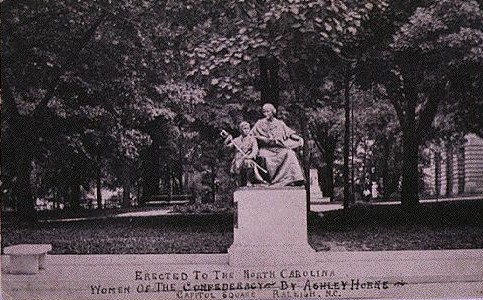
Symbolically, there could be no better location than Union Square, home of so many of what Catherine Bishir has called the state's "landmarks of power" that by 1915, when the Ruffin statue was erected, some had already said the square was too crowded. Ruffin ended up in an alcove at the entrance to what was then the Supreme Court building, now the Court of Appeals; the spot considered ideal, on Union Square across from the court building, had just been taken by the 1914 monument to the Women of the Confederacy.

Some other monuments on the square include the 1892 Confederate Monument, unveiled by Stonewall Jackson's granddaughter precisely 34 years after North Carolina seceded from the Union; a statue of Henry Lawson Wyatt, the first Confederate soldier to die in battle; and elaborate monuments to Charles Aycock, the "education governor" more recently known for his participation in the Wilmington coup of 1898, and Zebulon Vance, North Carolina's governor during the Civil War and again after the war as federal troops left the state. These monuments were all erected during the great period of the solidification of conservative Democratic power and the institutionalization of Jim Crow. As Bishir writes,

As the southern elite took control of the political process during the decades spanning the turn of the century, it also codified a view of history that fortified its position in the present and its vision of the future.

Throughout America in the decades just before and after 1900, political and cultural elites drew on the imagery of past golden ages to shape public memory in ways that supported their authority. By commissioning monumental sculpture that depicted American heroes and virtues in classical terms, and by reviving architectural themes from Colonial American, classical Roman, and Renaissance sources, cultural leaders affirmed the virtues of stability, harmony, and patriotism. The principal shapers of public memory and patrons of public sculpture and architecture in Raleigh and Wilmington, centers of political and cultural activity in the state, were members of an established elite. They were akin to aristocrats throughout the nation and they were well acquainted with national cultural trends. They also shared certain backgrounds, experiences, and values. All were Democrats, and, with a few notable exceptions, they were members of families of long-established social and economic prominence.


The Freedom Monument Project's supporters have pointed out that "except for an anonymous, wounded black soldier in the N.C. Vietnam Veterans Memorial, blacks are not represented on the State Capitol grounds." This monument proposes to correct that oversight. It holds the promise of inspiring whole new interpretations of the existing landmarks on and around Union Square--including the imposing statue of Judge Ruffin.

women of confederacy
After a bill introduced into the Legislature in 1911 by Gen. Julian Carr of Durham County to appropriate funds for a memorial to the women of the Confederacy failed to pass, Col. Ashley Horne put $10,000 of his own money toward the design and construction of the monument.


Thomas Ruffin's steady gaze still meets visitors to the North Carolina Court of Appeals. The statue was funded by the North Carolina Bar Association and Ruffin's family.


The Ruffin Field Trip


Last fall I had the pleasure of visiting Chapel Hill for a conference on Thomas Ruffin that Sally and Eric Muller put together. They also put together a terrific field trip, which included a trip to see Ruffin's office over in Hillsborough and then some slave quarters. Sally took a bunch of great pictures, but she didn't post them. I thought you'd enjoy Ruffin's office.

Friday, May 16, 2008

A Going Away Present


On Monday the folks at the University of Alabama Law School were kind enough to have a going away lunch for me and George Geis, who's moving to the University of Virginia. It was a real treat to be able to say bye to my colleagues of seven years; Tuscaloosa was a place where I learned a lot--about friendship and legal analysis and where I did some maturing as a scholar, too. I came to Alabama with a bunch of years of teaching experience already, so my experience here was different from the usual entry-level person. In a lot of ways that made it possible for me to focus on learning to appreciate the community and to work on projects that a new faculty member who's still learning how to teach just wouldn't have time for.

Sometimes I worry that my work isn't as interesting as it was before I arrived here. The project that's been most meaningful for me as a scholar was working on Reconstructing the Dreamland. I still think my two favorite pieces of scholarship are an article about a German lawyer who came to Pennsylvania in the late seventeenth century and wrote the first legal treatise in British North America and one on Harriet Beecher Stowe's critique of legal thought in her obscure but revealing novel Dred: A Tale of the Great Dismal Swamp. All three of those were completed before I arrived here. It's sort of sobering to think that my best work (or at least favorite work) may be behind me. Even my current project, University, Court, and Slave, about which I am very excited, traces its origins to my dissertation--although I refined and expanded it greatly in Tuscaloosa. (You'll be hearing a bunch more about University, Court, and Slave in the near future; it's a project about which I am excited, in part because it's letting me get back to my core area of interest: intellectual history of the old South.)

So why do I like my earlier work--or why haven't I produced some more good ideas of late? Hard to say. I found working on Reparations Pro and Con (written entirely in Tuscaloosa) very rewarding but also frustrating. Quite simply, it's hard to get a grip on our nation's long history with race. And I fear that few people want to have a conversation about race. So trying to write a book that does justice to each side and takes account of the important perspectives coming from each vantage is, well, tough.

But maybe there's something about the career paths of scholars in general that accounts for this. Partly I've been taken away from writing articles in recent years by committee work for the University (always illuminating to serve on university committees--you learn a ton, even if it impedes scholarship) and partly because I've been editing book reviews over at Law and History Review, which I love. Maybe it has to do with how we learn to ask questions, too. The issue I find most interesting in legal history--how legal doctrine relates to culture--is an issue that invites even a novice scholar to ask lots of questions. So by the time I started teaching and certainly by the time I'd been teaching a bunch of years, I'd identified a lot of datasets (from cases to literary addresses to black newspapers to literature to landscape art) to examine. So that even when I'm doing "new" work, it's looking at older questions and at data that I've known about for a long time. Boy, it's a real thrill to realize that you're looking at something entirely new to the scholarly community--like the manuscript of the first legal treatise in British North America or the transcript of a trial in the aftermath of the Tulsa riot that took place nearly eighty years ago and that no one had used in decades. I've been getting that thrill again with University, Court, and Slave because I've been reading cases, treatises, and literary addresses that are often ignored.

But the project that's going to get me back to the sense of complete novelty (I hope) is still mostly in the future--it's about the idea of equality in early twentieth-century black thought. And it's tentatively called "Reading the Great Constitutional Dream Book." I've presented an early version a few times. But it's only been an outline so far; the vast majority of the work lies ahead. And therein lies the story about the wonderfully thoughtful going away present my colleagues gave me. My working title comes from Ralph Ellison's Invisible Man. When the elderly couple are being evicted, IM asks what are they being evicted from? They have (almost) nothing--all they had was the "great constitutional dream book." And so my project looks to what those ideas were--and then (and this is the really hard part to levitate) how those ideas relate to the civil rights revolution. Ellison first learned about those ideas of the constitutional dream while he was growing up in Oklahoma City and he wrote about that experience a couple of times--including in three essays published in the Carlton Miscellany in 1980 (Carlton College's literary magazine). Somehow (and I'm sure this cost a fortune in effort and money both) they found an autographed copy of that issue (which also contains terrific articles on Ellison by such Ellison luminaries as Robert Steptoe and John Callihan)! Opening that present at the lunch was just another example (as Ellison said) of the unexpected outdoing itself in its power to surprise! While of course I'd read those essays (several were talks given at Brown University) before, it's a real treasure to have them in their original form.

Thursday, May 15, 2008

A Prison Library: Literature and Black Identity


The recent news that the FBI asked for information from the internet archive is further evidence that books are both important ways of transmitting ideas and important signifiers of which ideas readers find important.

It is not just law enforcement that is interested in reading habits, however. We are hearing a great deal about the project of “the history of the Book” these days. It aims to understand the role of books as vehicles of change: how do books contribute to changes in society, how do they help to create and sustain identity.

Sometimes historians look at books, to measure a culture. What does Invisible Man say about the culture of the United States on the eve of Brown? What do Booker T. Washington’s Up From Slavery and W.E.B. DuBois’ Souls of Black Folk say about Jim Crow?

At other times, historians draw inferences about people from their libraries. This post talks about a list of about 120 books on the "black experience" that Judge Don Young ordered to be placed into the Marion, Ohio prison library back in 1972, Taylor v. Perini, 413 F.Supp. 189, 215-19 (D.C. Ohio 1976). What interests me about the list is its potential for mapping the sources of identity in the late 1960s and early 1970s. What, then, are the books that the judge ordered added? More below the fold.

The Harlem renaissance and its leaders are well-represented: W.E.B. DuBois’ Souls of Black Folk; Richard Wright’s Native Son and Uncle Tom’s Children; James Weldon Johnson’s Autobiography of an Ex-Colored Man; Claude McKay’s Home to Harlem (1928) along with some other Renaissance-era literature, like Rudolph Fisher’s Conjure Man Dies: A Mystery Tale of Harlem (1932) and Walls of Jericho (1928)). Situated between the renaissance and the 1960s is Invisible Man.

There is the early 1960s literature that captured the possibilities of the Civil Rights movement: Claude Brown, Manchild in the Promised Land; Maya Angelou’s I Know Why the Caged Bird Sings (1969); King’s Where Do We Go From Here, The Trumpet of Conscience, Stride Toward Freedom (1958), and Why We Can’t Wait; Alan Westin’s Freedom Now! The Civil-Rights Struggle in America (1964); and Howard Zinn’s SNCC: The New Abolitionists (1968). I might also put John Killen’s And then We Heard Thunder (1964), James Baldwin’s Tell Me How Long the Train’s Been Gone (1968); John Alfred Williams’ The Man Who Cried I Am (1967) in that category–they are situated in a place between the optimism of the Civil Rights era and the later separatism. They ask, with King, what now?

Then there’s the literature that represents the transition to black power, as well as disillusionment with the Civil Rights movement or western society more generally, such as Franz Fanon’s Wretched of the Earth (1961) and White Skin, Black Mask (1952); Tom Hayden, Rebellion in Newark; Benjamin Muse, American Negro Revolution: From Non-Violence to Black Power, 1963-1967 (1968); Chuck Stone, Black Political Power in America (1970); Harold Cruce, Crisis of the Negro Intellectual (1967); Louise Meriwether’s My Daddy was a Numbers Runner (1969)). Along those lines, is literature that provides a popular, sociological critique of 1960s society, like Charles Silverman, Crisis in Black and White (1963). And there’s the literature that continued in the late 1960s and early 1970s to seek an answer in more traditional or different places, like Kenneth Clark’s Dark Ghetto (1967).

As you would expect, there are many on black power: Eldridge Cleaver’s Soul on Ice; Autobiography of Malcom X; Amiri Baraka, Home: Social Essays (1966); H. Rap Brown, Die N–r Die! A Political Autobiography; Lester Julius’ Look Out Whitey, Black Power’s Gon Get Your Mama; Bobby Seale, Seize the Time: The Story of the Black Panther Party and Huey P. Newton. Maybe I’d put Angela Davis, If They Come in the Morning (1971) into this category. And I guess Cecil Brown, Lives and Loves of Mr. Jive-Ass N–r, too. Prison literature, like George L. Jackson’s Blood in My Eye, is surprisingly rare in this collection.

There are a lot of histories: DuBois’ Black Reconstruction; John Hope Franklin’s From Slavery to Freedom and Reconstruction, Emancipation Proclamation, and Reconstruction; Franklin Frazier’s Negro Family in the United States (1968); Edward Cronon, Black Moses: Marcus Garvey (1960); David Levering Lewis’ King: A Critical Biography; Benjamin Quarrels’ Black Abolitionists, Mr. Lincoln and the Negroes; and The Negro in the Civil War; Kenneth Stampp’s The Peculiar Institution (1956); C. Vann Woodward’s The Strange Career of Jim Crow (1955); Arthur I. Waskow, From Race Riot to Sit-In (1966); Herbert Aptheker’s Negro Slave Revolts (1943). Along with the histories are other scholarly work that describe and analyze black culture, such as E.U. Essien-Udom’s Black Nationalism (1970); C. Eric Lincoln’s Black Muslims in America (1961); Henry A. Ploski’s Afro USA (1971); Marshall Stearns, The Story of Jazz (1970); Chuck Stone, Black Political Power in America; and Joseph R. Washington, Black Religion (1964); and other work that collects culture, such as Miles Mark Fisher, Negro Slave Song (1953); Arna Wendell Bontemps, American Negro Poetry (1963).

DuBois’ Black Reconstruction reminds us that there are books on Reconstruction by and for white people and books on Reconstruction by and for black people. Talk about segregation of memory! Jim Crow separated people intellectually, as well as physically and socially.

Of course the classification scheme that I’ve imposed above says a lot about how I view the world of the 1960s and early 1970s, from the vantage of the early twenty-first century. I’m continuing to think about how to classify the books. And as the classifications grow, I find that I want to put books into several categories. It’ll be interesting to see what readers think about the classifications.

There’s a lot more to say about this; prison officials responded that they already had a lot of literature on the black experience in America in their collection. Might be worth comparing the two lists. For example, Booker T. Washington’s Up From Slavery appears on the prison’s list. But nothing like it is to be found on the court’s list of books to be added. One other quick observation: it’s surprising what isn’t in that list. For instance, I would have expected more James Baldwin.

The special master, Vincent Nathan (who used to teach at the University of Toledo Law School), was kind enough to correspond with me about how the list of books was assembled. He remembers that it came from a group of law librarians. The list may, thus, say more about the intellectual interests of librarians than about the needs or attitudes of the plaintiff class. But even then I think it's informative of what people thought ought to be included on a list of the "black experience." Much left to talk about here.

(This post is a repeat of one over at blackprof a couple of years ago.)

Wednesday, May 14, 2008

Looking forward to the Visit

Thanks Sally for that very, very kind introduction and for inviting me to walk into Greenespace and chat for a while. It makes me very happy and optimistic about the future to know that someone as thoughtful as Sally is an elected official. And I'm looking forward to being Sally's neighbor and colleague in a couple of weeks. It's a dream come true to be on a faculty as terrific as UNC's.

I share Sally's interest in things antebellum and in how we remember the past. And because I'm giving a talk on landscape art and property law on Thursday I thought that I'd talk some about that now, because I'm still rearranging my note cards and trying how best to present this material.

The talk, "Property and Progress" (cute play on Henry George, eh?) is on the relationship between landscape art and property law in the years leading into Civil War at one of my favorite--and one of our country's finest--art museums, the Westervelt Warner Museum. The talk centers around my favorite work of American art, Asher B. Durand's Progress (1853), which just so happens to be owned by the museum. This will be a huge treat for me, to have the chance to talk about that most magical of paintings at its home. And, in fact, this talk is part of welcoming it home from travels to the Brooklyn Museum of Art and then out to San Diego for a major exhibit on Durand.

I join two themes here--first, the centrality of property and particularly the hand of humans on the land, in antebellum landscape art; second, the ways that antebellum property law reflected and amplified those values. The correlation between them is not perfect. A substantial part of landscape art reveals concern over increasing human intrusions on nature. For instance, Thomas Cole's landscapes frequently disclose an ambivalence about the market. What Cole and a lot of other people celebrate--including Frederick Church's Above the Clouds at Sunrise--is nature freed from humans.

Church_naturalbridge_2 The romantics of the antebellum era worried that someone tried to own the landscape. So when Natural Bridge in western Virginia was offered for sale, John Thompson protested it in the pages of the Southern Literary Messenger. Thomas Jefferson thought that the Natural Bridge, which he had once owned, should be treated as a public trust. (Frederick Church's image of the Natural Bridge, which is owned by the University of Virginia, is at right).

Coleoxbow
Landscape painters also captured farms and parcels of land, such as Thomas Cole's Ox Bow in the Connecticut River (right). It shows the landscape around Mount Holyoke. Look from left to right and see the increasing civilization. On the left is wild nature, twisted trees; over towards the right are fields, orchards, roads. Ox Bow was completed in 1836, the same year that Emerson completed Nature. You may recall that Emerson said of landscape that:
The charming landscape which I saw this morning, is indubitably made up of some twenty or thirty farms. Miller owns this field, Locke that, and Manning the woodland beyond. But none of them owns the landscape. There is a property in the horizon which no man has but he whose eye can integrate all the parts, that is, the poet. This is the best part of these men's farms, yet to this their warranty-deeds give no title.
Thomas Cole painted a number of such scenes. Sometimes I've used Cole's 1847 "Home in the Woods," which is in the Reynolda House Museum.
The idea here is to show the ways that humans put their imprint on nature--and how artists celebrated that imprint. George Inness' Lackawanna Valley (below) is a classic example. Look at the machine going through the the fields of cut-stumps; the railroad roundhouse in the background; the smoke stack even further off; what a strange juxaposition (it seems at first) of humans and nature. While it seems strange at first, my point is that landscape art is part of the celebration of human's use of land. The boy sitting in the foreground reminds one of Thoreau who talks in Walden of setting his watch to the railroad whistle. Where the image of Walden is of a secluded place, that solitude was often disturbed by the train whistle and then the sounds of the engine.

innesslackawana.jpg

There’re some neat connections here between property law’s reverence for private property (and its preference for use of land) and the kind of art that Americans produced. It's fun cultural history, I think. And every now and then there are some unexpected connections between judges and landscape art. For instance, in a lecture in 1844 at Dartmouth, United States Supreme Court Justice Levi Woodbury referred to Thomas Cole’s Course of Empire to illustrate how nations evolved–“starting first in the rudeness of nature; then maturing to high refinement and grandeur-till, amid the ravages of luxury, time and war, sinking into utter desolation.” The series of five paintings depict the same landscape (look for the mountain in the background), as the country goes from a state of nature, to civilization, consummation, destruction, and then desolation. Sort of sobering, but in keeping with many nineteenth-century Americans’ belief in the cycle of nations.
Others, including Justice Woodbury, saw an unbroken chain of upward progress, often facilitated by the increasing respect for private property. And so there's an odd contrast between Cole, who was ambivalent about humans' imposition on nature and Woodbury and a lot of other jurists, who were enamored of the market. And you know what Woodbury's talk is called? How could it be anything other than "Progress"?!
Cropseyuniversity_michigan Yup, colleges in the antebellum era were deeply interested in progress-- technological, economic, and moral (though what that meant was unclear). And so it should not surprise anyone that Jasper Cropsey painted the University of Michigan in 1855 (right). It has everything--the school buildings and church (at right), the fields, the roads, a horse drawn wagon, domesticated animals. The college in the garden, to paraphrase Leo Marx' brilliant book The Machine in the Garden. And another important source for this talk is Angela Miller's fantastic book The Empire of the Eye.
What, then, of the centerpiece of the talk: Durand's Progress? It’s a great canvass for seeing all sorts of images of what "progress" meant-–the shift from the native Americans over on the left (the state of nature), then moving across the canvass to the right, the telegraph wires, the steam boats, the canal, the peddler, the boy bringing the cattle to market, the church, the railroad roundhouse....
The talk is particularly meaningful for me, too, because it's the last lecture I'm giving in Tuscaloosa. So it'll be fun, but sad, too, because I'll be saying goodbye to a painting I love and a lot of friends, too.
Alfred Brophy

Tuesday, May 13, 2008

You can call him Al, and call yourself lucky.

It's a pleasure to lend some Greene space to Al Brophy, professor of law at the University of Alabama, soon to be of the University of North Carolina. Can't wait to welcome him and Barb in person as they settle in to their new Southern Village home. Meanwhile, he's agreed to sit a spell here and test out a few ideas.

I first became aware of the prodigious Alfred L. Brophy's work seven or eight years ago when I started seriously researching the life and career of Judge Thomas Ruffin. Already by then, he had a long list of law review articles out there, a J.D. with a Ph.D. in history. He seemed larger than life! How refreshing to find out, years later, when we had him up here for our symposium on Ruffin and State v. Mann, that he isn't very tall. Al is quite down to earth, smart and funny and full of interesting ideas.

Please join me in welcoming Al to GreeneSpace and to Chapel Hill.

Friday, May 02, 2008

New Orange County homelessness plan web site

Carson Dean, our new coordinator for Orange County's Ten-Year Plan to End Chronic Homelessness, has hit the ground running. I got a chance to see him in action on Wednesday afternoon, when he met with two rising UNC seniors who will be planning their senior class project, which they want to focus on homelessness. Earlier on Wednesday he had met with students from Hunger and Homelessness Outreach Project (HOPE) of the Campus Y together with other student groups interested in working on homelessness issues.

To the rising seniors, he made a couple of suggestions including one that would give support to homeless people as they enter the work force for perhaps the first time in many years, or ever. Increasing employment is one of the key goals of the plan, and Carson has been holding meetings already with key players to talk about that.

And meanwhile, he has dramatically improved the web site for the plan, upfitting it with lots of useful and current information.

Carson's official title is "coordinator" of our 10-year plan--which is exactly right. Within Orange County already there are lots of resources for addressing the needs of the homeless and those most at risk. The success of the plan depends on putting those resources to the most efficient use--coordinating these multiple efforts--as much as it does on getting new resources in place. Looks like he's off to a great start.

Check out the web pages and see how you can get involved.

Tuesday, April 29, 2008

Attacking the canvas

Lynn Boggess is a great painter and a pretty good carpenter too. Blogging about our visit to his opening at Tyndall Galleries on Saturday night, Paul talks about his use of the trowel as his instrument of choice, as well as his amazing homemade easel (one of several). Folded up, it looks like a shallow wooden crate. With a few turns of a power screw in reverse, it transforms into a three-legged construction capable of accommodating a canvas in rugged terrains.

The paint on Boggess' works is so thick it takes about ten years to dry out fully, he speculates.

You don't have to know all that to appreciate his art, but it really does make you appreciate the work that goes into it.

Tuesday, April 22, 2008

When is organic worth the premium?

With prices of organic foods high and higher, it's hard to know when they are worth the money. Pesticides are toxic, but does that mean that all foods treated with pesticides are equally bad?

Here's a chart that sorts it out. Doesn't it seem that strawberries with all their squishy little pores would be the worst? They're not.

Thursday, April 17, 2008

Roman holiday

rome

By Lisa Scheer, who has been on a roll lately. (That would have been a pun, pre-digital.)

Monday, April 14, 2008

Life against the overgrown

Public Art 360, the regional/national symposium that Janet Kagan & co. successfully pulled off this weekend in Chapel Hill, looks to have been a great success! Wish I could have attended more than just the one session on landscape architecture--but that one was pretty amazing.

Walter Hood, who grew up in Charlotte, is an artist, an architect, and a landscape architect; he's been called "one of the nation's rising stars of landscape architecture." His work is worthy of all those titles, and his mission is to show that the lines of separation are artificial. Given the character of some of his "interventions," I'd say he's a bit of a social worker and an activist as well. According to Metropolis magazine (July 2005),

At 46, Hood is now one of landscape architecture's leading public intellectuals: former chair of the department of Landscape Architecture and Environmental Planning at Berkeley, Pentagon memorial competition juror, and constant lecturer. As an African American in a profession with seemingly none and an urbanist in a discipline just barely breaking free of the pastoral, he's something of a phenomenon. His faculty position has given Hood the ability to pick and choose projects, a luxury he has exercised carefully and often polemically, working nearly exclusively in the public realm, and often in the inner city.


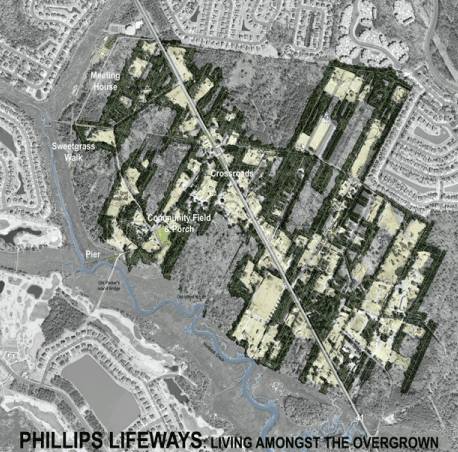
I was particularly taken by his work in the Phillips community near Charleston, South Carolina, where he helped the residents defeat a proposal to widen a road. The project would have cut the community in two. This achievement was won through the concept of "the overgrown." Imagine a well-manicured suburban back yard at the edge of an undeveloped tract: you are peering across civilization into the overgrown. The overgrown can be used as shield or sword. You can clear your landscape to enjoy using it and perhaps to enjoy the proximity to your neighbor; or, say, you aren't that friendly with your neighbor: you might "let the overgrown take care of it."

overgrown

Through an aggressive use of the concept of the overgrown--including actual use of plant material to expand the vegetation in key corridors--Hood helped the community persuade the relevant officials that the widening of the road would be an assault upon the community.

(In some back yards, the line between civilization and the overgrown is under constant negotiation.)


Sunday, April 13, 2008

The very long civil rights movement

Ken Zogry already had a fine career established in public history by 1998: he had completed two books, both of which would end up winning awards, The Best the Country Affords: Vermont Furniture, 1765-1850 (The Bennington Museum: 1995), and The University’s Living Room: A History of the Carolina Inn (UNC: 1999). Then, something happened that changed his life. He was asked to take a look at an endangered house in downtown Raleigh, a house built in 1901 by Dr. Manassa Thomas Pope. Dr. Pope, a graduate of the medical school at Shaw University, was the first licensed African American doctor in North Carolina. His daughters lived in the house until into the 1990s.

In 1998, Zogry prepared a National Register nomination for the house, which by then was surrounded by parking lots. He ended up involved in a 10-year struggle to save the house and to turn it into the first house museum of an African American family in North Carolina. It's not yet open to the public, but there are great plans, and Zogry is the executive director of the Pope House Museum Foundation.

About 1,800 of the documents Zogry found in the house at the outset are now in the Southern Historical Collection at UNC. What especially piqued his interest was a 1906 voter registration card issued to Dr. Pope. "Everything I had learned said this should not exist," he said as he began his talk on Saturday morning at a conference on New Perspectives in African American History and Culture. The discovery launched him on an investigation into a fascinating and little-known story about black male political resistance to white supremacy in the first two decades of the twentieth century--in Raleigh. The result is his UNC dissertation, which he has just recently defended.

What Zogry has discovered is that Dr. Pope's action in registering to vote was part of a concerted voter registration effort that went on around 1906; then it stopped, to pick up again in 1916. Many questions remain unanswered, including why the 10-year hiatus, but it is clear that there was a strong movement among African Americans to participate in politics even as Jim Crow laws were tightening and the conservative Democrats were shoring up their power after retaking the government in 1898.

In 1919, Dr. Pope actually ran for mayor of Raleigh. He was joined on the ballot by African American candidates for commissioner of safety and commissioner of public works. With no hope of a chance, these men were making a statement: "the strongest possible public action that black leaders could take against disenfranchisement," according to Zogry.

The election was lost, but all was not lost. A student named Ella Baker was attending Shaw in 1918. According to Zogry, the election of 1919 was "a formative experience" for her. After graduation she moved to Harlem and began her life's work--which included becoming "a guiding force" behind both the Southern Christian Leadership Conference and the Student Nonviolent Coordinating Committee. In fact, said Zogry, it was no accident that SNCC was formed at Shaw: Baker could have taken it to any major black school, but Shaw provided "a strong connection to history."

Commenting on Zogry's paper, Fitz Brundgage called Dr. Pope's mayoral election campaign significant because of its threat to the "appearance of hegemony." It was significant "because it underscores the persistence of a commitment to black political action that extends far back," back before the 1950s, back before the 1930s (which is sometimes what we think of as the outer edge of the civil rights movement), back to within the very height of the Jim Crow period. And Brundage would even take it farther back. Rather than read Dr. Pope's story as a predecessor to what was to come later in the twentieth century, he "would read it backward and talk about a continuous black struggle for equality, with varying tactics, but a continuity of struggle," one that has never let up: These various episodes of civil rights activities should not be seen as separate events that just happened, but rather as a long steady march, by actors conscious of their own history from one generation to the next.

Friday, April 11, 2008

Denis Cosgrove

My friend David Lowenthal has written a beautiful obituary in The Independent of London about a friend of his, Denis Cosgrove, who died too young, at 57. It surely would have been a pleasure to have known Professor Cosgrove.

Prizing geography's traditional mélange of nature and culture, Cosgrove had little affinity with either the abstract positivism of spatial science or the radical activism of post-colonial social critique. Happy in 16th-century Italy, he recalled that at home and at his Jesuit school, Rome had always been more important than London. Like Renaissance humanists, he saw the fulfilled life as a balance between the vita activa and the vita contemplativa; for himself he chose contemplation, self-reflection, thoughtful critical converse. His vocation was less about changing the world than changing oneself. Whereas policy-driven social science was blind to the liberating and consoling power of beauty, dismissing it as veneer and distraction, Cosgrove's aesthetic concern reflected his conviction that beauty was inseparable from goodness and truth. In common with Stoics and Jesuits, he told an interviewer, he valued education as "something that feeds the soul and the mind and the body together, posing questions like 'Who are we in relation to the world? How should we live our lives in a way that is fulfilling and morally proper?' "

In that quest, he was eminently successful. His warmth, humour, kindness, delight in children, theirs in him, and intellectual challenge, charmed and dazzled all who knew him.

Thursday, April 10, 2008

Bill Ferris-fest, and much more this weekend

There's too much going on in Chapel Hill this week for one person to possibly take in. Last night, Bill Ferris presented some of his rare and wonderful documentary films of Mississippi blues artists that he started making in the late 1960s. Today, this Renaissance southern scholar was on The State of Things on another subject: the 100th anniversary of the birth of Richard Wright, which is being celebrated at UNC this weekend in a big way. That conference begins on Saturday night with a staged reading of Paul Green's dramatic adaptation of Native Son. It culminates Sunday night in an event in Memorial Hall featuring Wright's daughter Julia Wright.

Meanwhile on Friday and Saturday, you could go to the conference on New Perspectives in African American History and Culture, sponsored by UNC's African American History Working Group.

Also on Friday and Saturday, you could experience Public Art 360: Symposium from Seven Perspectives. Kudos to Janet Kagan for working so hard to bring this conference together--it will gather public art professionals and interested folks from across the Southeast.

On Saturday and Sunday, you could delight yourself on the Chapel Hill Spring Garden Tour, visiting gardens in the Oaks and Meadowmont, including the gardens of the historic DuBose home.

On Sunday and Monday, you could go Beyond the Sunbelt: Southern Economic Development in a Global Context.

Don't know how many of these riches I can absorb. I'll start tomorrow with a summit on affordable housing in Chatham County, where I'm a panelist. Good to see they are thinking in this direction.

Wednesday, April 09, 2008

Good question: Why don't we celebrate April 9?

On this day in 1865, Robert E. Lee surrendered. The nightmare of the civil war was officially ended; the Union would be one again. Why, then, asks Kevin Levin at Civil War Memory, is this day not celebrated?

Kevin is being cagey here. As he knows better than most, whole books have been written to explain that after the war, what happened was a massive "reconciliation." The Confederacy was not treated like a defeated nation: President Andrew Johnson would not honor the promise of 40 acres and a mule to freed slaves. Eventually even ex-Confederate soldiers and their widows received pensions from the United States government. Our men died, your men died, it was awful: let's get over it and get on with things--so went the rhetoric of reconciliation as cities and towns on both sides of the Mason-Dixon Line ushered in Jim Crow. It's kind of as if the war didn't happen, or at least that it was all a big mistake. President Wilson spoke at the 50th anniversary of Gettysburg--where Union and Confederate veterans gallantly shook hands--without once mentioning emancipation. So it's little wonder that this day of the great achievement of the Union victory goes unnoticed.

At a Civil War symposium on the UNC campus a couple of weeks ago, Gary Gallagher gave an interesting interpretation of the various ways in which the war was conceived and remembered. Talking from his new book, Causes Won, Lost, and Forgotten: How Hollywood and Popular Art Shape What We Know about the Civil War (UNC Press), he outlined four dominant narrative traditions that have shaped our understanding of the war.

Gallagher argues that popular understandings of the war have been shaped by four traditions that arose in the nineteenth century and continue to the present: the Lost Cause, in which Confederates are seen as having waged an admirable struggle against hopeless odds; the Union Cause, which frames the war as an effort to maintain a viable republic in the face of secessionist actions; the Emancipation Cause, in which the war is viewed as a struggle to liberate 4 million slaves and eliminate a cancerous influence on American society; and the Reconciliation Cause, which represents attempts by northern and southern whites to extol "American" virtues and mute the role of African Americans.


A celebration of Grant's victory over Lee on April 9, 1865 would fit within the "Union Cause" narrative. And yet, as Gallagher persuasively argues at least as to the way the Civil War has been presented in movies since the movie "Glory" in 1989, the "Union Cause" narrative in our own time is supremely unpopular. In movie after movie--fourteen or so that he discussed--Union soldiers are depicted as ugly, violent, dishonest characters. There is no celebration of the United States as a great nation worthy of victory and respect. Yet as Gallagher further detailed, the goal of preserving the Union for the sake of its own preservation was a dominant narrative just before and during the Civil War itself. How would it look to European countries if this fragile experiment in democracy could not survive even 100 years?

What happened to the positive narrative of saving the Union for its own sake--the cause that Lincoln, among so many others, so fervently believed in? Even slaveholding southerners, at least those of a certain class, were reluctant to let the idea of one nation go for the sake of the rebel cause. Said North Carolina Judge Thomas Ruffin at a peace conference held in Washington in 1861, "I was born before the Constitution was adopted. May God grant that I not outlive it."

The more powerful narrative of reconciliation overcame it, in part; the narrative of the Lost Cause held on for a long time and survives in some quarters; the narrative of emancipation has reemerged since the civil rights movement, coming to fruition in movies like "Glory." But even when emancipation is celebrated, the Union soldiers come off as complete jerks. Why is that?

Gallagher's theory is that Hollywood is speaking to our time, as it always does speak to its own time, always in the interest of box office returns. And that in our time, whether you are on the left or the right, the federal government is not the good guy.