Showing posts with label State v. Mann. Show all posts

Sunday, August 03, 2008

Quakers with slaves

At right is the cover of the Chowan County grand jury indictment, in spring 1829, of John Mann for the assault and battery of the slave Lydia. (From the North Carolina Office of Archives and History.) The charge was presented by a man named Josiah Small. Yet the slave's owner, as Ruffin's opinion in State v. Mann tells us, was named Elizabeth Jones, who for all this time has eluded historians. Who was Josiah Small and what concern was Jones' slave to him? This document was my first clue in a long journey to find the answer.

Elizabeth Jones was Small's ward. Married to her older sister Matilda, Small assumed guardianship of Elizabeth and two of her brothers after the death of their father Thomas Jones, in 1822. To that household Elizabeth brought the slave she had inherited, Lydia. By 1829, Elizabeth was still a minor (barely, at 17), and Lydia was 23.

What's most interesting to me about the Small household is that Josiah Small was from an old Quaker family. He was a descendant of John Small (c.1639-1700), a Virginia Quaker whose family was among the waves of Quakers who scurried down to North Carolina to escape the wrath of Virginia's governor William Berkeley. A faithful servant of Charles I, "a King's man to his autocratic fingertips" as one historian writes, Berkeley suppressed all dissent from the Church of England, even after Cromwell came to power. By 1660, he'd succeeded in getting the Virginia legislature to pass a law requiring the imprisonment of all Quakers until they left the colony. He stayed in office until his death in 1677.

This was happening during the same period when the boundary line between North Carolina and Virginia was up for grabs. The North Carolina charter of 1663 was at apparent odds with the one of 1665; in conflict was a swath of territory about 30 miles deep from where the line currently is to the middle of the Albemarle Sound. The dispute wasn't settled until William Byrd's survey of 1728--which means that for some 60 years, it was an open question.

The dispute had to do with differences of opinion on the location of Weyanoke Creek, which was supposed to be the boundary. The creek couldn't be found any more. Virginia claimed it was the same as Wiccon Creek, a tributary of the Chowan. North Carolina said it was the Nottoway River. But as William Boyd points out in an introduction to William Byrd's work, major questions of tobacco and trade routes were involved.

As early as 1679 Virginia had prohibited the importation of North Carolina tobacco, a condition which greatly retarded the economic development of the northeastern part of the province, where the soil was well adapted to tobacco culture. If the boundary ran through Nottoway River, North Carolina tobacco could be shipped down that and other streams to Albemarle Sound and thence to points without the colony.


As the debate lingered on, in 1714, Governor Spotswood of Virginia, "claiming that North Carolina continued to grant lands in the disputed region and that 'loose and disorderly people daily flock there,' proposed that Virginia survey a line through the Nottoway River and North Carolina one through Wiccon Creek, and that all settlers between those lines be removed." !! That didn't happen. When Charles Eden became governor of North Carolina, he managed to reach a compromise on the boundary. The line he proposed is the one that eventually, in 1728, was surveyed by a company including William Byrd II.

It's a more complicated story than that, but let me return to the Quaker Smalls. Because of this confusion, it appears that some of Josiah Small's ancestors may have "moved" to North Carolina simply by staying put. At any rate, by the late 1700s his father Benjamin was well established in Chowan County. On his death he left an estate of more than 500 acres and some 18 slaves. Josiah inherited about half of this, plus he had other holdings. By the time of the 1830 census, Josiah had 17 slaves.

Quakers were certainly better off in North Carolina. Under the Carolina Charter of 1663 (written largely by John Locke), "No person . . . shall be in any ways molested, punished, disquieted, or called into question for any differences in opinion or practice in matters of religious concernment, but every person shall have and enjoy his conscience in matters of religion throughout the province."

Quakers had many inconvenient practices and beliefs. They would not swear an oath in court. They considered everybody equal, rich or poor; all were brothers and sisters. Whether you were a lord or a servant, to them you were "thee." They would not fight. And of course, they thought slavery was wrong.

When did the Small family decide to become slaveholders, and why? We know that certain Quakers in Chowan County were considered dangerously abolitionist at least through 1795, when Josiah's father Benjamin, who did own slaves, would have been around 50. In December 1795, some Quakers in Chowan County were accused of actively promoting emancipation. Responding to a perceived "situation of great peril and danger" brought on by "the society of people called Quakers,"--by their "insatiated enthusiasm . . . as to partial and general emancipation"--a grand jury resolved that "speedy and resolute measures ought to be adopted by the good sense & spirit of the people" to combat their pernicious influence." This document links the Quaker agitation to "the miserable havoc & malfeasance which have lately taken place in the West Indies," which must have been a reference to the 1791 revolution in Haiti. Historians have finally understood how terrifying that event was to slaveowners throughout the South--an event too explosive to even talk about. But in my research into the first three decades of the 1800s in Chowan County, I haven't yet found any evidence of Quakers standing on principle against slavery. Perhaps it was there, but the Smalls and many of their relatives by then were well assimilated into the slaveowner class.

A reasonable explanation for this phenomenon of slaveholding Quakers comes from Seth B. Hinshaw's history of Quakers in North Carolina: "The religious conviction that slavery was morally wrong developed quite slowly," he writes. By the time it took hold, Quakers in eastern North Carolina had been owning slaves for many years, handing them down (as we see in the Small family) from generation to generation. It's not a great answer, but it's the best I can do.

Some of this information will turn up in the law review essay I'm writing as a follow-up to my talk on State v. Mann at the Ruffin symposium last fall. I want to acknowledge how helpful the web is for a project like this--rather, how handy the web is for connecting historical researchers with genealogists. A lot of what I know about the Small family comes from genealogical sources, especially Janice Eileen Wallace, with whom I had a fascinating email correspondence. The same is true for Elizabeth Jones and her descendants, for which Sally's Family Place and Sally herself have been very helpful.

Sunday, July 13, 2008

A Book I Love + book.google=An Antebellum Math Problem

Ok--so I'm sitting here reading John McCardell's fantastic Idea of a Southern Nation. He references an algebra book published in the 1840s by a Davidson prof, D.H. Hill, (also later a Confederate general) that makes fun of yankees.

So I surf over to book.google--what a fabulous research tool this is. And though a librarian was just yesterday criticizing me for my research method (and for also not spending enough time in the archives), I have to say: it sure is convenient to be able to pull up the text on my desktop. So check out this problem from Professor Hill's book:

A Yankee mixes a certain number of wooden nutmegs, which cost him 1/4 cent apiece, with a quantity of real nutmegs, worth 4 cents apiece, and sells the whole assortment for $44; and gains $3.75 by the fraud. How many wooden nutmegs were there?
Fun in math class, eh? (Am I right in thinking that 4x-1/4x=375?)

In honor of Sally's terrific work on State v. Mann, how about this problem involving the hiring of a slave:
A planter hired a negro-man at the rate of $100 per annum, and his clothing. At the end of 8 months the master of the slave took him home, and received $75 in cash, and no clothing. What was the clothing valued at?

Also, on the issue of emancipation and the generosity of North and South, this:

A gentleman in Richmond expressed a willingness to liberate his slave, valued at $1000, upon the receipt of that sum from charitable persons. He received contributions from 24 persons; and of these there were 14/19ths fewer from the North than from the South, and the average donation of the former was 4/5ths smaller than that of the latter. What was the entire amount given by the latter?

Mighty interesting stuff to see what's on the minds of antebellum textbook authors, eh?

(By the way, just so this is clear--the book I love is McCardell's Idea of a Southern Nation.)

Thursday, July 10, 2008

Wingfield, Chowan County

While Al has been keeping GreeneSpace alive, for which I'm very grateful, I've been back at work on my essay on Thomas Ruffin and State v. Mann as a follow-up to last fall's symposium. Lately that project has taken me back to the archives. As anyone who has done this sort of thing knows, it's easy to get lost in the archives, to go down trails you never intended just because they are interesting.

One of the jurors who heard John Mann's case in Chowan County in the fall of 1829 was Thomas I. Brownrigg. He was from a wealthy Irish Protestant family that established the first commercial fishing operation in provincial North Carolina, on the Chowan River just above Edenton. By his day, the estate that his grandfather Richard Brownrigg had established consisted of some 1,400 acres. Thomas' half-sister Priscilla Brownrigg was married to the solicitor (the prosecutor) bringing the case against Mann, John L. Bailey. (So much for conflict of interest.)

In double-checking some of these facts, I found this paragraph written in 1873 by Thomas Brownrigg Bailey to his mother Priscilla Brownrigg Bailey:

I rode over to Wingfield . . . The dear old place, my ancestors' home, around which cluster all the fond and proud associations of my family, is as much altered from the paradise it once was as a skeleton is different from the full and rounded form of youth and health and beauty. I rode down to the rear of the garden and took a long and wistful view of the most beautiful river I have ever seen; its glittering waters looked just as they did forty years ago. And the cypress trees with their broad bases stood out in the water, isolated, only awaiting their time to fall prostrate like others on the strand . . . the waves beating their solemn cadence on the lonely shore and the sighing of the wind through the cedars made symphony with my troubled heart. I felt humbled as in the presence of the dead; I tried to conjure up the long ago, when gay and festive and merrie throng gathered on the lawn, or made the house echo with song and dance and music's voluptuous swell. I tried to imagine where Father poured into your willing ear the words of love and plighted faith, but it would not do. In spite of me I was depressed beyond measure, and there the scarred and ruined house stared me in the face like an ugly demon. I bade silent farewell to the place and rode away.

Accompanying this paragraph was a note saying the house had been occupied in 1863 by the Buffaloes, "a band of traitorous Southerners."

What happened? It appears that during the Civil War there were two Union infantry regiments organized in eastern North Carolina out of white North Carolinians. According to Professor Donald E. Collins, they had their reasons:

Why did 1,300 men from the counties of Eastern North Carolina go against their native state and join the Union army? The answer is complex and is not simply loyalty to the United States and/or opposition to slavery. The nucleus of the First and Second North Carolina regiments, those who entered in the first enthusiastic burst of recruiting, were anti-slavery men who opposed secession. That, however, is even too simple an explanation. As pointed out by historian Wayne K. Durrill in his book A War of Another Kind, in describing the war in Washington County [See: Tidbits], it was a form of class warfare of haves versus have-nots -- the poor whites and small yeoman farmers who opposed and acted against their wealthy slave holding planter neighbors. Such men rushed to join a Union army that would help them punish the secessionist planter class.


Further,

The earliest North Carolina Union soldiers were "carried away with the idea that when they became soldiers they would be licensed to shoot down indiscriminately every disloyal citizen to the government they could find, and appropriate all of the property belonging to such persons to their own comfort, or to the benefit of the Government. " These Unionists were less anti-slavery than pro-white labor. They wished to end slavery as the first step toward deporting Blacks from the country -- to the benefit of the white working man.


These soldiers were called Home Guards. Their role was not to involve leaving the state. Rather, they were to cooperate with northern soldiers, perhaps serving as scouts or doing reconnaissance. "Perhaps the most hazardous duty involved recruiting forays into the no-man's land of the Albemarle Sound and Roanoke/Chowan rivers region where they were regularly harassed by small bands of Confederate guerilas."

But the company that took over Wingfield was no credit to the Union. According to William Mallison in The Civil War on the Outer Banks, after being turned into a post of the Union army, Wingfield went from bad to worse.

It became a center of “fugitive negroes, lawless white men, traitors and deserters from the Confederate army. Their leader, Captain Jack Fairless, a deserter, and his men “pillaged, plundered, burned, and decoyed off slaves in their forays into Chowan . . . Bertie, Perquimans, Hertford, and Gates Counties.”


Capt. Fairless was fatally shot by one of his own drunken men. A fierce battle then took place between the remaining Union men and some Confederates, the Union side "armed with an antique cannon stolen from Edenton." The Confederates eventually prevailed, but Wingfield was destroyed.

Saturday, May 17, 2008

A new prospect for Raleigh's monumental landscape

Congratulations to the folks with the North Carolina Freedom Monument Project for securing Gov. Easley's support in their work to establish a monument to the African-American experience in the state on Union Square in Raleigh, the grounds of the Capitol. Initiated in 2002 by the Paul Green Foundation, this project has benefited from the dedicated work of many people, especially our friends Marsha Warren and Reg Hildebrand.

A couple of years ago, I said to Reg that I hoped the monument could be located within sight of the statue to Thomas Ruffin, author of the infamous State v. Mann, which handed to masters almost unlimited power to suborn their slaves through physical "correction." At that time, it was not clear where the monument would be sited.

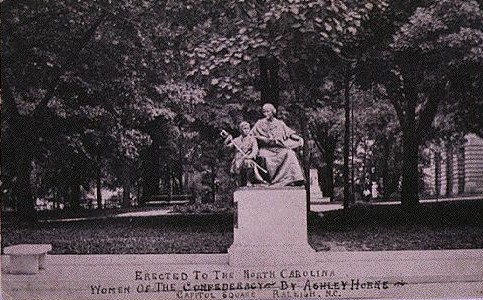
Symbolically, there could be no better location than Union Square, home of so many of what Catherine Bishir has called the state's "landmarks of power" that by 1915, when the Ruffin statue was erected, some had already said the square was too crowded. Ruffin ended up in an alcove at the entrance to what was then the Supreme Court building, now the Court of Appeals; the spot considered ideal, on Union Square across from the court building, had just been taken by the 1914 monument to the Women of the Confederacy.

Some other monuments on the square include the 1892 Confederate Monument, unveiled by Stonewall Jackson's granddaughter precisely 34 years after North Carolina seceded from the Union; a statue of Henry Lawson Wyatt, the first Confederate soldier to die in battle; and elaborate monuments to Charles Aycock, the "education governor" more recently known for his participation in the Wilmington coup of 1898, and Zebulon Vance, North Carolina's governor during the Civil War and again after the war as federal troops left the state. These monuments were all erected during the great period of the solidification of conservative Democratic power and the institutionalization of Jim Crow. As Bishir writes,

As the southern elite took control of the political process during the decades spanning the turn of the century, it also codified a view of history that fortified its position in the present and its vision of the future.

Throughout America in the decades just before and after 1900, political and cultural elites drew on the imagery of past golden ages to shape public memory in ways that supported their authority. By commissioning monumental sculpture that depicted American heroes and virtues in classical terms, and by reviving architectural themes from Colonial American, classical Roman, and Renaissance sources, cultural leaders affirmed the virtues of stability, harmony, and patriotism. The principal shapers of public memory and patrons of public sculpture and architecture in Raleigh and Wilmington, centers of political and cultural activity in the state, were members of an established elite. They were akin to aristocrats throughout the nation and they were well acquainted with national cultural trends. They also shared certain backgrounds, experiences, and values. All were Democrats, and, with a few notable exceptions, they were members of families of long-established social and economic prominence.


The Freedom Monument Project's supporters have pointed out that "except for an anonymous, wounded black soldier in the N.C. Vietnam Veterans Memorial, blacks are not represented on the State Capitol grounds." This monument proposes to correct that oversight. It holds the promise of inspiring whole new interpretations of the existing landmarks on and around Union Square--including the imposing statue of Judge Ruffin.

women of confederacy
After a bill introduced into the Legislature in 1911 by Gen. Julian Carr of Durham County to appropriate funds for a memorial to the women of the Confederacy failed to pass, Col. Ashley Horne put $10,000 of his own money toward the design and construction of the monument.


Thomas Ruffin's steady gaze still meets visitors to the North Carolina Court of Appeals. The statue was funded by the North Carolina Bar Association and Ruffin's family.


Thursday, November 15, 2007

Remembering Thomas Ruffin

As a prologue to the symposium "The Perils of Public Homage: State v. Mann and Thomas Ruffin in History and Memory," which takes place tomorrow, Sanford Levinson, Eric Muller, and I were on WUNC's "The State of Things" today.

The symposium runs all day tomorrow.

Thursday, November 08, 2007

To the courthouse--finally


After a painstaking restoration project that took an awfully long time, the Chowan County Courthouse reopened in October 2004. I said at the time that I wished I had been there for the reopening. Today, finally, I got there. They leave it open during the day. You can walk in and imagine what it was like to be in court there in the nineteenth century, or eighteenth (the building was built in 1767). Upstairs was a grand ballroom where President Monroe was lavishly entertained in 1819. They partied so hard then and on other occasions that by the latter 19th century it became prudent to add columns to the courtroom below.


This is the courtroom where, in the fall of 1829, John Mann was found guilty of assault upon a hired slave named Lydia, an opinion that Thomas Ruffin for the North Carolina Supreme Court overturned.


Saturday, October 16, 2004

Courting history

Wish I'd been in Edenton last week for the reopening of the historic Chowan County Courthouse. It would have been fascinating, if not really historically accurate, to see the N.C. Supreme Court in session there. Built in 1767 when Edenton was an important Revolutionary-era town, this was a busy local court for a couple hundred years.
The oldest Court House in North Carolina, [it] is an architectural gem of national reputation. A sketch of its life reads like a panoramic review of the life of North Carolina: the hardships of the early colony, the struggles of revolution, civil war and reconstruction; all finally unfolding into the commonwealth that is the Old North State of today. Through six conflicts the call to arms has resounded within its walls; it can recall the inauguration of every President of the United States; Governors from the time of Josiah Martin have spoken from its rostrum; Princes and Presidents have danced on its floors and the most illustrious lawyers of the State have pleaded their causes before its bar.

It was here in 1829 that a jury found a poor white man named John Mann guilty of assault for shooting a rented slave as she ran off from being whipped by him, a decision overturned by Thomas Ruffin and immortalized by Harriet Beecher Stowe in her novel Dred and in A Key to Uncle Tom's Cabin--and still widely studied.

This courthouse loomed large in the life of Harriet Jacobs, who escaped Edenton to become "a quiet revolutionary" on her own terms.

Surprisingly, but fittingly, a picture of the Chowan County Courthouse is featured in a recent essay by Wendell Berry on the subject of land use and the environment. It's an example of "old buildings [that] look good because they were built by people who respected themselves and wanted the respect of their neighbors"--an example we can learn from.