I made a very quick trip out to Asheville before school starts--been hearing a bunch about the place and, of course, it was everything I'd heard and more. Reminds me of Burlington, Vermont, Northampton, Massachusetts, and Portland, Oregon--the combination of restaurants and grunge and people with money, too. I'm looking forward to spending some more time out there in another year. But right now I want to talk about four things in particular.
As I was driving up Patton Street, towards (what I understand to be) the center of town, I saw an obelisk. And I said, ah, that must be a monument to the Confederacy; I'm guessing it was put up in the early twentieth century. So, after parking the car in a nearby lot (complete with spray-painted "Tourists Go Home"--gotta love the local flavor!) and a walk back there, I see that I was pretty much on the mark. It's a monument put up in the late 1930s to Zebulon Vance--governor of our state during the Civil War. And, of course, it was put up by the United Daughters of the Confederacy. So I was pretty close; and what to my wondering eyes did appear in front of it, but a smaller granite monument put up in the 1924, also by the UDC, marking Dixie Highway and commemorating Robert E. Lee. So far, so good. Actually, calling this stuff is like shooting fish in a barrel--every southern town needs its confederate monument and they're almost all from the early twentieth century. So you can impress your friends and family by making these kinds of predictions. Let's see, big monument; southern town; ... "well, [affecting voice of authority], I bet that's an early twentieth century monument to the confederacy." And almost all the time you'll be right!
So a walk down towards the enormous courthouse and what do I see: a bunch of hippies surrounding a magnolia tree. As close readers of GreeneSpace will recall, I love magnolia trees--and so does pretty much everyone else, which is part of the reason why the moonlight and magnolia school was so popular. They were camping out, protesting the impending destruction of the tree to create ... a condominium, right next to the park they're building! They crux of this seems to be a decision by the local authorities to sell land left to the city by George Pack. One recent report talks about it in this way: "The park land was willed to the people forever by two deeds of the late and benevolent George Pack. The deeds and land now in question are said by many to have been improperly, if not illegally, sold by Buncombe County Commissioners in November 2006." Hmm, I'd want to see the deeds (or will, I take it in this case)--sounds like a gift in fee simple absolute, but perhaps there was a restriction on use or sale?!
Now, I part company with hippies on some issues--like property rights. However, I'm always happy to see people exercising their constitutional rights in order to encourage the rest of us to spare trees from the ax--particularly the ancient, beautiful, and slow-growing magnolia. Sounds like a new piece of what I might call hippie jurisprudence. There's something about trees, which appeals to my sense of vested rights. The old ones are venerable in part because they are old; they've survived the test of time, so that alone is a reason to preserve them, it seems to me. (Not to mention that trees as a stand-in in southern literature for families.)
Anyway, after a short time at the protest, I spotted yet another monument to the side of the courthouse. And this time as I approached it, I guessed--based on the stones--that it was from the 1880s or 1890s. Bingo! 1893 monument to soldiers at Chickamauga in 1863. Ah, gotta love monuments and monument law--and what a day when you see them all combined.
And now I'm ready for school to start, because this has been just the perfect summer.
Showing posts with label Civil War. Show all posts
Showing posts with label Civil War. Show all posts
Monday, August 18, 2008

Wednesday, July 23, 2008
Where are the Neo-Confederates When You Need Them?
This evening I want to read Jefferson Davis' July 1852 address to the Phi Sigma and Hermean Societies of the University of Mississippi. But you know what? I can't find it on the internet. It's moments like these that I conclude the neo-confederates really are insignificant. If you can't scan in all the works of your leader and stick them up on the net somewhere, the question just has to be asked: what are you doing? And the answer has to be not much.
Thursday, July 10, 2008
Wingfield, Chowan County
 While Al has been keeping GreeneSpace alive, for which I'm very grateful, I've been back at work on my essay on Thomas Ruffin and State v. Mann as a follow-up to last fall's symposium. Lately that project has taken me back to the archives. As anyone who has done this sort of thing knows, it's easy to get lost in the archives, to go down trails you never intended just because they are interesting.
One of the jurors who heard John Mann's case in Chowan County in the fall of 1829 was Thomas I. Brownrigg. He was from a wealthy Irish Protestant family that established the first commercial fishing operation in provincial North Carolina, on the Chowan River just above Edenton. By his day, the estate that his grandfather Richard Brownrigg had established consisted of some 1,400 acres. Thomas' half-sister Priscilla Brownrigg was married to the solicitor (the prosecutor) bringing the case against Mann, John L. Bailey. (So much for conflict of interest.)
In double-checking some of these facts, I found this paragraph written in 1873 by Thomas Brownrigg Bailey to his mother Priscilla Brownrigg Bailey:
I rode over to Wingfield . . . The dear old place, my ancestors' home, around which cluster all the fond and proud associations of my family, is as much altered from the paradise it once was as a skeleton is different from the full and rounded form of youth and health and beauty. I rode down to the rear of the garden and took a long and wistful view of the most beautiful river I have ever seen; its glittering waters looked just as they did forty years ago. And the cypress trees with their broad bases stood out in the water, isolated, only awaiting their time to fall prostrate like others on the strand . . . the waves beating their solemn cadence on the lonely shore and the sighing of the wind through the cedars made symphony with my troubled heart. I felt humbled as in the presence of the dead; I tried to conjure up the long ago, when gay and festive and merrie throng gathered on the lawn, or made the house echo with song and dance and music's voluptuous swell. I tried to imagine where Father poured into your willing ear the words of love and plighted faith, but it would not do. In spite of me I was depressed beyond measure, and there the scarred and ruined house stared me in the face like an ugly demon. I bade silent farewell to the place and rode away.
Accompanying this paragraph was a note saying the house had been occupied in 1863 by the Buffaloes, "a band of traitorous Southerners."
What happened? It appears that during the Civil War there were two Union infantry regiments organized in eastern North Carolina out of white North Carolinians. According to Professor Donald E. Collins, they had their reasons:
Why did 1,300 men from the counties of Eastern North Carolina go against their native state and join the Union army? The answer is complex and is not simply loyalty to the United States and/or opposition to slavery. The nucleus of the First and Second North Carolina regiments, those who entered in the first enthusiastic burst of recruiting, were anti-slavery men who opposed secession. That, however, is even too simple an explanation. As pointed out by historian Wayne K. Durrill in his book A War of Another Kind, in describing the war in Washington County [See: Tidbits], it was a form of class warfare of haves versus have-nots -- the poor whites and small yeoman farmers who opposed and acted against their wealthy slave holding planter neighbors. Such men rushed to join a Union army that would help them punish the secessionist planter class.
Further,
The earliest North Carolina Union soldiers were "carried away with the idea that when they became soldiers they would be licensed to shoot down indiscriminately every disloyal citizen to the government they could find, and appropriate all of the property belonging to such persons to their own comfort, or to the benefit of the Government. " These Unionists were less anti-slavery than pro-white labor. They wished to end slavery as the first step toward deporting Blacks from the country -- to the benefit of the white working man.
These soldiers were called Home Guards. Their role was not to involve leaving the state. Rather, they were to cooperate with northern soldiers, perhaps serving as scouts or doing reconnaissance. "Perhaps the most hazardous duty involved recruiting forays into the no-man's land of the Albemarle Sound and Roanoke/Chowan rivers region where they were regularly harassed by small bands of Confederate guerilas."
But the company that took over Wingfield was no credit to the Union. According to William Mallison in The Civil War on the Outer Banks, after being turned into a post of the Union army, Wingfield went from bad to worse.
It became a center of “fugitive negroes, lawless white men, traitors and deserters from the Confederate army. Their leader, Captain Jack Fairless, a deserter, and his men “pillaged, plundered, burned, and decoyed off slaves in their forays into Chowan . . . Bertie, Perquimans, Hertford, and Gates Counties.”
Capt. Fairless was fatally shot by one of his own drunken men. A fierce battle then took place between the remaining Union men and some Confederates, the Union side "armed with an antique cannon stolen from Edenton." The Confederates eventually prevailed, but Wingfield was destroyed.
Saturday, May 17, 2008
A new prospect for Raleigh's monumental landscape
Congratulations to the folks with the North Carolina Freedom Monument Project for securing Gov. Easley's support in their work to establish a monument to the African-American experience in the state on Union Square in Raleigh, the grounds of the Capitol. Initiated in 2002 by the Paul Green Foundation, this project has benefited from the dedicated work of many people, especially our friends Marsha Warren and Reg Hildebrand.
A couple of years ago, I said to Reg that I hoped the monument could be located within sight of the statue to Thomas Ruffin, author of the infamous State v. Mann, which handed to masters almost unlimited power to suborn their slaves through physical "correction." At that time, it was not clear where the monument would be sited.
Symbolically, there could be no better location than Union Square, home of so many of what Catherine Bishir has called the state's "landmarks of power" that by 1915, when the Ruffin statue was erected, some had already said the square was too crowded. Ruffin ended up in an alcove at the entrance to what was then the Supreme Court building, now the Court of Appeals; the spot considered ideal, on Union Square across from the court building, had just been taken by the 1914 monument to the Women of the Confederacy.
Some other monuments on the square include the 1892 Confederate Monument, unveiled by Stonewall Jackson's granddaughter precisely 34 years after North Carolina seceded from the Union; a statue of Henry Lawson Wyatt, the first Confederate soldier to die in battle; and elaborate monuments to Charles Aycock, the "education governor" more recently known for his participation in the Wilmington coup of 1898, and Zebulon Vance, North Carolina's governor during the Civil War and again after the war as federal troops left the state. These monuments were all erected during the great period of the solidification of conservative Democratic power and the institutionalization of Jim Crow. As Bishir writes,
The Freedom Monument Project's supporters have pointed out that "except for an anonymous, wounded black soldier in the N.C. Vietnam Veterans Memorial, blacks are not represented on the State Capitol grounds." This monument proposes to correct that oversight. It holds the promise of inspiring whole new interpretations of the existing landmarks on and around Union Square--including the imposing statue of Judge Ruffin.
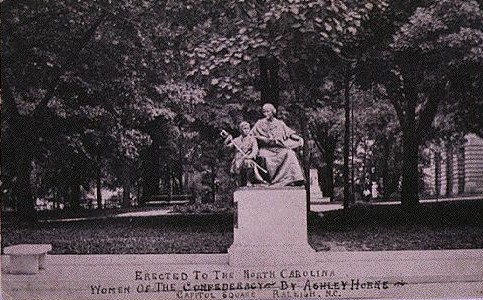
After a bill introduced into the Legislature in 1911 by Gen. Julian Carr of Durham County to appropriate funds for a memorial to the women of the Confederacy failed to pass, Col. Ashley Horne put $10,000 of his own money toward the design and construction of the monument.

Thomas Ruffin's steady gaze still meets visitors to the North Carolina Court of Appeals. The statue was funded by the North Carolina Bar Association and Ruffin's family.
A couple of years ago, I said to Reg that I hoped the monument could be located within sight of the statue to Thomas Ruffin, author of the infamous State v. Mann, which handed to masters almost unlimited power to suborn their slaves through physical "correction." At that time, it was not clear where the monument would be sited.
Symbolically, there could be no better location than Union Square, home of so many of what Catherine Bishir has called the state's "landmarks of power" that by 1915, when the Ruffin statue was erected, some had already said the square was too crowded. Ruffin ended up in an alcove at the entrance to what was then the Supreme Court building, now the Court of Appeals; the spot considered ideal, on Union Square across from the court building, had just been taken by the 1914 monument to the Women of the Confederacy.
Some other monuments on the square include the 1892 Confederate Monument, unveiled by Stonewall Jackson's granddaughter precisely 34 years after North Carolina seceded from the Union; a statue of Henry Lawson Wyatt, the first Confederate soldier to die in battle; and elaborate monuments to Charles Aycock, the "education governor" more recently known for his participation in the Wilmington coup of 1898, and Zebulon Vance, North Carolina's governor during the Civil War and again after the war as federal troops left the state. These monuments were all erected during the great period of the solidification of conservative Democratic power and the institutionalization of Jim Crow. As Bishir writes,

As the southern elite took control of the political process during the decades spanning the turn of the century, it also codified a view of history that fortified its position in the present and its vision of the future.
Throughout America in the decades just before and after 1900, political and cultural elites drew on the imagery of past golden ages to shape public memory in ways that supported their authority. By commissioning monumental sculpture that depicted American heroes and virtues in classical terms, and by reviving architectural themes from Colonial American, classical Roman, and Renaissance sources, cultural leaders affirmed the virtues of stability, harmony, and patriotism. The principal shapers of public memory and patrons of public sculpture and architecture in Raleigh and Wilmington, centers of political and cultural activity in the state, were members of an established elite. They were akin to aristocrats throughout the nation and they were well acquainted with national cultural trends. They also shared certain backgrounds, experiences, and values. All were Democrats, and, with a few notable exceptions, they were members of families of long-established social and economic prominence.
The Freedom Monument Project's supporters have pointed out that "except for an anonymous, wounded black soldier in the N.C. Vietnam Veterans Memorial, blacks are not represented on the State Capitol grounds." This monument proposes to correct that oversight. It holds the promise of inspiring whole new interpretations of the existing landmarks on and around Union Square--including the imposing statue of Judge Ruffin.
After a bill introduced into the Legislature in 1911 by Gen. Julian Carr of Durham County to appropriate funds for a memorial to the women of the Confederacy failed to pass, Col. Ashley Horne put $10,000 of his own money toward the design and construction of the monument.
Thomas Ruffin's steady gaze still meets visitors to the North Carolina Court of Appeals. The statue was funded by the North Carolina Bar Association and Ruffin's family.
Wednesday, April 09, 2008
Good question: Why don't we celebrate April 9?
On this day in 1865, Robert E. Lee surrendered. The nightmare of the civil war was officially ended; the Union would be one again. Why, then, asks Kevin Levin at Civil War Memory, is this day not celebrated?
Kevin is being cagey here. As he knows better than most, whole books have been written to explain that after the war, what happened was a massive "reconciliation." The Confederacy was not treated like a defeated nation: President Andrew Johnson would not honor the promise of 40 acres and a mule to freed slaves. Eventually even ex-Confederate soldiers and their widows received pensions from the United States government. Our men died, your men died, it was awful: let's get over it and get on with things--so went the rhetoric of reconciliation as cities and towns on both sides of the Mason-Dixon Line ushered in Jim Crow. It's kind of as if the war didn't happen, or at least that it was all a big mistake. President Wilson spoke at the 50th anniversary of Gettysburg--where Union and Confederate veterans gallantly shook hands--without once mentioning emancipation. So it's little wonder that this day of the great achievement of the Union victory goes unnoticed.
At a Civil War symposium on the UNC campus a couple of weeks ago, Gary Gallagher gave an interesting interpretation of the various ways in which the war was conceived and remembered. Talking from his new book, Causes Won, Lost, and Forgotten: How Hollywood and Popular Art Shape What We Know about the Civil War (UNC Press), he outlined four dominant narrative traditions that have shaped our understanding of the war.
A celebration of Grant's victory over Lee on April 9, 1865 would fit within the "Union Cause" narrative. And yet, as Gallagher persuasively argues at least as to the way the Civil War has been presented in movies since the movie "Glory" in 1989, the "Union Cause" narrative in our own time is supremely unpopular. In movie after movie--fourteen or so that he discussed--Union soldiers are depicted as ugly, violent, dishonest characters. There is no celebration of the United States as a great nation worthy of victory and respect. Yet as Gallagher further detailed, the goal of preserving the Union for the sake of its own preservation was a dominant narrative just before and during the Civil War itself. How would it look to European countries if this fragile experiment in democracy could not survive even 100 years?
What happened to the positive narrative of saving the Union for its own sake--the cause that Lincoln, among so many others, so fervently believed in? Even slaveholding southerners, at least those of a certain class, were reluctant to let the idea of one nation go for the sake of the rebel cause. Said North Carolina Judge Thomas Ruffin at a peace conference held in Washington in 1861, "I was born before the Constitution was adopted. May God grant that I not outlive it."
The more powerful narrative of reconciliation overcame it, in part; the narrative of the Lost Cause held on for a long time and survives in some quarters; the narrative of emancipation has reemerged since the civil rights movement, coming to fruition in movies like "Glory." But even when emancipation is celebrated, the Union soldiers come off as complete jerks. Why is that?
Gallagher's theory is that Hollywood is speaking to our time, as it always does speak to its own time, always in the interest of box office returns. And that in our time, whether you are on the left or the right, the federal government is not the good guy.
Kevin is being cagey here. As he knows better than most, whole books have been written to explain that after the war, what happened was a massive "reconciliation." The Confederacy was not treated like a defeated nation: President Andrew Johnson would not honor the promise of 40 acres and a mule to freed slaves. Eventually even ex-Confederate soldiers and their widows received pensions from the United States government. Our men died, your men died, it was awful: let's get over it and get on with things--so went the rhetoric of reconciliation as cities and towns on both sides of the Mason-Dixon Line ushered in Jim Crow. It's kind of as if the war didn't happen, or at least that it was all a big mistake. President Wilson spoke at the 50th anniversary of Gettysburg--where Union and Confederate veterans gallantly shook hands--without once mentioning emancipation. So it's little wonder that this day of the great achievement of the Union victory goes unnoticed.
At a Civil War symposium on the UNC campus a couple of weeks ago, Gary Gallagher gave an interesting interpretation of the various ways in which the war was conceived and remembered. Talking from his new book, Causes Won, Lost, and Forgotten: How Hollywood and Popular Art Shape What We Know about the Civil War (UNC Press), he outlined four dominant narrative traditions that have shaped our understanding of the war.
Gallagher argues that popular understandings of the war have been shaped by four traditions that arose in the nineteenth century and continue to the present: the Lost Cause, in which Confederates are seen as having waged an admirable struggle against hopeless odds; the Union Cause, which frames the war as an effort to maintain a viable republic in the face of secessionist actions; the Emancipation Cause, in which the war is viewed as a struggle to liberate 4 million slaves and eliminate a cancerous influence on American society; and the Reconciliation Cause, which represents attempts by northern and southern whites to extol "American" virtues and mute the role of African Americans.
A celebration of Grant's victory over Lee on April 9, 1865 would fit within the "Union Cause" narrative. And yet, as Gallagher persuasively argues at least as to the way the Civil War has been presented in movies since the movie "Glory" in 1989, the "Union Cause" narrative in our own time is supremely unpopular. In movie after movie--fourteen or so that he discussed--Union soldiers are depicted as ugly, violent, dishonest characters. There is no celebration of the United States as a great nation worthy of victory and respect. Yet as Gallagher further detailed, the goal of preserving the Union for the sake of its own preservation was a dominant narrative just before and during the Civil War itself. How would it look to European countries if this fragile experiment in democracy could not survive even 100 years?
What happened to the positive narrative of saving the Union for its own sake--the cause that Lincoln, among so many others, so fervently believed in? Even slaveholding southerners, at least those of a certain class, were reluctant to let the idea of one nation go for the sake of the rebel cause. Said North Carolina Judge Thomas Ruffin at a peace conference held in Washington in 1861, "I was born before the Constitution was adopted. May God grant that I not outlive it."
The more powerful narrative of reconciliation overcame it, in part; the narrative of the Lost Cause held on for a long time and survives in some quarters; the narrative of emancipation has reemerged since the civil rights movement, coming to fruition in movies like "Glory." But even when emancipation is celebrated, the Union soldiers come off as complete jerks. Why is that?
Gallagher's theory is that Hollywood is speaking to our time, as it always does speak to its own time, always in the interest of box office returns. And that in our time, whether you are on the left or the right, the federal government is not the good guy.
Friday, March 30, 2007
Pictorial revisionism
Jerome Handler and Michael Tuite of the University of Virginia show in painstaking detail how a photograph of a group of black Civil War soldiers in the command of a white Union officer is transformed to represent the 1st Louisiana Native Guard of the Confederate Army.
You can buy a copy from The Rebel Store.
You can buy a copy from The Rebel Store.
Friday, March 09, 2007
History lessons
At the end of a fine tribute to Arthur M. Schlesinger Jr., who died on February 28, New York Times Book Review editor Sam Tanenhaus throws down the gauntlet. Having noted Scheschinger's ability, in the pitch of the "anxious" twentieth century, to connect American history to the pulse of the present moment, he looks to our own moment and sees a vacuum: "If our own anxious age is to attain similar heights our historians must help lead the way."
Naturally and for good reason, the blogosphere reacts. Comes Mary Dudziak at Legal History Blog: "This makes me wonder what Tanenhaus has been reading," she writes, as she proceeds to list a handful of recent histories that explicitly touch on current issues. She could have included her own book Cold War Civil Rights. Though its subject isn't the immediate present, its understanding of the international dynamics of the civil rights era certainly resonates in our global era.
From where I sit, historians are speaking effectively to the present. I'm thinking of the work going on to reconsider Southern history as a whole. The names David Blight, Gaines Foster, Kirk Savage, and Fitz Brundage may not be household. Around North Carolina, though, at least Tim Tyson is. Their messages are consistent: the Lost Cause was highly motivated mythology. The ways in which we remember the Civil War, Reconstruction, and Jim Crow are worth revisiting and revising. There's at least a dotted line between the essays in Brundage's essay collection Where These Memories Grow and the 2004 conference on UNC's campus to look more closely at the university's Reconstruction history. Blood Done Sign My Name, required reading at UNC and elsewhere, tapped into veins of other memories, giving people permission to talk about race in more honest ways. This reconsideration has risen to such a pitch that even the National Park Service offers a contextual take on the creation of the Lincoln Memorial. Kevin Levin quotes from the NPS's discussion of the memorial's symbolism:
Mr. Tanenhaus has a lot of good reading waiting for him. These are not grand narratives in the Schlesinger style. But they add up to something important and maybe a little threatening. Is it a technical glitch that the passage Levin cites from the NPS pages is not to be found now, or did the National Review have something to do with it?
Over at Cliopatria, more responses to Tanenhaus.
UPDATE: Tanenhaus responds: "where are the master narratives of our moment?" The assumption in that question, I think, gets to the heart of the debate he's set off.
Naturally and for good reason, the blogosphere reacts. Comes Mary Dudziak at Legal History Blog: "This makes me wonder what Tanenhaus has been reading," she writes, as she proceeds to list a handful of recent histories that explicitly touch on current issues. She could have included her own book Cold War Civil Rights. Though its subject isn't the immediate present, its understanding of the international dynamics of the civil rights era certainly resonates in our global era.
From where I sit, historians are speaking effectively to the present. I'm thinking of the work going on to reconsider Southern history as a whole. The names David Blight, Gaines Foster, Kirk Savage, and Fitz Brundage may not be household. Around North Carolina, though, at least Tim Tyson is. Their messages are consistent: the Lost Cause was highly motivated mythology. The ways in which we remember the Civil War, Reconstruction, and Jim Crow are worth revisiting and revising. There's at least a dotted line between the essays in Brundage's essay collection Where These Memories Grow and the 2004 conference on UNC's campus to look more closely at the university's Reconstruction history. Blood Done Sign My Name, required reading at UNC and elsewhere, tapped into veins of other memories, giving people permission to talk about race in more honest ways. This reconsideration has risen to such a pitch that even the National Park Service offers a contextual take on the creation of the Lincoln Memorial. Kevin Levin quotes from the NPS's discussion of the memorial's symbolism:
The period between 1865-1909 was a period marked as a time of incredible technological advances, rapid industrial growth, and imperialistic expansionism; of enflamed patriotism during and after the Spanish-American War; and a continuance of Jim Crow laws, the exploitation of the working class, and Tammany Hall-style politics. Perhaps it should come as little surprise that the predominately white, classically minded and university educated, upper-middle class generation of architects and engineers that built the Lincoln Memorial would stress the theme of National Unity over that of Social Justice.
Mr. Tanenhaus has a lot of good reading waiting for him. These are not grand narratives in the Schlesinger style. But they add up to something important and maybe a little threatening. Is it a technical glitch that the passage Levin cites from the NPS pages is not to be found now, or did the National Review have something to do with it?
Over at Cliopatria, more responses to Tanenhaus.
UPDATE: Tanenhaus responds: "where are the master narratives of our moment?" The assumption in that question, I think, gets to the heart of the debate he's set off.
Monday, January 01, 2007
Emancipation and remembrance
Today is the 144th anniversary of the Emancipation Proclamation. New Year's Day--not a hard connection to make. How come we don't remember? (Well, some people do remember.)
Relatedly, from several sources lately I've heard about the call by the president of the University of Texas to have a discussion about the campus' memorials to Jefferson Davis and Robert E. Lee. He's planning an "advisory committee." I don't know the particulars of this one, but both the call and the response are achingly predictable. We've seen it at UNC.
Kevin Levin's posing of the question on his blog has generated an interesting dialogue with a Georgia man. This man's comments challenge Kevin to get to the heart of the matter:
Relatedly, from several sources lately I've heard about the call by the president of the University of Texas to have a discussion about the campus' memorials to Jefferson Davis and Robert E. Lee. He's planning an "advisory committee." I don't know the particulars of this one, but both the call and the response are achingly predictable. We've seen it at UNC.
Kevin Levin's posing of the question on his blog has generated an interesting dialogue with a Georgia man. This man's comments challenge Kevin to get to the heart of the matter:
I heartily endorse Kevin's suggested further reading: David Blight's Race and Reunion and Kirk Savage's Standing Soldiers, Kneeling Slaves.
I am not suggesting that these monuments were placed for necessarily "anti-black" reasons. What I am asking you to think about is the fact that until recently the overwhelming number of statues that commemorate the Civil War throughout the country were placed by white Americans. Again, I am not suggesting overt racism in all of these cases, but you must remember that the decision re: who and/or what issues would be remembered were decided by white Americans who enjoyed a monopoly on political control, especially in the South. I guess what I am wondering is if the landscape of monuments would have been more diverse had political participation through basic civil rights been extended to black Americans. The answer seems to me to be a resounding yes. Is it any surprise that African Americans would find statues to N.B. Forrest offensive? Don't you think black Americans would have voiced these concerns at the time these statues were unveiled? Might Monument Avenue in Richmond looked different had its substantial black population had a chance to voice its concerns about who would be immortalized?
I am working on the assumption that if one race monopolizes political power they will also monopolize the process of remembrance. And that process of remembrance will reinforce political control. It's a vicious cycle.
Sunday, December 17, 2006
Albion Tourgée and Samuel Field Phillips
We learn via Kevin Levin's Civil War Memory blog that there's a biography of Albion Tourgée just out from Oxford. It's about time for an update on this important civil rights figure. Chief architect of the claims brought by Homer Plessy to the Supreme Court, he argued that the Constitution was "color-blind," a notion that Justice Harlan picked up in his vigorous dissent.
Tourgée's stint in Greensboro from 1865 to 1876 as a Union idealist (a/k/a/ "carpetbagger") who became a local judge and civic leader lends his story regional interest; even closer to home is his influence on a Chapel Hill man, Samuel Field Phillps. Phillips was one of Cornelia Phillips Spencer's brothers. Spencer, the woman who famously "rang the bell" in celebration of the reopening of UNC in 1875 after its closing during Reconstruction, is controversial for her part in supporting the Democratic establishment both throughout and after the Civil War. In 2004 a conference was held on the UNC campus to reconsider the Reconstruction period of UNC's history and, more particularly, to revisit the appropriateness of the "Bell Award" given annually in recent years to distinguished UNC women.
Chancellor Moeser subsequently discontinued the Bell Award (conversations with potential winners indicated more trouble ahead: a number of them said they would not accept it). But Spencer Residence Hall remains (so that we might "tell our story better," said the chancellor earlier this year), and Spencer's legacy remains mixed. As Harry Watson said in his remarks at that 2004 conference, "the antebellum University of North Carolina was part of a massively unjust society." It's a common defense of the defenders of the old South, Spencer among them, that they were products of their time, that their culture left them without resources for thinking around or against the racism that chained them so thoroughly.
But as Watson also notes, this defense fails in Spencer's case. It fails by way of her brother's example.
Samuel Phillips started out much like any Southern partisan. A Chapel Hill lawyer and a Whig legislator in the 1850s, he hoped a civil war could be avoided; when it was not, he was as enthusiastic as any for the war. He even supported the prospect of continued fighting after Gettysburg and Vicksburg. But by December 1864 he was aligned with other North Carolina legislators who favored suing for an immediate peace. Even this position, though, was one ultimately aimed to preserve the status quo: it was based in a "belief that negotiated peace would prevent immediate emancipation," writes Robert D. Miller in a 1981 article on Phillips. (A "delusional" belief, as it turned out.)*
At the 1866 constitutional convention Phillips, by then Speaker of the House, worked to enact a strict Black Code that allowed freedmen no political rights but did extend to them certain property rights. When the voters rejected this constitution as too liberal, Phillips, convinced that a less generous approach would invite military intervention, retired, for a time, from public life. (Indeed in 1868 "blacks, scalawags, and carpetbaggers--fulfilling Phillips's prophecy--wrote a remarkably democratic state constitution that included full political rights for blacks.")
By 1868, according to Miller, Phillips "had reassessed the state's relationship to the federal government and had accepted the legitimacy of Congressional Reconstruction." The South had lost; he "acquiesced to the constitutional reality of black suffrage."
Phillips was among North Carolina moderates who actually voted a Republican ticket in 1868 rather than endorse the Democrats' outrageous tactics to keep the black vote in check. But he still viewed black enfranchisement as a matter of expediency rather than justice. The credit for his final transformation belongs to Albion Tourgée, who by 1868 was a superior court judge in Guilford County. Writes Miller, "Tourgée's fine legal mind and his impartiality on the bench in the face of increased Klan hostility enhanced Phillips's admiration for the man and fostered a friendship that would culminate in collaboration on the Plessy case in 1896."
In 1870 Phillips ran as a Republican for state attorney general. He lost, of course, but from his new Republican loyalty "there would be no backsliding." In 1872 President Grant appointed him solicitor general of the United States. As advocate for the federal government's positions he "wrote consistnetly strong briefs . . . based on egalitarian principles."
Plessy v. Ferguson was not the first case in which Phillips' work got Justice Harlan's attention. In the Civil Rights Cases of 1883, his task was to defend the Civil Rights Act of 1875, a law that required equal access to privately owned "public accommodations." Taking the then logical but now inconceivable position that the 13th Amendment's prohibitions of "slavery [and] involuntary servitude" were to be read expansively, he argued that the legislation was protected by it as well as the 14th amendment. Writes Miller,
Phillips was clearly arguing against the grain of the Court and public opinion, but his efforts did not go unnoticed by an old friend. In 1885, by which time he was a private attorney, Tourgée asked him to help with Homer Plessy's case. Again he argued both the 13th and the 14th Amendments as guarantors of the right to travel without discrimination. The combination of his legal theories and Tourgée's powerful rhetoric certainly worked on Justic Harlan, though not, unfortunately, on a majority of the Court.
Philips outlived two wives, living long enough to cheer Booker T. Washington's dinner in the White House with Theodore Roosevelt. He'd traveled a long way from Chapel Hill. It'll be interesting to see what else we can learn about him from the new biography of Albion Tourgée.
*"Samuel Field Phillips: The Odyssey of a Southern Dissenter," North Carolina Historical Review 43 (1981): 263-80, by Robert D. Miller, assistant professor of history, Bennett College, Greensboro, N.C.
Tourgée's stint in Greensboro from 1865 to 1876 as a Union idealist (a/k/a/ "carpetbagger") who became a local judge and civic leader lends his story regional interest; even closer to home is his influence on a Chapel Hill man, Samuel Field Phillps. Phillips was one of Cornelia Phillips Spencer's brothers. Spencer, the woman who famously "rang the bell" in celebration of the reopening of UNC in 1875 after its closing during Reconstruction, is controversial for her part in supporting the Democratic establishment both throughout and after the Civil War. In 2004 a conference was held on the UNC campus to reconsider the Reconstruction period of UNC's history and, more particularly, to revisit the appropriateness of the "Bell Award" given annually in recent years to distinguished UNC women.
Chancellor Moeser subsequently discontinued the Bell Award (conversations with potential winners indicated more trouble ahead: a number of them said they would not accept it). But Spencer Residence Hall remains (so that we might "tell our story better," said the chancellor earlier this year), and Spencer's legacy remains mixed. As Harry Watson said in his remarks at that 2004 conference, "the antebellum University of North Carolina was part of a massively unjust society." It's a common defense of the defenders of the old South, Spencer among them, that they were products of their time, that their culture left them without resources for thinking around or against the racism that chained them so thoroughly.
But as Watson also notes, this defense fails in Spencer's case. It fails by way of her brother's example.
Samuel Phillips started out much like any Southern partisan. A Chapel Hill lawyer and a Whig legislator in the 1850s, he hoped a civil war could be avoided; when it was not, he was as enthusiastic as any for the war. He even supported the prospect of continued fighting after Gettysburg and Vicksburg. But by December 1864 he was aligned with other North Carolina legislators who favored suing for an immediate peace. Even this position, though, was one ultimately aimed to preserve the status quo: it was based in a "belief that negotiated peace would prevent immediate emancipation," writes Robert D. Miller in a 1981 article on Phillips. (A "delusional" belief, as it turned out.)*
At the 1866 constitutional convention Phillips, by then Speaker of the House, worked to enact a strict Black Code that allowed freedmen no political rights but did extend to them certain property rights. When the voters rejected this constitution as too liberal, Phillips, convinced that a less generous approach would invite military intervention, retired, for a time, from public life. (Indeed in 1868 "blacks, scalawags, and carpetbaggers--fulfilling Phillips's prophecy--wrote a remarkably democratic state constitution that included full political rights for blacks.")
By 1868, according to Miller, Phillips "had reassessed the state's relationship to the federal government and had accepted the legitimacy of Congressional Reconstruction." The South had lost; he "acquiesced to the constitutional reality of black suffrage."
Phillips was among North Carolina moderates who actually voted a Republican ticket in 1868 rather than endorse the Democrats' outrageous tactics to keep the black vote in check. But he still viewed black enfranchisement as a matter of expediency rather than justice. The credit for his final transformation belongs to Albion Tourgée, who by 1868 was a superior court judge in Guilford County. Writes Miller, "Tourgée's fine legal mind and his impartiality on the bench in the face of increased Klan hostility enhanced Phillips's admiration for the man and fostered a friendship that would culminate in collaboration on the Plessy case in 1896."
In 1870 Phillips ran as a Republican for state attorney general. He lost, of course, but from his new Republican loyalty "there would be no backsliding." In 1872 President Grant appointed him solicitor general of the United States. As advocate for the federal government's positions he "wrote consistnetly strong briefs . . . based on egalitarian principles."
Plessy v. Ferguson was not the first case in which Phillips' work got Justice Harlan's attention. In the Civil Rights Cases of 1883, his task was to defend the Civil Rights Act of 1875, a law that required equal access to privately owned "public accommodations." Taking the then logical but now inconceivable position that the 13th Amendment's prohibitions of "slavery [and] involuntary servitude" were to be read expansively, he argued that the legislation was protected by it as well as the 14th amendment. Writes Miller,
As Harlan was to do later in his [dissenting] opinion, the North Carolinian returned to Blackstone to argue that the power of locomotion [i.e., mobility] was an essential right of freedom. Slavery had violated that right, and the institution's abolition, therefore, ostensibly freed blacks from impositions on their freedom of movement. Locomotion, however, should not be defined merely as the absence of confinement, Phillips continued, but rather as an expansive right which included mobility on highways, common carriers, and freedom to use public inns. Racially motivated restrictions on such mobility were clear violations of the Thirteenth Amendment, constituting badges of servitude. If mobility were not equally accessible to all citizens, he warned, "the 'pursuit of happiness' will degenerate into a monopoly."
Phillips was clearly arguing against the grain of the Court and public opinion, but his efforts did not go unnoticed by an old friend. In 1885, by which time he was a private attorney, Tourgée asked him to help with Homer Plessy's case. Again he argued both the 13th and the 14th Amendments as guarantors of the right to travel without discrimination. The combination of his legal theories and Tourgée's powerful rhetoric certainly worked on Justic Harlan, though not, unfortunately, on a majority of the Court.
Philips outlived two wives, living long enough to cheer Booker T. Washington's dinner in the White House with Theodore Roosevelt. He'd traveled a long way from Chapel Hill. It'll be interesting to see what else we can learn about him from the new biography of Albion Tourgée.
*"Samuel Field Phillips: The Odyssey of a Southern Dissenter," North Carolina Historical Review 43 (1981): 263-80, by Robert D. Miller, assistant professor of history, Bennett College, Greensboro, N.C.
Tuesday, November 07, 2006
Civil war memory
Congratulations to high school history teacher Kevin Levin, whose Civil War Memory site celebrated its first blogiversary yesterday. How lucky his students are to have a teacher who's so engaged with the complex contemporary understandings, academic and popular, of the Civil War era. For example, he recently asked his students to take the WPA slave narratives and compare two interviews with the same person conducted by different interviewers. Today before breakfast he has already weighed in on the Confederate flag as fashion statement. Levin is teaching history as critical thinking, and the rest of us are fortunate to get to tag along.
Related: You are there at an interdisciplinary conference on October 13 at Arizona State University, captured on video: "Slavery and Antislavery: A New Research and Teaching Workshop." Aren't the internets great? (Useful quote from Timothy McCarthy: "To be interdisciplinary is to be thorough.")
Related: You are there at an interdisciplinary conference on October 13 at Arizona State University, captured on video: "Slavery and Antislavery: A New Research and Teaching Workshop." Aren't the internets great? (Useful quote from Timothy McCarthy: "To be interdisciplinary is to be thorough.")
Tuesday, September 05, 2006
Civil War Memory blog
If every American high school student had a history teacher like Kevin Levin, keeper of Civil War Memory, the world would be a better place. Today he's continuing his previous discussion of the new interpretations of Civil War battlefields, a cause that Jesse Jackson Jr. has been advocating for awhile now. Jackson "introduced report language into the National Park Service appropriation budget that encouraged National Park Service Civil War park superintendents to expand the scope of their interpretation to include the discussion of such topics as slavery." How subversive! As Jackson put it,
Might as well turn the battle sites over to the Army, Jackson concluded.
A lot's at stake in these very public interpretations. Writes Levin,
Now the National Park Service is broadening its horizons, bringing civilians in to its narratives, trying harder to do "good history."
When I go to Vicksburg or Manassas, or any other battle site, I ask what is the historical significance of this particular site. The park service superintendent responds saying right here was a left oblique and right there was a right oblique. So, the historical significance of Vicksburg is about an oblique. . . . At these sites, nothing tells us that there were no more Federalists or Whigs, and the Democratic Party was split in two, North and South, because of slavery after Lincoln won, or that we ended up with a two party system, Democrats and Republicans, based on the legacy of slavery. Nor is there anything to say that Lincoln ran on a certain campaign platform, and that South Carolina and other southern states said that if he won they would leave the Union. Then, when Lincoln took office he said he would put eleven stars back on that flag. All that has more to do with the history of Vicksburg and Manassas than a left or a right oblique.
Might as well turn the battle sites over to the Army, Jackson concluded.
A lot's at stake in these very public interpretations. Writes Levin,
As we approach the sesquicentennial it is safe to conclude that we are still wedded to an interpretation that treats the war as part of a broader narrative of American Exceptionalism or as an arena where the virtues of courage and steadfastness were practiced by men on both sides. From this perspective little has changed in how we view the war over the last one hundred years. According to this view our Civil War is something to celebrate rather than explore by continually asking new questions. Slavery and emancipation play almost no role since it forces us to address the tough questions of what caused the war, how the war evolved, and its short- and long-term consequences. No, better to keep our attention on the battlefields where such messiness can be avoided.
Now the National Park Service is broadening its horizons, bringing civilians in to its narratives, trying harder to do "good history."
Subscribe to:
Posts (Atom)