Congratulations to George Smart of Triangle Modernist Houses for organizing a terrific modern home tour in Durham Saturday! We enjoyed the three houses on the tour in Hope Valley--Brian Shawcroft's 1963 Bruce and Nancy Wardropper house, Robert "Judge" Carr's 1958 Miriam and Henry Nicholson house, and the new "Three Pavilions" by Bill Waddell for Monica Hunter.
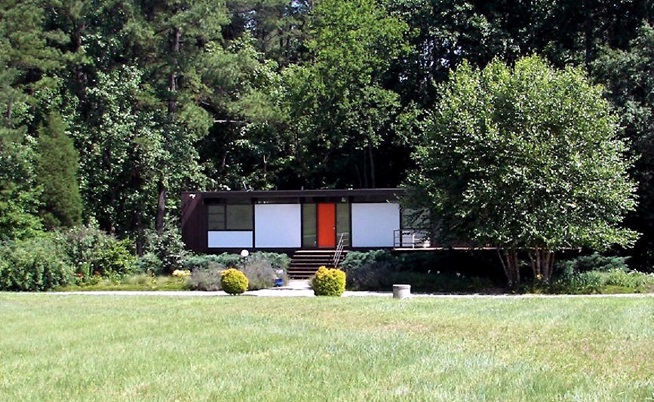
Also available on open house was the wonderful house designed by George Matsumoto for George Poland, a professor of foreign languages and literature at NCSU, in 1954. The house, designed like Matsumoto's own house only on smaller scale, was beautifully sited above Crabtree Valley in Raleigh, but development crowded upon it and threatened to consume it. Poland's heirs worked with Preservation North Carolina in 2001 to find a seller willing to re-situate the house and give it the love it deserved.
Don DeFeo did just that, working with architect Ellen Cassilly to coordinate the move to a new pastoral setting in Durham County, to design modest renovations, and to design a new downstairs.
Now he is selling the house through the Modern Home Network and Preservation North Carolina. What a delight to be able to experience this special jewel box of a house.
Showing posts with label Mid-century modern. Show all posts
Sunday, May 18, 2008
Wednesday, January 16, 2008
Recently speaking
Christine Madrid French is an architectural historian, president of the Recent Past Preservation Network, and, as far as I can tell, the person who has single-handedly kept the bulldozers away from Richard Neutra's remarkable Cyclorama building at Gettysburg National Military Park (so far). Here, she gives an interview for the Next American City Project.
Related: Berkley Square, a neighborhood in West Las Vegas built after World War II and marketed to African Americans, has recently been noted for its historic value. "The community has expressed much interest in its past, and the Historic Preservation Commission is excited about the prospect of designating this historically rich African American neighborhood."
Sunday, December 23, 2007
Thursday, December 20, 2007
Modern chairs
As noted by the NYT's personal shopper: "A number of midcentury modern chairs that have long been out of production — some of them for decades — are being produced again, some by new manufacturers."
Not to be confused with Modern Skirts.
Sunday, October 07, 2007
Fallingwater in 3-D
Via Greenespace reader Justin Watt, a most amazing computer-animated video, etc. of the construction of Fallingwater from the ground up.
Amazing.
Amazing.
Monday, September 24, 2007
Endangered: Paschal House, mid-century treasure
"I personally think this is, flat out, the greatest modern house in North Carolina," says Raleigh architect Frank Harmon about the house built in 1950, designed by James Fitzgibbon for George and Beth Paschal.
It happens to sit on seven developable parcels in inside-the-beltline Raleigh.
The family recognizes the importance of the house, which is on the National Register; but they are asking $5.6 million. Preservation North Carolina is on a rescue mission--would be willing to sell off parts of the property if the house could be preserved.
See photo gallery for an idea of what could be lost.
It happens to sit on seven developable parcels in inside-the-beltline Raleigh.
The family recognizes the importance of the house, which is on the National Register; but they are asking $5.6 million. Preservation North Carolina is on a rescue mission--would be willing to sell off parts of the property if the house could be preserved.
See photo gallery for an idea of what could be lost.
Tuesday, August 21, 2007
"A is for Architecture"
George Smart's mother, Ann Seltman Smart, was an accomplished radio personality in Raleigh in the 1950s, one of the first women broadcasters in North Carolina. In the 1960s, for UNC-TV, she produced this great 20-minute documentary film on North Carolina architecture. What a wonderful period piece from a time when architecture looked forward and North Carolina was where it was happening. We look back at the 60s and wonder how they could have made so many mistakes, how we ended up with all this sprawl. What gets forgotten is that they were trying, at least the best of them were, to "design for living" in all the right ways. What's painfully evident from this production is that architects considered themselves urban planners. I don't know exactly when or why architects retreated from the front lines of planning and building. We don't look to architects to be planners any more. Architecture is for the few who can afford it and who care to ask for it. This film is from another time.
So, watch the film; then watch this 7-minute video that George has produced as part of his nomination of his mother to the North Carolina Broadcasters Hall of Fame. Clearly she deserves to be there!
Thursday, August 09, 2007
Triangle Modernist Houses
Thank goodness, George Smart has taken all of his impressive research on the modernist architects of the Raleigh, Chapel Hill, and Durham region and has launched a web site. Writes George by way of introduction,
In January of 2007, I typed "Raleigh modernist architecture" into Google and began learning about our tiny universe of cool houses and their ardent admirers. A cataloguer at heart, I could not resist the urge to learn and index as many as I could, visiting almost all of them or at least talking with their owners over the next six months. This webpage is the result of my local investigative research. I also included some others I particularly like from outside the area. These houses truly rock, if you are into this kind of thing...
...which I learned, sadly, that most people aren't. The failure of modernist design to catch on with homebuyers is staggering. Except in rare cases, like the neighborhood of Arapahoe Acres in Englewood, Colorado, these unconventional houses are considered slightly treasonous anomalies to the predictable homeowners association mindset.
All too true, but it's also true that many people are interested in this architecture--I hear from them from all over the place, via this blog, all the time. In Charlotte, the real estate community is catching on: there's at least one real estate agent who markets these houses for their historic architectural value.
It would be a great niche market for someone in Chapel Hill.
In January of 2007, I typed "Raleigh modernist architecture" into Google and began learning about our tiny universe of cool houses and their ardent admirers. A cataloguer at heart, I could not resist the urge to learn and index as many as I could, visiting almost all of them or at least talking with their owners over the next six months. This webpage is the result of my local investigative research. I also included some others I particularly like from outside the area. These houses truly rock, if you are into this kind of thing...
...which I learned, sadly, that most people aren't. The failure of modernist design to catch on with homebuyers is staggering. Except in rare cases, like the neighborhood of Arapahoe Acres in Englewood, Colorado, these unconventional houses are considered slightly treasonous anomalies to the predictable homeowners association mindset.
All too true, but it's also true that many people are interested in this architecture--I hear from them from all over the place, via this blog, all the time. In Charlotte, the real estate community is catching on: there's at least one real estate agent who markets these houses for their historic architectural value.
It would be a great niche market for someone in Chapel Hill.
Tuesday, March 06, 2007
Chapel Hill, backward and forward
At last night's Town Council meeting, we authorized an agreement with Preservation North Carolina for a historic preservation easement on the old Library Building, 523 East Franklin Street, now home to the Chapel Hill Museum. This was the result of my petition from 2005. At the time I blogged about the local significance of this building, designed by Don Stewart. I'm thrilled that this distinctive and important example of mid-century modern architecture in Chapel Hill will be preserved for future generations.
And will there ever be lots of Chapel Hillians in the future! We also discussed the draft Durham-Chapel Hill-Carrboro MPO 2035 Long-Range Transportation Planning Organization Socio-Economic Projections. Chapel Hill's population is expected to grow by 55 percent in that time (with jobs growth of 107 percent), to about 80,000. How accurate are these numbers? So far with their crystal ball, says planner David Bonk, they've been accurate to +/- 10 percent.
Saturday, February 24, 2007
Raleigh Modern: Catalano House
Not all mid-century modern houses in Raleigh have fared as well as the Fadum House. Without a doubt, the most serious loss has been the Catalano House, demolished six years ago.

How could that have happened? Mid-century modern fan George Smart of Durham wanted to know, and so he investigated. Here's his report.

How could that have happened? Mid-century modern fan George Smart of Durham wanted to know, and so he investigated. Here's his report.
1954 - Eduardo Catalano House, perhaps the coolest house ever designed in North Carolina. 1467 Ridge Road, Raleigh.
Catalano, an Argentinian architect who taught at NCSU's School of Design, drew this 1700 sf home for himself but only lived there a few years. The design was highly publicized as the "House of the Decade" by House and Home magazine in the 1950s and was praised by the rarely praising Frank Lloyd Wright. As with most modernist houses in Raleigh, it was built by Frank Walser. The Catalano House was sometimes referred to as the "Potato Chip" house because of the swooping hyperbolic paraboloid roof.
Catalano sold it to engineer Ezra Meir and his wife Violet in September of 1957. The Meirs sold it to William and Bettie Hinnant in December of 1966. The Hinnants sold it to Raleigh attorney Arch E. Lynch, Jr. in May of 1978. Lynch lived there until approximately 1996. From 1996 to 2001, the house was unoccupied. Vandals, storms, lack of heat, and neglect made the house rapidly deteriorate. The roof rotted in sections over time. It would have taken tens of thousands of dollars to repair, if repair were even possible. Eventually the damage was too extensive to repair.
Preservation North Carolina bought an option on the house and tried unsuccessfully to sell it for $360,000 to anyone who would rebuild the same design. Lynch sold it to JBar Associates in March of 2001. The house was destroyed later that year. JBar, owned by Andrew Rothschild and Jonathan Bluestone, have since built two large houses on the property.
Shortly after its destruction, Catalano lobbied to have just the roof rebuilt on the grounds of the NC Museum of Art, which they declined. In early 2005, he proposed a gift of $1.5M rebuild the roof as part of a central campus Pavilion plan but strong faculty opposition caused him to withdraw, despite the fact NCSU hired an architectural firm to evaluate seven other alternative sites.
Saturday, February 17, 2007
Raleigh Modern: Fadum House transformed
Last June, I blogged about the Fadum House as one stop on Preservation North Carolina's tour of modernist architecture in Raleigh. It was in the midst of an expansive, sympathetic addition/renovation. Here's what it looked like then, from the rear. (More pics.)

Now finished, it's featured in today's N&O. (More pics.) "The original house, along with the handful of other modernist residences left in the city, is one of the last vestiges of a promising post-war Raleigh that bloomed but never flourished," writes Richard Butner. Being not so big houses, even very fine examples of the houses of this period can end up as teardowns.
They are small houses, and yet there are those who love them. Largely because of my June blog series, I hear right along from folks who do (including Richard Butner, who I hope will keep on writing about Raleigh's mid-century treasures). One woman wrote from Washington, N.C. to say she was looking for a mid-century modern house anywhere in the state, or the country. She said she'd called a Chapel Hill real estate agent who promptly tried to talk her out of the "ranch house," the only term in her vocabulary for what she interpreted to be this woman's interest. We experienced a similar bias when we were looking for our own house. What will it take for the agents to get a clue? (They're clued in Charlotte.)
Ruth Little's book on Chapel Hill architecture has a whole chapter on mid-century design in Chapel Hill. Will that advance the conversation?
Meanwhile over in Raleigh, the new owners of the Fadum House are setting an example for preservation, in both senses. The pine trees that were cut for the expansion were put to work as flooring and paneling.

Now finished, it's featured in today's N&O. (More pics.) "The original house, along with the handful of other modernist residences left in the city, is one of the last vestiges of a promising post-war Raleigh that bloomed but never flourished," writes Richard Butner. Being not so big houses, even very fine examples of the houses of this period can end up as teardowns.
They are small houses, and yet there are those who love them. Largely because of my June blog series, I hear right along from folks who do (including Richard Butner, who I hope will keep on writing about Raleigh's mid-century treasures). One woman wrote from Washington, N.C. to say she was looking for a mid-century modern house anywhere in the state, or the country. She said she'd called a Chapel Hill real estate agent who promptly tried to talk her out of the "ranch house," the only term in her vocabulary for what she interpreted to be this woman's interest. We experienced a similar bias when we were looking for our own house. What will it take for the agents to get a clue? (They're clued in Charlotte.)
Ruth Little's book on Chapel Hill architecture has a whole chapter on mid-century design in Chapel Hill. Will that advance the conversation?
Meanwhile over in Raleigh, the new owners of the Fadum House are setting an example for preservation, in both senses. The pine trees that were cut for the expansion were put to work as flooring and paneling.
Thursday, November 16, 2006
The onetime future of flight
A 1960s-era commercial for the Braniff SST . . . plus promos with two colorful fellows (Andy Warhol and Salvador Dali).
Commentary from Boing Boing.

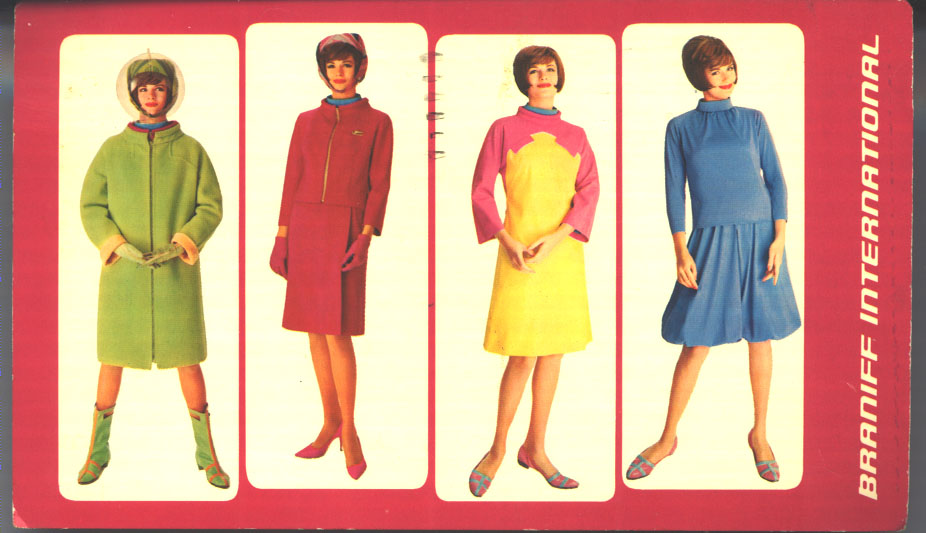
High Fashion Quick Change
"Braniff International airline hostesses are outfitted in a couture collection by Emilio Pucci. They can make four changes in a single flight." (From the Greene collection of vintage post cards.)
Commentary from Boing Boing.

High Fashion Quick Change
"Braniff International airline hostesses are outfitted in a couture collection by Emilio Pucci. They can make four changes in a single flight." (From the Greene collection of vintage post cards.)
Saturday, October 30, 2004
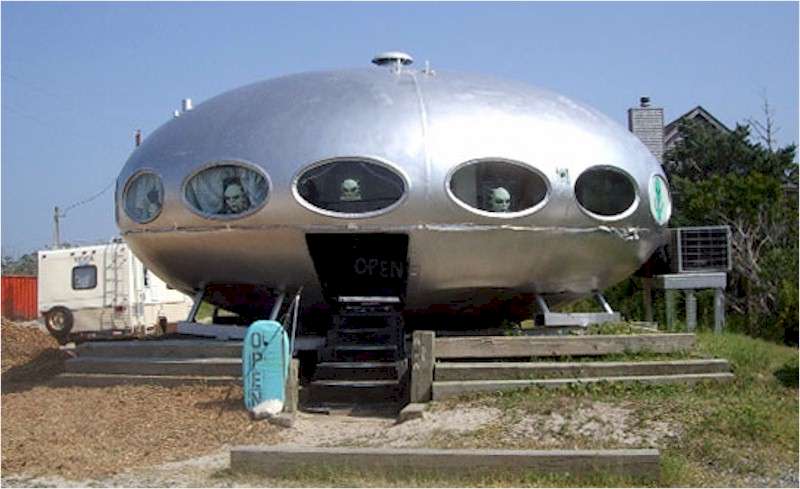
Sometimes you just have to get away from it all
For years this module has been on Hatteras, poised for sudden departure. I'm thinking tonight would be a good time, during Hallowe'en's witching hour.
Hey Mr. Spaceman?
Subscribe to:
Posts (Atom)