Paul has a lovely write-up of his trip to India in the latest Red Hat Magazine.
On video: 8 minutes of Paul with the Software Freedom Law Center's lawyer Eben Moglen.
Thursday, November 30, 2006

Wednesday, November 29, 2006
Superheros young and old
In Durham, a four-year-old "snuck into his bedroom, dressed himself in a Power Ranger costume and armed himself with a plastic sword," police said. "The child then exited his room and approached the armed suspect, in an attempt to protect his family." He succeeded. "He fully believed he morphed," said his aunt.
Meanwhile in Columbia, S.C., a 63-year-old comic book illustrator died wearing Superman pajamas.
Meanwhile in Columbia, S.C., a 63-year-old comic book illustrator died wearing Superman pajamas.
Tuesday, November 28, 2006
Go take a hike.
The $1.95 death sentence, and other neglected stories
Via Eric Muller: new Legal History Blog by Mary Dudziak, author of the great book Cold War Civil Rights: Race and the Image of American Democracy. She's posted a link to her own recent essay "The Case of 'Death for a Dollar Ninety-Five': Finding America in American Injustice," which is beautifully written and worth reading.
Sounds a little like John Grisham's new book, a nonfiction story that came out of a New York Times obit he read of a man who faced a combination of negligent prosecution and incompetent defense counsel, then thanks to better lawyers and DNA evidence was spared the death penalty and walked out of prison a free man. After that, he drank himself to death.
Related, as Dudziak notes: the Triangle Legal History Seminar. Eric is speaking this Friday.
This is a story about a case long forgotten. It was a case that needed to be forgotten, to safeguard the meaning of American justice. The case of "Death for a Dollar Ninety-Five" began one July night in Marion, Alabama, in 1957, and soon captured the attention of the world. It involved an African American man, a white woman, and the robbery of a small amount of change late in the evening. The conviction was swift and the penalty was death. International criticism soon rained down on the Alabama Governor and the American Secretary of State, leading to clemency and a life sentence. For $1.95. And the case was forgotten. This story helps us to see the way narratives of American justice and injustice are managed. The United States identifies itself with the rule of law, and so miscarriages of justice are often perceived as breaches in that identity, violations of the nation's own core principles. Resolutions of miscarriages of injustice, this paper will argue, are often about repairing a breach in American identity, making America whole again. What happens to the person at the center of the story is, at best, secondary. For the story to turn out right, the nation is restored, and the person is forgotten.
Sounds a little like John Grisham's new book, a nonfiction story that came out of a New York Times obit he read of a man who faced a combination of negligent prosecution and incompetent defense counsel, then thanks to better lawyers and DNA evidence was spared the death penalty and walked out of prison a free man. After that, he drank himself to death.
Related, as Dudziak notes: the Triangle Legal History Seminar. Eric is speaking this Friday.
Monday, November 27, 2006
A test of trust
Would you trust your fellow drivers to obey the rules of the road with nary a sign or a signpost?
European traffic planners are dreaming of streets free of rules and directives. They want drivers and pedestrians to interact in a free and humane way, as brethren -- by means of friendly gestures, nods of the head and eye contact, without the harassment of prohibitions, restrictions and warning signs.
. . .
Psychologists have long revealed the senselessness of such exaggerated regulation. About 70 percent of traffic signs are ignored by drivers. What's more, the glut of prohibitions is tantamount to treating the driver like a child and it also foments resentment. He may stop in front of the crosswalk, but that only makes him feel justified in preventing pedestrians from crossing the street on every other occasion. Every traffic light baits him with the promise of making it over the crossing while the light is still yellow.
. . .
The new traffic model's advocates believe the only way out of this vicious circle is to give drivers more liberty and encourage them to take responsibility for themselves. They demand streets like those during the Middle Ages, when horse-drawn chariots, handcarts and people scurried about in a completely unregulated fashion. The new model's proponents envision today's drivers and pedestrians blending into a colorful and peaceful traffic stream.
Airport to MLK: one for the books
Back during the long deliberations over the change of the name of Airport Road to Martin Luther King Jr. Boulevard, I found the work of cultural geographer Derek Alderman, who has made a scholarly specialty out of studying MLK road name changes, useful in putting the request into a larger context. Latest on his list of publications now is an essay (.pdf) in the collection Landscape and Race in the United States, edited by Richard Schein. In the essay, "Naming Streets for Martin Luther King Jr.: No Easy Road," he discusses the Chapel Hill process:
Later in discussing specifically why the King commemoration has come to focus on roads, and not, say, libraries or parks or schools, Alderman quotes yours truly:
It's been a year and a half since we dedicated our own Martin Luther King Jr. Boulevard. It's going to be longer than that before we see his values thoroughly reflected in Chapel Hill. But it was a significant step with more than token meaning.
Speaking of King, the sixth volume of his collected papers will be out this spring. Writes Ralph Luker, "This volume is of special interest because it includes material – many sermons and speeches, some letters -- that Coretta Scott King long delayed making available to the King Project. It is a large part of what was recently purchased for $32 million by an Atlanta trust. . . . Until now, much of the material in this volume has never been closely read by King scholars."

In representing the street-naming issue as divisive, some whites have suggested that King--because of his legacy as a peacemaker--would not have wanted his commemoration characterized by racial conflict. For example, street-naming opponents in Chapel Hill, North Carolina, argued this point when they called on black leaders to rename a park, library, or school for King rather than the controversial Airport Road. Black supporters such as Michele Laws countered with King's own words: "The ultimate measure of a man is not where he stands in moments of comfort and convenience but where he stands in times of challenge and controversy." These attempts by some whites to represent the civil rights leader's image as nonconfrontational is, according to Michael Eric Dyson, part of a larger national amnesia about King's true legacy. According to Dyson, most of America chooses to remember King as the "moral guardian of racial harmony" rather than as a radical challenger of the racial and economic order. In this respect, the politics of street naming are not just about black Americans establishing the legitimacy and resonancy of King's achievements but also about wrestling away control of his historical legacy from conservative whites, who have appropriated his image to maintain the status quo rather than redefine it.
Later in discussing specifically why the King commemoration has come to focus on roads, and not, say, libraries or parks or schools, Alderman quotes yours truly:
Under Jim Crow laws, blacks had a hard time just making a road trip. They had to pack their own food, even their own toilet paper, for they didn't know if they would find a restaurant that would serve them or even a gas station where they could use the bathroom. . . . Mobility, the freedom to travel the public roads without fear and with assurance that you got what you needed--these were the basic goals for King. Thus I can't think of a better way to honor Dr. King than with a road naming.
It's been a year and a half since we dedicated our own Martin Luther King Jr. Boulevard. It's going to be longer than that before we see his values thoroughly reflected in Chapel Hill. But it was a significant step with more than token meaning.
Speaking of King, the sixth volume of his collected papers will be out this spring. Writes Ralph Luker, "This volume is of special interest because it includes material – many sermons and speeches, some letters -- that Coretta Scott King long delayed making available to the King Project. It is a large part of what was recently purchased for $32 million by an Atlanta trust. . . . Until now, much of the material in this volume has never been closely read by King scholars."
Wednesday, November 22, 2006
On this day
When we think of him, he is without a hat, standing in the wind and the weather. He was impatient of topcoats and hats, preferring to be exposed, and he was young enough and tough enough to confront and to enjoy the cold and the wind of these times, whether the winds of nature or the winds of political circumstance and national danger. He died of exposure, but in a way that he would have settled for--in the line of duty, and with his friends and enemies all around, supporting him and shooting at him. It can be said of him, as of few men in a like position, that he did not fear the weather, and did not trim his sails, but instead challenged the wind itself, to improve its direction and to cause it to blow more softly and more kindly over the world and its people.
E.B. White, The New Yorker, November 30, 1963
Tuesday, November 21, 2006
Going nowhere
First it was the Hatteras to Ocracoke ferry that was cancelled, after 8 a.m. today, then later all of them. No ferries to Ocracoke till probably Thursday morning. We were planning to head out tomorrow morning for our annual pilgrimage. But the rain is pretty steady here too, so we might as well make a fire in the fireplace and settle in.
UPDATE 11/23: Landfall at noon today. Happy Thanksgiving.
UPDATE 11/23: Landfall at noon today. Happy Thanksgiving.
"Rewind"
In February 2005, I saw, and blogged about, a most amazing performance given by members of the North Carolina Women's Prison Repertory Company. One of them was Regina Walters. She has completed her prison sentence, and her story is the subject of a new performance, set for December 1, at the ArtsCenter in Carrboro.
The question that the 2005 performance raised for me was this: what are prisons for, punishment or rehabilitation? It seemed that the state was not so interested in rehabilitation. Yet these women, dreadfully sorry for dreadful things they had done, were searching desperately for a way back: to wholeness, to some promise of life after they had paid their proverbial dues. The state was not offering that; but at least this program was. Still I wonder what the state has to offer to Regina Walters and others on their return to society. One of the issues that keeps surfacing in our discussions about homelessness in Orange County is the critical lack of planning and transitional services available to people discharged from prison. (Ex-cons aren't exactly welcomed by employers either.)
Regina Walters will be at the performance for discussion afterward. I hope to be there too.
Hindsight beyond 20/20. "Rewind" traces the steps and missteps that led an enthusiastic cheerleader and talented ballerina to life as North Carolina prison inmate #0423358. Recently released from prison, this former member of the N.C. Women's Prison Repertory Ensemble was incarcerated for 12 years. Now Regina looks frankly at the personal traumas and choices that landed her at 17 in an alley beside a man with a gun and at the challenges and uncertainties of her new life outside.
The question that the 2005 performance raised for me was this: what are prisons for, punishment or rehabilitation? It seemed that the state was not so interested in rehabilitation. Yet these women, dreadfully sorry for dreadful things they had done, were searching desperately for a way back: to wholeness, to some promise of life after they had paid their proverbial dues. The state was not offering that; but at least this program was. Still I wonder what the state has to offer to Regina Walters and others on their return to society. One of the issues that keeps surfacing in our discussions about homelessness in Orange County is the critical lack of planning and transitional services available to people discharged from prison. (Ex-cons aren't exactly welcomed by employers either.)
Regina Walters will be at the performance for discussion afterward. I hope to be there too.
Sunday, November 19, 2006
The march of the mantises
Praying mantises are on the march. Check the "best shot" in today's Chapel Hill News against this picture taken last weekend. (Zoom in for close-ups!)

Since this one was hanging out in the North Carolina Botanical Garden, we assume it was a Carolina mantid.
AE caught a cool one earlier in the season.
Since this one was hanging out in the North Carolina Botanical Garden, we assume it was a Carolina mantid.
AE caught a cool one earlier in the season.
Saturday, November 18, 2006
:-) / :-(
Is your glass half full or half empty?
Stumbling on Happiness, by Harvard psychology professor Daniel Gilbert (son of Larry Gilbert of Chapel Hill), explores the phenomenon of happiness, with results that promise to be surprising. From the excerpt at Amazon:
So happiness and optimism are more complicated than we might think. Turns out, so is pessimism, we learn in Scott McLemee's review of Pessimism: Philsophy, Ethic, Spirit, by Joshua Foa Dienstag.
Related: Paul comes down in favor of happiness, while Kristina in the comments demonstrates that a good gripe can help you get a grip.
Stumbling on Happiness, by Harvard psychology professor Daniel Gilbert (son of Larry Gilbert of Chapel Hill), explores the phenomenon of happiness, with results that promise to be surprising. From the excerpt at Amazon:
Yours [your brain] is nexting right now. For example, at this moment you may be consciously thinking about the sentence you just read, or about the key ring in your pocket that is jammed uncomfortably against your thigh, or about whether the War of 1812 really deserves its own overture. Whatever you are thinking, your thoughts are surely about something other than the word with which this sentence will end. But even as you hear these very words echoing in your very head, and think whatever thoughts they inspire, your brain is using the word it is reading right now and the words it read just before to make a reasonable guess about the identity of the word it will read next, which is what allows you to read so fluently. Any brain that has been raised on a steady diet of film noir and cheap detective novels fully expects the word night to follow the phrase It was a dark and stormy, and thus when it does encounter the word night, it is especially well prepared to digest it. As long as your brain’s guess about the next word turns out to be right, you cruise along happily, left to right, left to right, turning black squiggles into ideas, scenes, characters, and concepts, blissfully unaware that your nexting brain is predicting the future of the sentence at a fantastic rate. It is only when your brain predicts badly that you suddenly feel avocado.
So happiness and optimism are more complicated than we might think. Turns out, so is pessimism, we learn in Scott McLemee's review of Pessimism: Philsophy, Ethic, Spirit, by Joshua Foa Dienstag.
"Optimism," writes Dienstag, "makes us perpetual enemies of those future moments that do not meet our expectations, which means all future moments. It is when we expect nothing from the future that we are free to experience it as it will be, rather than as a disappointment.
Related: Paul comes down in favor of happiness, while Kristina in the comments demonstrates that a good gripe can help you get a grip.
Friday, November 17, 2006
"The ghosts of 1898"
The report of the 1898 Wilmington Race Riot Commission, produced at the direction of the North Carolina General Assembly, is a milstone in the state's history, as I wrote at the time it was published last December. Following the report, in late May, the Commission submitted to the General Assembly a set of recommended compensatory actions. Among them:
The Star-News itself pledged to "work with other state media to address the commission's recommendations."
The special section published today jointly by the Raleigh News & Observer and the Charlotte Observer, and included in today's Wilmington Star-News, responds to this recommendation by bringing the highlights of the report to a broad audience. Wisely, the two papers chose Tim Tyson to write the narrative--not only because he's a great writer and ideally qualified, but also because, as editor Melanie Sill points out, the Raleigh and Charlotte papers were active participants in this sorry history.
UPDATE 11/19: Today's N&O includes interviews with four descendants of players in the event, two white and two black: George Rountree III, Anne Russell, Lewin Manly, and Faye Chaplin. These are important contributions to the story.
The commission recommended that several newspapers - including the Star-News - which reported on the event as it happened, to work with the North Carolina black press association to prepare a summary of the commission report, study the effects of 1898 and impact of Jim Crow on the state's black press and endow scholarships for black journalists.
The Star-News itself pledged to "work with other state media to address the commission's recommendations."
The special section published today jointly by the Raleigh News & Observer and the Charlotte Observer, and included in today's Wilmington Star-News, responds to this recommendation by bringing the highlights of the report to a broad audience. Wisely, the two papers chose Tim Tyson to write the narrative--not only because he's a great writer and ideally qualified, but also because, as editor Melanie Sill points out, the Raleigh and Charlotte papers were active participants in this sorry history.
UPDATE 11/19: Today's N&O includes interviews with four descendants of players in the event, two white and two black: George Rountree III, Anne Russell, Lewin Manly, and Faye Chaplin. These are important contributions to the story.
Lot 5 plans go public
After long negotiations, the Town Council is ready to present the proposed contract with Ram Development Corp. for the public's consideration. A public forum will be held at our regular meeting this coming Monday. As a member of the negotiating team, I'm very happy about where we are. We've remained true to our core principles: we are seeking through a private partner to make the downtown a great place to live--in turn enlivening the Franklin Street corridor for everyone's benefit. The proposal includes significant public space, as we've insisted on, as well as commercial space; Ram will contribute $200,000 toward programming that space. The project's design has been molded into an attractive "soft modernism" through peer review sessions with Marvin Malecha, dean of the College of Design at North Carolina State. Ram promises to invest $671,000 in public art, engaging distinguished artist Mikyoung Kim to lead that effort. The construction will be LEED-certified. Twenty-one of the 137 condo units, or 15 percent, will be permanently affordable, controlled by the Orange Community Housing and Land Trust.
The scope and terms of the proposal have changed over the course of the negotiations--largely due to rising costs to the developer, a real concern not unique to this developer. We are disappointed that the Wallace Deck component is no longer part of the proposal (though we hope that the addition of residential units above the deck can happen someday). We are also disappointed that the Town's initial proposed outlay of $500,000 to pay for underground parking for the affordable condos has grown to a maximum of $7.2 million to buy one entire level--the public level--of the two-level underground parking garage. This money would not be due until the certificate of occupancy for the garage is issued; in other words it would not be advanced with risk that the facility would somehow not be built. Within the context of a development totalling some $75 million, we believe this is a justifiable public investment in a public good.
The redevelopment of this town-owned property (which will continue to be town-owned) in a way that will contribute substantially to the revitalization of the downtown business district has been a Council priority for a number of years. We've been actively working on it for the three years that I've been on the Council. It's an accomplishment to be able to bring the project this far, and all of us look forward to hearing the public's response.
Not unrelated: Also on Monday night the Council will receive the final report of the Inclusionary Zoning Task Force, which I have chaired for the past year, with help from colleagues Cam Hill and Mark Kleinschmidt.
The scope and terms of the proposal have changed over the course of the negotiations--largely due to rising costs to the developer, a real concern not unique to this developer. We are disappointed that the Wallace Deck component is no longer part of the proposal (though we hope that the addition of residential units above the deck can happen someday). We are also disappointed that the Town's initial proposed outlay of $500,000 to pay for underground parking for the affordable condos has grown to a maximum of $7.2 million to buy one entire level--the public level--of the two-level underground parking garage. This money would not be due until the certificate of occupancy for the garage is issued; in other words it would not be advanced with risk that the facility would somehow not be built. Within the context of a development totalling some $75 million, we believe this is a justifiable public investment in a public good.
The redevelopment of this town-owned property (which will continue to be town-owned) in a way that will contribute substantially to the revitalization of the downtown business district has been a Council priority for a number of years. We've been actively working on it for the three years that I've been on the Council. It's an accomplishment to be able to bring the project this far, and all of us look forward to hearing the public's response.
Not unrelated: Also on Monday night the Council will receive the final report of the Inclusionary Zoning Task Force, which I have chaired for the past year, with help from colleagues Cam Hill and Mark Kleinschmidt.
Thursday, November 16, 2006
The onetime future of flight
A 1960s-era commercial for the Braniff SST . . . plus promos with two colorful fellows (Andy Warhol and Salvador Dali).
Commentary from Boing Boing.
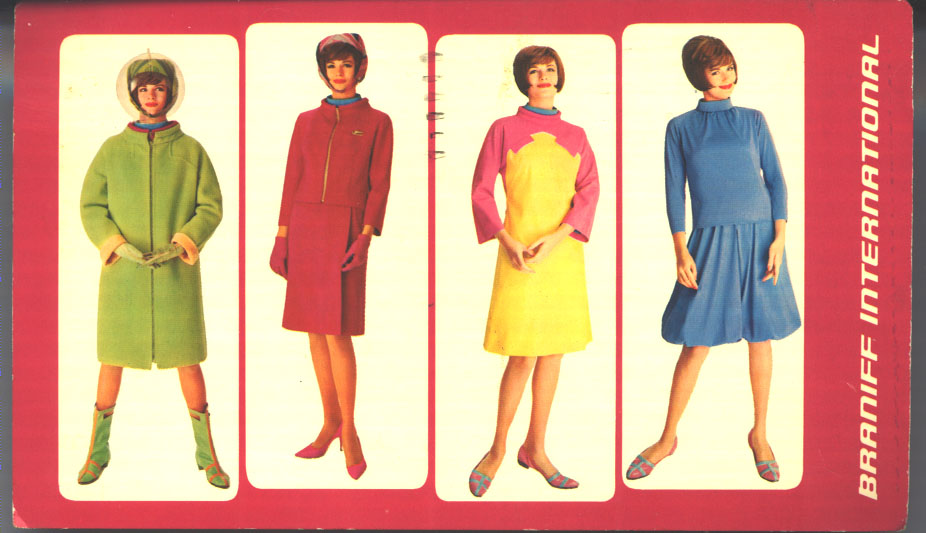
High Fashion Quick Change
"Braniff International airline hostesses are outfitted in a couture collection by Emilio Pucci. They can make four changes in a single flight." (From the Greene collection of vintage post cards.)
Commentary from Boing Boing.
High Fashion Quick Change
"Braniff International airline hostesses are outfitted in a couture collection by Emilio Pucci. They can make four changes in a single flight." (From the Greene collection of vintage post cards.)
Wednesday, November 15, 2006
Jefferson's slaves
A data base documenting over six hundred people owned, at one time or another, by Thomas Jefferson.
Chapel Hill's own Charles Irons contributed to this project.
Chapel Hill's own Charles Irons contributed to this project.
November: focus on homelessness
For the National City Network, November's turn toward winter weather prompts a focus on homelessness.

Photo by Lisa Scheer of a homeless woman's camp in Greensboro.
At a downtown safety forum yesterday morning, sponsored by the Chapel Hill Downtown Partnership, I gave an overview of the Orange County Partnership to End Homelessness. I cited data from the National City Network indicating the broad diversity of the estimated 600,000 people who are homeless in the richest country on the planet:
As I always try to do, I encouraged folks at the forum to think about homelessness from the point of view of being homeless--for I myself find it really a challenge to imagine. When you don't have a home, you essentially don't have a position from which to be heard in the civic sphere, I pointed out, citing, as I have before, the philosopher David Schrader. For Aristotle, the state was made up of households (not roving individuals). The home affords privacy, which is essential to autonomy: "autonomy against the authority of society." The homeless have no defenses and few advocates.
But what people wanted to talk about was not homelessness but its near cousin, panhandling, and the blight it contributes to downtown. Can't we outlaw it even further? some asked. Legally we probably could was my reponse, but that would not make it right. Glad to see the that downtown outreach committee agrees and is choosing instead to work on education and . . . outreach.
UPDATE 11/21: Editorials in the Chapel Hill Herald and the Daily Tar Heel register concern about overregulation of panhandling.
Photo by Lisa Scheer of a homeless woman's camp in Greensboro.
At a downtown safety forum yesterday morning, sponsored by the Chapel Hill Downtown Partnership, I gave an overview of the Orange County Partnership to End Homelessness. I cited data from the National City Network indicating the broad diversity of the estimated 600,000 people who are homeless in the richest country on the planet:
34 percent of homeless service users are members of homeless families
28 percent of homeless persons state that they sometimes or often do not get enough to eat
66 percent of homeless report indicators of alcohol, drug abuse and mental health problems
44 percent of homeless individuals did paid work in the last month
49 percent of homeless individuals are in their first episode of homelessness
As I always try to do, I encouraged folks at the forum to think about homelessness from the point of view of being homeless--for I myself find it really a challenge to imagine. When you don't have a home, you essentially don't have a position from which to be heard in the civic sphere, I pointed out, citing, as I have before, the philosopher David Schrader. For Aristotle, the state was made up of households (not roving individuals). The home affords privacy, which is essential to autonomy: "autonomy against the authority of society." The homeless have no defenses and few advocates.
But what people wanted to talk about was not homelessness but its near cousin, panhandling, and the blight it contributes to downtown. Can't we outlaw it even further? some asked. Legally we probably could was my reponse, but that would not make it right. Glad to see the that downtown outreach committee agrees and is choosing instead to work on education and . . . outreach.
UPDATE 11/21: Editorials in the Chapel Hill Herald and the Daily Tar Heel register concern about overregulation of panhandling.
Tuesday, November 14, 2006
Shearon Harris: NRC hearing
Carrboro alderman Dan Coleman has a brief report of the NRC meeting in Washington yesterday in which NC WARN, SURGE, et al. were allowed to make the case why their petition under sec. 2.206 of the applicable federal regs should be heard. He and I and others were there via conference call. I think what we heard from the NRC hearing board was at least a tacit (if not more) admission that the Shearon Harris facility is out of compliance with the regulations, but that the agency is giving them a pass, for essentially as long as they need, on the promise that they will come into compliance eventually. When the petitioners' attorney John Runkle pointedly accused the NRC of letting Progress Energy call the shots, there was no response. Throughout, Progress had very little to say. "In all, it was not a reassuring hearing," concluded Pete McDowell of NC WARN. It will be interesting to review the transcript (promised by Thanksgiving) in order to follow all the subtle leaps of logic that the board engaged in.
The only encouraging moment was when they said they would consider holding an information meeting here in the Triangle.
The only encouraging moment was when they said they would consider holding an information meeting here in the Triangle.
Sunday, November 12, 2006
The Kelo backlash and the poor
Back in January, while writing about the devastating effects of the so-called "urban renewal" program on Durham's Hayti neighborhood, it occurred to me that the outrage that we already were witnessing (culminating in last week's elections) in response to the Kelo decision was conspicuously missing in the aftermath of Kelo's key precedent: Berman v. Parker, the 1954 Supreme Court decision that authorized cities to enter into wholesale displacement and destruction for the sake of cleaning up "blighted" neighborhoods. (Pointedly, this decision said that non-"blighted" buildings could justifiably be torn down if they were within a "blighted" area. In Durham, this analysis played out in the demolition of a fine old church where Martin Luther King Jr. had spoken.) The ultimate outcome of the "urban renewal" projects that followed this decision was supposed to be improved housing options for the people who were displaced. But as Fitz Brundage writes in his narrative of Hayti, that wasn't what happened in Durham--a story that was repeated many times in other places. Where was the outrage then? I asked in January.
In a new online legal journal/weblog, Northwestern Colloquy (noticed via Balkinization), I find an article that addresses this question in very smart ways:
In a new online legal journal/weblog, Northwestern Colloquy (noticed via Balkinization), I find an article that addresses this question in very smart ways:
This Essay provides a review of the changes in state law following Kelo v. City of New London, and in particular focuses on the dominant reform: the prohibition of economic development condemnations in non-poor areas (which Kelo allows, as a matter of federal constitutional law) coupled with continued allowance for blight condemnations in poor areas. This dominant reform, the Essay argues, privileges the stability of middle-class households over the stability of poor ones, and thus expressively devalues poor people and poor communities in legal and political discourse.
Clyde Jonescoming

On UNC Homecoming weekend, evidence that Clyde Jones was here.
Many more examples of Jones' art. Still more.
The Jonesfest continues at Crook's Corner, where for the month of November his one-dimensional art is on display (along with the few critters that remain in the restaurant's permanent collection).
Last night Paul, Tucker, and I took Dan Gillmor to Crook's. Director of the Center for Citizen Media and author of We the Media, he's in town to speak tomorrow on citizen journalism (sponsored by ibiblio).
Dan and I snagged the last two helpings of Bill Smith's Green Tabasco Chicken, which is included in Food & Wine magazine's 2006 Best of the Best: The Best Recipes from the Best 25 Cookbooks of the Year. (From Smith's Seasoned in the South.) Topped it off with persimmon pudding.
Subscribe to:
Posts (Atom)