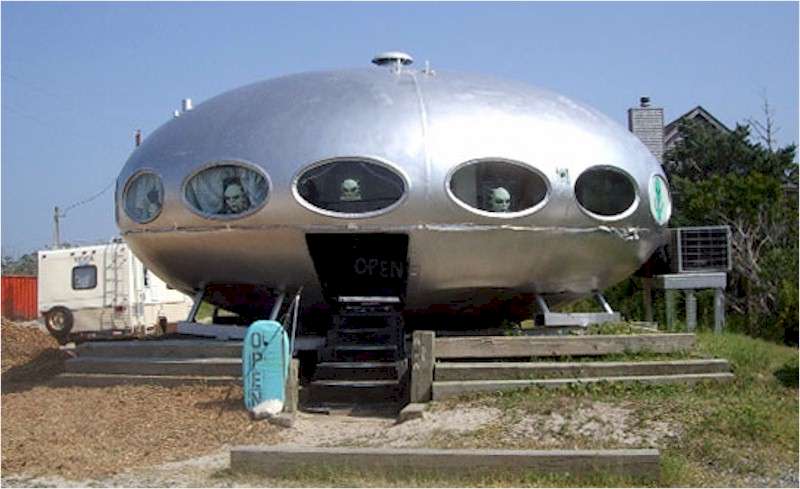
For years this module has been on Hatteras, poised for sudden departure. I'm thinking tonight would be a good time, during Hallowe'en's witching hour.
Hey Mr. Spaceman?
Our support for Bush is tempered by unease over the poor choices and results of his first term. To succeed in his second-term, Bush must begin by taking responsibility for U.S. failures in Iraq, admit his mistakes and adjust U.S. strategy. Big time, as his running mate might say.
The Post's endorsement of George W. Bush is one of the best condemnations of his administration that I've seen. It's a grand litany of failures, all of which you acknowledge. Rereading the article carefully, I found one positive word about Bush: "decisiveness."Then there's the wobbly Salt Lake Tribune:
Decisiveness? This man decided to invade Iraq, cut taxes, loosen environmental laws, suppress stem-cell research, etc., long before he became president, and never changed his mind nor admitted any mistake in face of manifest evidence, and never will. And in face of this stubbornness, you offer suggestions that he should do all things differently in his second term, expecting, I suppose, that he will, and therefore you endorse him.
Incomprehensible.
Tribune readers know that this newspaper has been consistently critical of a number of the president's policies, particularly his war in Iraq, his tax cuts for the rich and his abysmal environmental record.
Each country that plunges into nightmare--whether Germany under Hitler, the Soviet Union under the Bolsheviks, Chile under Pinochet, or, for that matter, Iraq under Saddam Hussein--travels there along its own path. The American political system--based on free elections, the rights of citizens, and the rule of law--is, though under the severest pressure, still available for use. If it is lost, and the full American nightmare descends, there will be many causes. They will include the militarization of foreign policy, global imperial ambition, the loss of balance among the branches of government, the erosion of civil liberties, and the overwhelming influence of corporate money and power over political life--all present before Osama bin Laden made his appearance. But at every step of the way the skids will be greased by the national capacity, conferred by the media and exploited by politicians, to produce and consume illusion, which, though hardly an American monopoly, may be the specific form of corruption most dangerous to American democracy.

Across their tables they fixed it up,
Behind their doors away from the mob.
And the guns did a job that nicked off millions.
The guns blew seven million off the map.
The guns sent seven million west.
Seven million shoving up the daisies.
Across their tables they fixed it up,
The liars who lie to nations.
[P]olitical action by scientists has not been so forceful since 1964, when Barry Goldwater's statements promoting the deployment of battlefield nuclear weapons spawned the creation of the 100,000-member group Scientists and Engineers for Johnson.
This year, 48 Nobel laureates dropped all pretense of nonpartisanship as they signed a letter endorsingSenator John Kerry. "Unlike previous administrations, Republican and Democratic alike, the Bush administration has ignored unbiased scientific advice in the policy making that is so important to our collective welfare," they wrote. The critics include members of past Republican administrations.
Under the Bush administration, he said, "they're picking and choosing information according to the answer that they want to get, and they've appointed so many people who are just focused on this that they really are having an impact on the day-to-day flow of information."
Believing, it seems, is more important to the President than the substance of his belief. Jesus Christ's particular teachings--well, those are good, too. But what really matters is that if you believe you can do something, you can.
I don't want to make PowerPoint the motor for an apocalyptic future. But it's part of a general trend. It's one element among others that keep us from complexity. We face a very complex world. History is quite complex. Current events and literature are complex. Students are thinking and doing presentations on complicated things, and we need them to be able to think about them in complicated ways.
PowerPoint is not a step in the right direction. It's an exemplar of a technology we should be quite skeptical about as a pedagogical tool.
The oldest Court House in North Carolina, [it] is an architectural gem of national reputation. A sketch of its life reads like a panoramic review of the life of North Carolina: the hardships of the early colony, the struggles of revolution, civil war and reconstruction; all finally unfolding into the commonwealth that is the Old North State of today. Through six conflicts the call to arms has resounded within its walls; it can recall the inauguration of every President of the United States; Governors from the time of Josiah Martin have spoken from its rostrum; Princes and Presidents have danced on its floors and the most illustrious lawyers of the State have pleaded their causes before its bar.

