Sunday, June 25, 2006

A science fiction story, sadly open-ended

About a year ago, at Wired magazine's NextFest on the Navy Pier in Chicago, Paul and I met the late Philip K. Dick, the science fiction writer. He was not a ghost, but he was a high-functioning simulation, which puts him very close to the real thing, at least in the special case of Philip K. Dick. We found him most engaging.

philip k dick

Since then, Mr. Dick has lost his head. Rather, his creator lost his head. He accidentally left it in an overhead compartment as he was changing planes back in December on his way to San Francisco. It was retrieved and sent on to him on the next flight, supposedly, but it never arrived and has not turned up yet.

Here's hoping for a happy ending to this true-life science fiction thriller.

Saturday, June 24, 2006

Friday, June 23, 2006

The roots of tradition

The Raleigh Christian group Called2Action, which last year packed Town Hall to urge us to open our "hearts and minds . . . to hearing the Truth" about gay rights, is lobbying the General Assembly to require the daily recital of the Pledge of Allegiance in public schools. Ed Cone has noticed the interesting discussion started by "Anglico" at BlueNC.

Anglico uses a great cartoon to show that this issue asks us to think about what conservatives mean by "tradition." (Click to enlarge.)

traditional pledge

Justice Scalia is a big one for tradition. He is also an originalist, which would seem to put him in conflict with himself, but in his own mind he has the two ideas knitted together:

If the text is ambiguous, yielding several conflicting interpretations, Scalia turns to the specific legal tradition flowing from that text -- to "what it meant to the society that adopted it." "Text and tradition" is a phrase that fills Justice Scalia's opinions. Judges are to be governed only by the "text and tradition of the Constitution," not by their "intellectual, moral, and personal perceptions."


But as Jack Balkin has pointed out recently ("Deconstruction's Legal Career," Cardozo Law Review, November 2005), as interpretive traditions go, "tradition" can be as slippery as anything else.

It turns out that "tradition" comes from the same word as "betrayal." Both involve a handing over. Claiming to speak in the name of tradition can also be a kind of betrayal in several different ways. First, traditions are often contested. Hewing to one particular vision of tradition obliterates other interpretations of the past and other alternatives for the future. Tradition never speaks with one voice, although, to be sure, persons of particular predilections may hear only one. In this way, a tradition can be a kind of extradition, banishing other perspectives and handing them over to their enemies, so to speak. Second, to respect tradition is also to betray, submerge, and extinguish other existing and competing traditions. It can lead us to focus on a falsely unitary or unequivocal story about the meaning of the past when we should recognize the past as a complicated set of perspectives in tension with each other. Finally, to act in the name of a tradition is often to betray the tradition itself, by disregarding the living, changing features of a tradition and substituting a determinate and lifeless simulacrum.


More Balkin here (1990 article on the same theme).

Thursday, June 22, 2006

"Nothing beside remains . . ."

From a great poem:

Nothing beside remains: round the decay
Of that colossal wreck, boundless and bare,
The lone and level sands stretch far away.


These pictures from southern Mississippi before and after Katrina will give you pause. They're from a book published by the Sun Herald of Biloxi.

Wednesday, June 21, 2006

Among (white) men

Virtually all day yesterday and today, plus dinner last night and a public hearing tonight, I've been involved with Town Council interviews of our three finalists for town manager. Since the only other female council member has been unable to attend all but a fraction of the day sessions, and since the candidates are all white men, I've often been the only woman in a crowded room. It's all white men except for my colleague Bill Thorpe. I'm used to working with men, but this was a palpable distinction.

I wasn't on the council subcommittee that recommended our three finalists, and I was disappointed that a woman or minority was not among them, but I trust their judgment when they say that these three were significantly ahead of the pack. I wonder if it isn't self-perpetuating--women not being promoted, and so unable to make their mark and show their wonderful qualifications. But when it comes time to evaluate resumes and references, it's hard to justify taking a chance on someone who doesn't have the experience. It's a dilemma. I don't know the answer.

We did, however, end up with three very qualified candidates. Our decision will not be easy. It's of some interest to note that all three of them come from cities more demographically diverse than Chapel Hill: Elgin, Illinois; Aurora, Colorado; Fayetteville, N.C.

Meanwhile, Portland and Seattle are getting whiter. It feels as if Chapel Hill is too--and for the same reasons.

UPDATE from Mark Kleinschmidt: And they're all straight too.

Tuesday, June 20, 2006

Downsizing the Dream

Sarah Susanka starts off The Not So Big House with a story about a couple who came up to her after one of her lectures. They'd spent over $500,000 for a house that they hated. "All we've got is square footage with no soul," they said. Of course, the book is a few years old, or maybe they just didn't live in Chapel Hill. Either way, the price seems low for what they are describing.

In my neighborhood, the houses in a new development are priced upwards of $750,000. This one could be yours for $1.4 million.

But it has been on the market for over a year--possibly a sign of a trend indicating that more people are thinking like that couple that spoke with Susan Susanka. Says the Wall Street Journal,

The golden age of McMansions may be coming to an end. These oversized homes _ characterized by sprawling layouts on small lots, and built in cookie-cutter style by big developers _ fueled much of the housing boom. But thanks to rising energy and mortgage costs, shrinking families and a growing number of retirement-age baby boomers set on downsizing, there are signs of an emerging glut.

Sunday, June 18, 2006

Greene County ramble

I'd never been to Greene County, even though I'd spent a good bit of time a few years ago on two appellate briefs that helped folks there keep a regional landfill at bay. I've kept up with Frank Warren of Snow Hill ever since, and finally it seemed time for a visit.

Paul and I went down yesterday. It was a good time, because we got to attend a quarterly regional meeting of the North Carolina Environmental Justice Network. The meeting was held in the Greene County Community Center, where the walls are lined with photos of graduating classes of the all-black South Greene High School through 1969.

At least those pictures are still around, said Gary Grant, meeting facilitator. He remembered when his black high school was turned into a different facility in an integrated system, all of the class photos, trophies, everything was hauled into the dumpster. (I can't think of an example where the black high school became the system's high school. Did it ever happen?)

Greene County people recalled what it took to win their battle against the landfill that their county commissioners were determined to bring in. It was what you might expect: patience and persistence. Having the law on their side helped. But ultimately this kind of decision is political. The real change happened when constituents managed to change the mind of just one commissioner. The tide could turn again, though.

We next heard from the Citizens for a Safe and Vibrant Community on their May 16 rally in Sandyfield, Columbus County, in opposition to a landfill proposed to go in between Sandyfield and East Arcadia, two African American communities. Some 250 strong, the protesters had planned to attend the Sandyfield Town Council meeting after the event. But they found a sign at Town Council saying "Closed until further notice."

As I've noted before, landfills are a growth industry in North Carolina. There is some hope of a moratorium out of the current legislative session. Nicole Stewart of the N.C. Conservation Network gave a workshop on how to communicate with local and state officials. Now is the time.

After the meeting, Frank Warren humored us by driving us around the town and county. There's an unusual brick Rosenwald School just down from the Community Center where we were; then the central Snow Hill residential district, which like the school is on the National Register, as is the nearby St. Barnabas Episcopal Church. We rambled out to where the regional landfill is not located (at least not yet) and beyond, even to Maury to see the new maximum-security prison, the county's third, sited under questionable circumstances.

Greene County like all of eastern North Carolina has become a dumping ground (I haven't even mentioned the hog farms). What's it going to take to turn things around?

Wednesday, June 14, 2006

Council actions: art, peace and justice

See my Chapel Hill Town Council colleague Mark Kleinschmidt's two nice posts about significant actions we took Monday night: becoming perhaps the first community in the nation to create a comprehensive master plan for public art; and giving the name Peace and Justice Plaza to the important civic space in front of the old Post Office on Franklin Street.

With Mark I served on the steering committee to develop the art master plan. Consultant Gail Goodwin served us well, enabling us to imagine all sorts of ways in which art could be worked into the very fabric of the town--and setting us up with a blueprint from which, over time, we can make it happen.

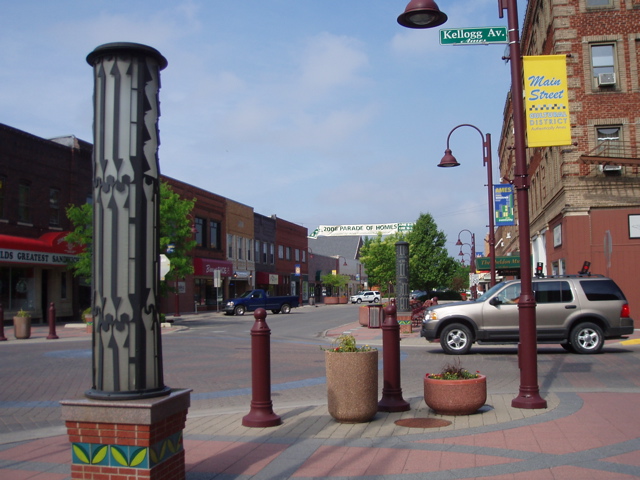
ames streetscape
Ames, Iowa: downtown streetscape with sculptural light fixtures. Ames has had a public art program since 1990--the first community in the country to do so.

On the plaza, I chaired the council naming subcommittee's discussion of recommendations that came out of a request. We were asked to name the space in front of the old Post office, the traditional site for protests and vigils, for Joe and Lucy Straley and Charlotte Adams, three people who spent countless hours over many years there making their voices heard. The issue the Council faced was whether to name the space Straley-Adams Plaza (or some such) or to name it, as we ultimately did, for ideals that their work stood for, while also having them be honored by name at the site with a plaque: a plaque that would allow for honoring other citizens at future times. Good arguments could be made for either, but I believe we made the right decision. I've been thinking in new ways about the very idea of a governmental body naming anything after any individual ever since reading a fascinating article by Ann Bartow of Feminist Law Professors. In "Trademarks of Privilege: Naming Rights and the Physical Public Domain" (forthcoming, UC Davis Law Review), she essentially questions whether the government should ever be in the business of naming:

This paper critiques the branding and labeling of the physical public domain with the names of corporations, commercial products, and individuals. It suggests there are under-recognized public policy conflicts between the naming policies and practices of political subdivisions, trademark law, and right of publicity doctrines. It further argues that naming acts as currently constituted are often undemocratic and unfair, constitute illegitimate private appropriation of public assets, and constitute a limited form of compelled speech. It concludes by considering alternative mechanisms by which the names of public facilities could be chosen.


Bartow's suspicions are aligned with those Sanford Levinson, who argues that, through their authority to name facilities and narrate events, government bodies slip from hosting a "marketplace of ideas" into engaging in direct (but not necessarily democratic) political discourse. Although I believe our Council is as responsive as we can be to the requests of our constituents, and that we can and do work within processes that are democratic, I see what the danger is. Accordingly, I think we need to treat naming requests carefully.

I'm very happy that we will honor Joe and Lucy Straley and Charlotte Adams by commemorating their contributions to the community--at Peace and Justice Plaza.

Tuesday, June 13, 2006

This view will soon be history.

raleighstreet

If you recognize this scene, probably you've spent enough time in your car here (no left arrow; light cycle delay) to meditate upon the way the ivy overflows the stone walls, the way the walls themselves are bending toward you under the slow pressure of the ivy and the earth and the roots of the tall old trees, which too are bending lovingly toward each other and, imperceptibly more and more with the passage of time, toward your car.

What UNC officials have come to see here is an occasion for an "emergency repair." By way of courtesy review with the Historic District Commission last week, historic preservation manager Paul Kapp and landscape architect Jill Coleman outlined the scope of the upcoming project.

On June 19, it will begin: the road will be closed, and for a number of weeks. (Find an alternate route.) The stone walls will be dismantled. Four trees, identified as diseased, will go. The banks will be aligned vertically. "Soil nails" will be used to train the earth to stay put. Concrete ("shotcrete") will be applied. The old stones will be put back in place, but hereafter the walls will be stone veneer, no longer shouldering the old responsibility.

The tall dying trees will be replaced, and as more tall old trees die, they too will be replaced: with smaller trees, most likely flowering fruit. It is contemplated that farther back from the bank, on both sides, additional tall-growing trees will be planted--so that someday travelers here will observe a "layered" effect. It will, we are told, be quite lovely in the spring.

It makes so much sense, but let us mark a loss. This familiar corridor will never be quite the beautiful happenstance, the touchstone of layers of university history, that it is now. Go take a look. You have less than a week.

Monday, June 12, 2006

Saturday in Saxapahaw

As Paul reports, we spent a delightful Saturday evening in Saxapahaw listening to Django Haskins

haskins

and picking a flower

flowers

and bringing it home.

flower

Saturday, June 10, 2006

Chapel Hill Modern

fleming
Photo: Roland Giduz for Chapel Hill News Leader, 1954; North Carolina Collection, UNC-Chapel Hill

fleming
Photo: Barbara Wishy for Preservation North Carolina, 2003

A follow-up tour of mid-century modern structures in Chapel Hill wouldn't be hard to get up. Terry Waugh designed this house for Dr. William and Bea Fleming. There are four other Waugh houses in the same block and numerous others in town. A West Coast influence was brought to Chapel Hill by architect/planner Jim Webb, whose practice included Don Stewart and others. Stewart designed the old Chapel Hill Library building, for which the town is in the process of negotiating a historic preservation easement with Preservation North Carolina. Harwell Hamilton Harris did some residential design here. There are a few of Carl Koch's Techbuilt modular homes. There's a Lustron. Lots of possibilities.

Raleigh Modern 5

With the Uyanick-Eichenberger/Anderson house we come to see how tightly knit the NCSU School of Design community was--and remains. Architect Edward W. "Terry" Waugh, a South African native who studied at Cranbrook under Eliel Saarinen, joined a practice in Kansas City with fellow Cranbrook graduate George Matsumoto. Together in 1948 they followed Henry Kamphoefner to Raleigh. Nick Uyanick, an engineering professor at NCSU, taught structural principles to design school students. He also worked on the building that became known as the Dorton Arena, designed by School of Design professor Matthew Nowicki (who died in a plane crash before construction got under way).

The house is owned by Kurt Eichenberger and Donna Anderson. Eichenberger is an NCSU architecture graduate; his father, Fred Eichenberger, taught at the School of Design and knew the Uyanicks.

eichenberger

The house Waugh designed for the Uyanick family is tucked away in the woods, still with a tranquil feel even though the Raleigh Beltline is not far away. From the PNC materials:

The modest facade belies a warm and expansive interior. Large glass panels create a horizontal plane that softens the distinction between exterior and interior, and strong orange horizontal beams extend from interior to exterior to reinforce the sense of fluid space.


eichenberger

The house was designed in three zones: the first zone for guests and entertaining, the middle zone for family socializing, and the third, more private zone for bedrooms and baths.


eichenberger
Living/dining area


eichenberger
Family room

More photos.

For Waugh, both the siting and the orientation of the house were very important. The son of an engineer himself, he made conscious use of topography and solar patterns in order to achieve maximum privacy and natural climate control. "Without a doubt," we read in The South Builds (1960), co-authored by Waugh and his wife Elizabeth Waugh, "houses in the South ideally should have all rooms oriented in a southern direction with adequate overhang to cut out the summer sun. Similarly, the house--and bedrooms in particular--should open when possible to the prevailing breezes." Today--without a doubt--Waugh would be a strong advocate of solar energy. "The so-called solar house is a modern term," he observes, "but not a new idea. Vitruvius, writing centuries ago, spoke convincingly of the need to accommodate building design to the characteristics of the sun."

In the Uyanick-Eichenberger/Anderson house as well as the others on the PNC tour, many of the design principles Waugh champions are evident: the homes are modern with a distinctly "humanist" southern accent. "While the modern architect of the humanist group is in the minority, he has the greater freedom and the greater capacity for making the physical forces of nature work in his favor." In contrast, "[t]he sculptural formalist is defeated at the start if, in his effort to preserve the inherent beauty of the form, he disregards the need for such things as air spaces to cool the roof and ceiling-height partitions to secure acoustical privacy."

To close this mini-series on modern architecture in Raleigh, a word about the period in which these architects worked: the late 1940s into the 1960s. Economically, the South, like the rest of postwar America, was booming. Home construction, fueled by the GI Bill, was up. Suburban sprawl is the unfortunate legacy of this period of automobile-dependent expansion. Today we know that story all too well, but let us not forget that there were those like Waugh who saw it coming and hoped to head it off.

The modern architect cannot avoid a war that is now underway as a result of the spreading of the city over the countryside. A part of this war is the battle between the downtown merchants and the merchants of the outer shopping centers. A tremendous amount of money has been invested by leading banks and insurance companies in downtown buildings, as it has in town factories, which are also showing a tendency to migrate outside of city limits. The money-controlling institutions are obviously not going to abandon their heavy capital investment, and the fight to save the original downtown is coming more and more into the open. . . .

It is quite clear that there is going to be a long struggle between the desire of the average city dweller and shopper to escape from the concrete wilderness of the downtown metropolis and the desire of the investor to protect his enormous investment. If the Southern architect, either one in practice or the fledgling about to leave the architectural school, does not assume the responsibility and the social obligation imposed upon an ancient and respected profesison to join in this fight and help to bring it to a proper conclusion, then American cities in the New South will be left to the arbitrary control of the speculator, the highway engineer, the layman boards, the planner who is not an architect. In this respect the architects are already shamefully tardy. To state it simply, modern architects have no great significance unless they accept responsibility for over-all city and regional planning.


Waugh did not live to see it, but the architects lost the battle: in planning they are marginalized, and much of what he feared has come to pass. Still, the legacy of good design that he and these other "humanist" modernists left us can inspire us to keep trying to get it right.

Previously: Holy Trinity Evangelical Lutheran Church, Fadum house, Kamphoefner house, Rothstein house.

Friday, June 09, 2006

Raleigh Modern 4

The house built for Philip and Mae Rothstein in 1959 is "[o]ne of Raleigh's purest and best preserved embodiments of the clean, geometric International style," according to the PNC tour brochure; "the beautifully sited house exemplifies the high quality of work given to Raleigh by modernist architect G. Milton Small, Jr." Small, who became particularly well known for commercial and instutional buildings, had studied under Mies van der Rohe and came much under his influence.

rsteinhouse

According to the PNC materials:

Mae Rothstein . . . "requested a clean, crisp house, a black and white house, including the white vinyl floors used throughout." Described as a perfectionist, Mae worked with the architect and builder in selection of materials and to assure excellence of craftsmanship. Builder Frank Walser was one of the few contractors in Raleigh whose work met the exacting standards of Small and other leading modernist architects. Until their deaths in 1976, the couple maintained their beloved house meticulously. After two subsequent owners, the present owner has renewed the house with equal care for its special qualities.


Though it reflects "a certain chiseled orderliness," according to Elizabeth Waugh in her 1967 book Raleigh: North Carolina's Capital, the total effect of the Rothstein house is inviting and warm.

rsteinhouse

The sloping site is dealt with by placing the house on short columns, achieving a floating effect. The perimeter of the house, the space under the generous eaves, is filled with washed white gravel, for reasons practical and aesthetic. The house and landscape have matured beautifully together.

rsteinhouse

In 2005, the Rothstein house joined the Kamphoefner house, the Fadum house, and Small's own house on the National Register.

More pictures.

Next: Uyanick-Eichenberger/Anderson house.

Previously: Holy Trinity Evangelical Lutheran Church, Fadum house, Kamphoefner house.

On old books and libraries

Another nice column from Jacob Stein:

Cyril Connolly, the British critic and essayist, in his essay titled “Tapering Off” deals with his book-buying obsession. He resolves he will buy no more books. He will decide on the books he will keep and the books he will give away.

Book collectors do not try to sell their books. That would be sinful. Either give them away or leave them up to the executor and the auctioneer to get the best price. . . .


By the end of the column, Stein waxes lyrical about libraries he has enjoyed, including the MLK Library in downtown Washington and the law library at the D.C. Bar Association. The latter, as he sadly notes, no longer exists. What he doesn't mention is that building housing the MLK Library, designed by Mies van der Rohe, widely praised at the time it went up in 1972 and built so that it could be reconfigured and expanded, is seriously endangered.

Thursday, June 08, 2006

Another blow for plant diversity

A few years ago I bought three Hinoki cypress plants from Heronswood Nursery. Two of them died, but that's not the point (my fault, not enough sun). The point is that Heronswood--a small nursery, not even twenty years old, which grew, according to the Times, to "into a collection that would change the face of American gardening"--has just become the victim of its own success. It was bought up by Burpee & Co., which, just the other day, abruptly shut it down.

It is an increasingly familiar story, in this industry and others: a small specialty nursery known for unique plants is bought by a larger company hoping to take advantage of its cutting-edge appeal and to get new plants for mass marketing. What ensues is invariably a loss of diversity — as the new owner narrows the selection of plants, choosing mainly those it thinks will have mass appeal — and, often, a loss of the vision that made the nursery attractive to begin with.


I fear for Plant Delights.

Raleigh Modern 3

The Holy Trinity Evangelical Lutheran Church is a study in contrasts. A modern building with a traditional spire, the rough texture of the exterior brick is answered by clean smoothness on the inside. Architect Horace Taylor, a graduate of the School of Design and a Holy Trinity church member, took on this project with his classmate/partner Stan Fishel.

holytrinity
From the air, the roof creates a cross. From the ground, more of a space-age effect.

An appropriate concern for acoustics drove many of the interior design decisions: terrzao floors, exposed brick walls, a brick reredos curved inward to reflect the clergy's voices. In later years, succumbing to the inevitable tension between the value of acoustics and a wish for "warmth," the floors were carpeted and the pews cushioned. But a recent renovation project reconsidered those dubious improvements and has returned the hard surfaces to the space.

holytrinity

During the renovation, the shaft of the rooftop cross was opened up to create a skylight, to dramatic effect.

holytrinity

More from the PNC tour materials:

Taylor made the interior purposely simple to focus the congregation's attention. He sought out a striking white marble with gold streaks for the altar to draw all eyes to the central area of worship. The stained glass windows, designed by Crosby Willett of Willett Stained Glass Studios of Philadelphia, represent major events in the church calendar. They present a color gradation rising from dark to lighter colors. The striking window behind the altar represents the Holy Spirit symbolized by a dove traveling to the heart of man which is just above the level of the altar. The window rises the full height of the building, with the physicality and earthly reality of man at the lower level.


holytrinity

A few more photos.

Previously: Fadum house, Kamphoefner house.

Next: Rothstein house, Uyanick-Eichenberger house.

Wednesday, June 07, 2006

Focusing on homelessness

Last week, the steering committee of the Orange County Partnership to End Homelessness made an important decision. Up until then, it had not been determined whether the goal was to end all homelessness in the county in 10 years, or only to end chronic homelessness. Martha Are, North Carolina's homelessness czarina, gave a presentation similar to the one she gave to the Town Council earlier, citing, among other things, Malcolm Gladwell's article on the "power law" dynamics of homelessness. After a healthy discussion, we decided to emphasize the chronically homeless in our planning (but not at the expense of current efforts to help all the homeless).

The 10-year planning processes come out of a federal initiative that is really aimed at chronic homelessness, using a definition issued by HUD: "an unaccompanied homeless individual with a disabling condition who has either been continuously homeless for a year or more or has had at least four episodes of homelessness in the past three years."

This definition is less than comprehensive. It leaves out families; it leaves out children. Also it says nothing about the transitionally homeless, those who will experience homelessness for less than a year. And as it happens, all of that is most of the homeless population. Because it seems kind of stingy, there is considerable resistance to the HUD definition.

All over the place--not just in Orange County--there's a noticeable slippage between the goal to "end chronic homelessness," which seems as if it might just be possible, and that of "ending homelessness," which can only be what judges and law professors call aspirational. Of course, it would be great to end homelessness. At the same time, there's much to be said for a goal that is realistic.

I think the committee made the right decision to focus on chronic homelessness. We may not like the HUD definition, but it is what it is, and to an extent, we are following the money. Further, as Martha Are and others are bringing real-world evidence to demonstrate, programs that start by getting the chronically homeless off the street are having better success in attracting funding to respond to all levels of homelessness.

Representing Mayor Kevin Foy, last month Adam Schaefer attended a National Summit for Jurisdictional Leaders on ten-year plans to end chronic homelessness held in Denver. More on that conference from the front page of today's Times.

Raleigh Modern 2

Next to the Kamphoefner house, and built shortly after, is the Fadum house, created for Ralph and Nancy Fadum. He was chair of the civil engineering department at NCSU; she was one of the first female attorneys to practice in the area as well as a student of modern design. According to the PNC tour's material, it was she who looked around for an architect, and upon consulting Henry Kamphoefner, settled on James W. Fitzgibbon, a design school faculty member who had come with Kamphoefner from the University of Oklahoma but remained in Raleigh only five years. (He is known in Raleigh also for the Paschal house.)

fadhouse
Photo: Raleigh Historic Districts Commission

From the tour material:

In Raleigh, the Fadum house "led the hit parade for months as it was going up," reported the News and Observer. A few "sidewalk superintendents" compared its form to a chicken coop, but it was generally admired as "A House of Light by Day and By Night," and for its sophisticated melding of natural materials and house to site.

As noted by Linda Edmisten [who wrote the National Register nomination], the building was the first in Wake County to use load-bearing wood columns to carry a cantilevered roof truss grid--thus sheltering spaces within non-load bearing brick and glass curtain walls. In 1951 Architectural Record praised the "light, suspended quality" created by the handling of the angle of the columns. The house, set on a concrete slab, rises from one story tall on the street side to a full two stories overlooking the Carolina Country Club gold course, with a marvelous expanse of glass opening up the interior space to nature. This arrangement was also planned to enhance energy efficiency, with the glass walls facing southeast and a deeply overhanging roof.

The house is a striking embodiment of Wright's Usonian principles. As [Raleigh architect] David Black explains, these included the modest size and cost; efficient use of space through open planning; zoning of spaces by use; innovation in structure and materials; and responsiveness to site and climate. In formal terms, the Usonian house typically features such materials as brick, plywood, and wood; flat or single-slope roofs, and expanses of glass to emphasize the indoor-outdoor relationship. Both the Kamphoefner and Fadum Houses display these features, but the Fadum House is "more explicitly Usonian and daring," To keep costs down, architect Fitzgibbon planned the house to use standard materials of steel, brick, wood, and plywood. He enhanced the economy of space with built-in cabinetry and other storage features. Another strong Wrightian influence is seen in the brick fireplace with sunken hearth and built-in settee, a cozy spot that complements the dramatic prospect of the glass curtain wall.


The Fadum house is undergoing an expansion on the scale of that of the Kamphoefner house. The architect is Brian Shawcroft (scroll down), a British native who was associated with the School of Design from 1960 to 1968 before striking out on his own. Much of his work is for institutions: it includes Davie Hall at UNC-Chapel Hill, soon to be demolished. (Davie's fate was sad though not unexpected news to Shawcroft, who was on hand for the tour.) It was obviously quite a design challenge to figure out how to "expand" this house: Shawcroft accomplishes it by "gently linking" (quoting the tour materials) the original structure to a brand new one.

See for yourself the new and the old.

Previously: Kamphoefner house.

Next: Holy Trinity Evangelical Lutheran Church, Rothstein house, Uyanick-Eichenberger/Anderson house.

Tuesday, June 06, 2006

Raleigh Modern 1

raleighmodern

On June 3, Preservation North Carolina hosted an architectural tour of examples of mid-century modernism in Raleigh. Thanks largely to the influence of the N.C. School (now College) of Design under Henry Kamphoefner's leadership beginning in 1948, Raleigh today has quite a nice legacy of modern design--not an overwhelming amount in a city that never did forsake its traditional roots, but a lot to be proud of. In this post, the first of a series, I'll focus on Kamphoefner's house, which he designed with George Matsumoto. Below is how it appears from the golf course to the rear of the house. The life in this house flows out into the back yard.

khoefner back
Photo: Raleigh Historic Districts Commission

The view from the street, in contrast, is unassuming.

khoefner front
Photo: Raleigh Historic Districts Commission

The house, no longer in Kamphoefner hands, has undergone a significant expansion and renovation designed by Robert P. Burns, a distinguished architect and professor at the College of Design. In 2003, the project earned the Gertrude S. Carraway Award of Merit from Preservation North Carolina. In 2006, Burns died in a car wreck (.pdf).

According to the tour materials, the Kamphoefner house reflects Frank Lloyd Wright's "ideal of a home as 'refuge and prospect.'" The "refuge" is the private living quarters, with its back to the street; the "prospect" the view from the sheltered yet open living space in the back. Further in Wright's tradition, the house makes generous use of natural materials, resulting in a feeling of warmth that characterizes, to a greater or lesser degree, all the homes on the Raleigh tour. Rejecting or highly modifying the sleek modular formalism of the International style, the Raleigh modernists came to practice what one in their ranks, Terry Waugh, called "humanist" modernism--with Waugh conceding that among the purer modernists it might be called "romantic." (The South Builds: New Architecture in the Old South, UNC Press, 1960.)

Enter the Kamphoefner house.

Next: Fadum house, Holy Trinity Evangelical Lutheran Church, Rothstein house, Uyanick-Eichenberger/Anderson house.

House of Barbie

What can Barbie tell us about the history of the Jews?

More than you might imagine.

(Via Feminist Law Professors.)

Sunday, June 04, 2006

Love in cyberspace

Jason Kottke is the talk of the town.

Slacker

That would be me. First, out of town; then, a house guest in town. One thing and another and the blog suffers, and the more days I go, the harder it is to get back up to the mark. Contrary to sometime appearances, I am not hooked on blogging. I feel guilty for the lapses to my few regular readers--not good blogger ethics!--but evidently not guilty enough.

If I had been more diligent, I would have certainly blogged by now about the publication of the final report of the 1898 Wilmington Race Riot Commission, which was issued this past Wednesday. The report brings to light much that needed to be known about "this country's only recorded coup d'etat." It is much the same as the draft report that I discussed when it came out in December. The key difference is in the recommendations that it offers:

Within the recommendations that would affect Wilmington particularly, were calls for a new redevelopment authority and economic incentives to encourage minority business and homeownership in the Northside and Brooklyn, which were among the sites of racial violence more than a century ago.

. . .

The report also called for a new permanent exhibit at the Cape Fear Museum, money to make research resources available at the New Hanover County Public Library and new monuments and markers.

Among the recommendations with statewide impact, a unit on the 1898 events would be made a permanent part of the state public school curriculum. Also, the commission recommended that a television documentary be produced and aired nationally.

The commission recommended that several newspapers - including the Star-News - which reported on the event as it happened, to work with the North Carolina black press association to prepare a summary of the commission report, study the effects of 1898 and impact of Jim Crow on the state's black press and endow scholarships for black journalists.

. . .

The recommendations also asked Congress to include New Hanover County in the U.S. Voting Rights Act, a move that would give federal oversight over the drawing of electoral districts.


As Eric Muller (no slacker) has well said, these are concrete and appropriate steps to redress a specific and grievous harm. "Reparations"? Well, yes indeed.

Wednesday, May 31, 2006

Spam. A lot.

No, not that spam. I'm talking real spam, a real lot.

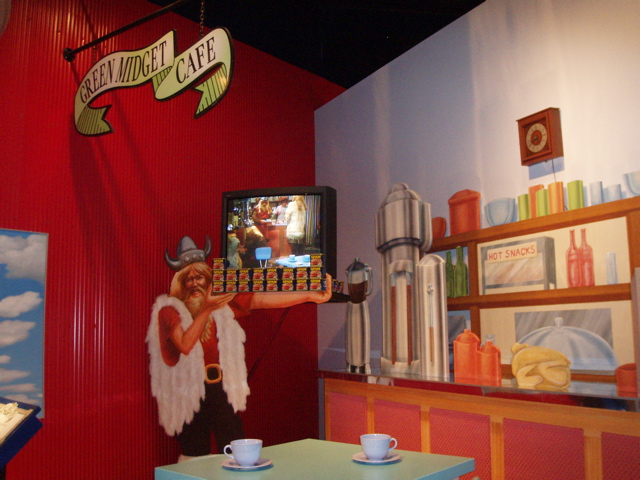
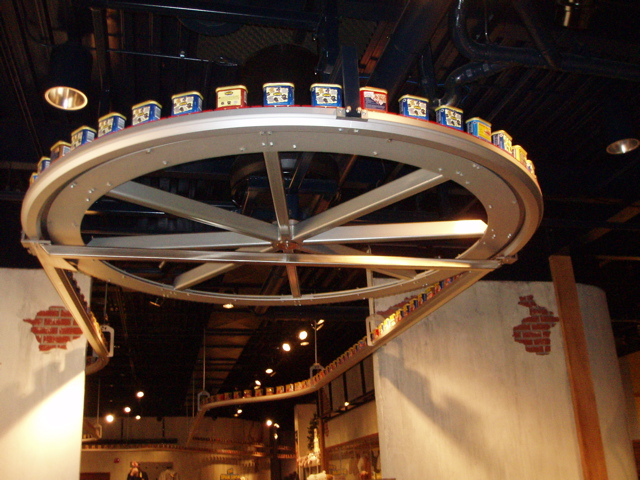
An unexpected pleasure of our trip to Iowa, on the way back to the Minneapolis airport, was a side trip off I-35: to the Spam Museum near the Hormel headquarters in Austin, Minnesota.


Green Midget cafe
Have Spam with a Viking at the Green Midget Cafe.

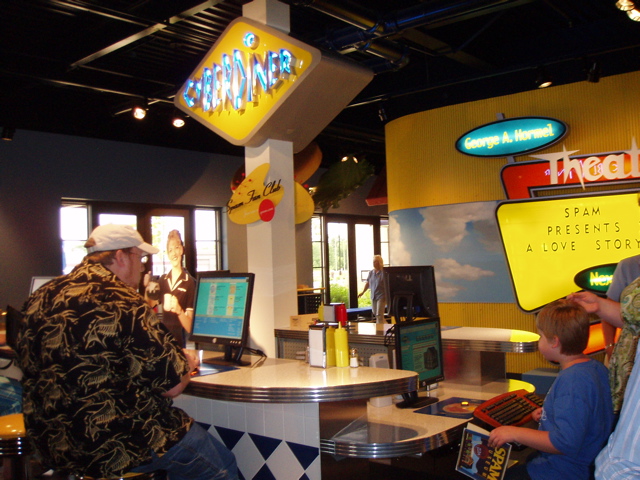
Green Midget cafe
In the Cyber Diner, you can find links to . . . Spam sites!

Green Midget cafe
You'll flip for what's next . . .

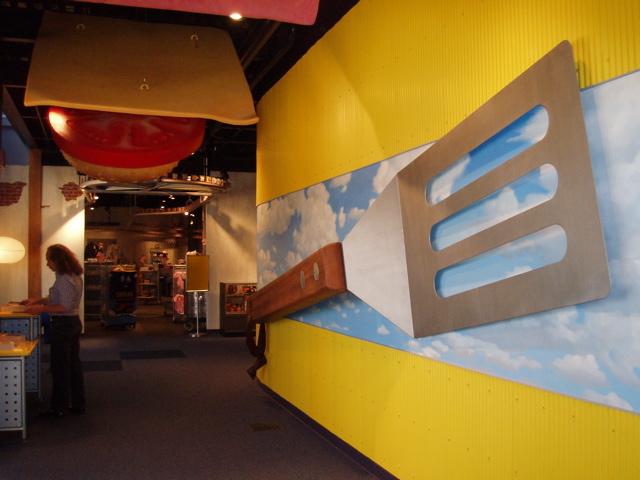
Green Midget cafe
. . . as you're conveyed into the gift shop.

Green Midget cafe
Which is largely what it's all about. (Patak's is a Hormel label. Who knew?)

Roses and more roses

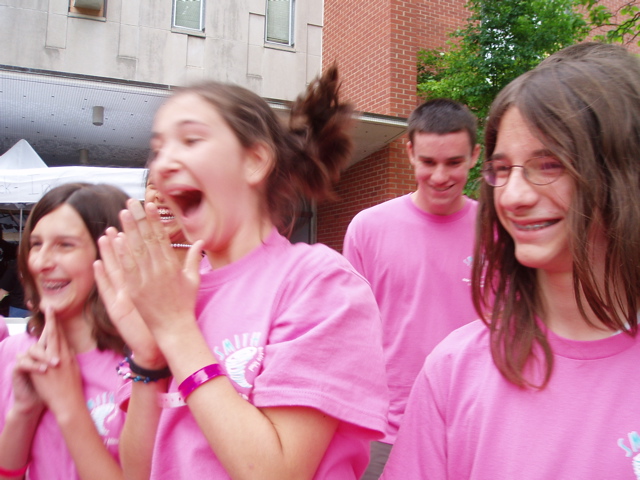
All four Chapel Hill Odyssey of the Mind teams appropriately get roses from this morning's Chapel Hill News for their performances in Ames last week. Paul has much more.

OM team
A few happy OMers after their "spontaneous" competition.

Monday, May 22, 2006

Telegraph to Chapel Hill

Berkeley's Telegraph Avenue has a few things in common with Franklin Street, including a gap where a Gap used to be.

Friday, May 19, 2006

Border patrol

Paul hears a rumor that it's sunset at South of the Border.

I don't know, I always thought twilight showed it to best advantage.

Wednesday, May 17, 2006

In the news

Items of interest from today's Chapel Hill News:

Town council to hold forum on wireless networking tomorrow night. (Companion piece: a factual correction on Orange Politics.) I'm looking forward to listening and learning. See you there?

Jeffrey Beam writes in the aftermath of the West House decision. He points out, importantly, that it is not true that West House is ineligible for the National Register of Historic Places. A correct but misleading statement by university officials got way too much mileage in the press. To say the house is "not eligible" for listing, as the university has, is true only in that a nomination for listing has never been filed. A nomination is a narrative document, an argument for why the building deserves to be listed. It takes work to create. The university has never made the effort. As Jeffrey writes, preservations familiar with West House have no doubt that the effort of writing a nomination would have gotten the building placed on the National Register.

Roses to four Chapel Hill Odyssey of the Mind teams, including Tucker's, for advancing to the world competition. Woo woo! This time next week we'll be headed for Ames, Iowa.

Hillsborough friend Julia Workman is Orange County Teacher of the Year. Congratulations, Julia.

Today's best shot is from Michael Czeiszperger.

Farther afield: decision on disposition of proceeds from North Carolina red light cameras upheld by the Court of Appeals. High Point plans to appeal. It's a unanimous decision, though, and well reasoned. The law says 90 percent of "all penalties and forfeitures and of all fines collected in the several counties for any breach of the penal laws of the state, shall belong to and remain in the several counties, and shall be faithfully appropriated and used exclusively for maintaining free public schools.” The city argued that the revenues collected were for breach of civil law, not penal. Pointing out that municipalities do not have the power to create criminal offenses through town ordinances, the court looked past this technical difference. When you're fined locally for running a red light it's as if you're fined for violating the corresponding state law that is a criminal offense. Interestingly, one of the cases cited as precedent is the one that UNC-Chapel Hill recently lost in the Supreme Court regarding the application of the same law to the fines collected for violations of campus traffic ordinances. Even though the Board of Trustees called these "civil penalties," the court found them "mostly penal in nature."

Many of you know that this decision is not a great disappointment to me.

Tuesday, May 16, 2006

Open letter to Seattle City Council

Dear fellow public officials in Seattle,

One of your constituents has contacted me and other members of the Chapel Hill Town Council to ask us to encourage you to join us in speaking out as a local political body in favor of impeaching the President. I am happy to do so.

On May 8, we responded to a petition from a group of our citizens, Elders for Peace from a retirement center named Carol Woods, calling for President Bush's impeachment. We acted on it in real time and unanimously. It's not the first time the Council has taken a stand on issues of national concern over which we in fact have no direct control, and I expect it won't be the last.

Why? Because in the words of one of our Elders, "You are the closest governmental body to the people." Who else can they turn to if not us? Washington is very, very far away.

The Chapel Hill Herald thinks we did the right thing:

They believed -- as we do -- that it is wholly appropriate for local officials, for a local community, to take a stand on an issue as important as impeachment and the conduct of a president. They believed -- as we do -- that even small communities far away from the centers of power have not just the right, but the obligation to stand up when they believe there is injustice.


Our distinguished constitutional law professor-emeritus Dan Pollitt, writing in this week's Independent Weekly, offers a valuable history lesson on prior impeachment proceedings. He too believes that we in the grass roots are "obligated to speak out":

The greatest danger to democracy lies in an inert populace. One person throwing pebbles can make ripples. But if a second and third person join in, the pond is full of waves, maybe breakers. That is the theory and hope of democracy.

I encourage you to listen to your constituents, consult your own conscience, and, if you are so moved, to join us in roiling the waters.

An enduring poet

I looked to wood s lot for tributes to Stanley Kunitz, and he did not disappoint. But then, neither did Paul.

Durham, then and now

Going on 100 years ago, W.E.B. Du Bois visited Durham, N.C., and liked what he saw. Besides being known for tobacco, and the site of Gen. Johnson's surrender, and Trinity College, he believed it should be hailed for "its solution to the race problem." In The Upbuilding of Black Durham: The Success of the Negroes and Their Value to a Tolerant and Helpful City (1912), he surveyed the town's thriving and self-sufficient black communities and interests, including a black-owned hosiery mill and the North Carolina Mutual Insurance Company. He praised white Durham for fostering an enabling environment:

A Southern community is thus seen to have it in its power to choose its Negro inhabitants. If it is afraid of ambition and enterprise on the part of black folk, if it believes that "education spoils a nigger," then it will get the shiftless, happy-go-lucky semi-criminal black man; and the ambitious and enterprising ones will either sink or migrate. On the other hand, many honest Southerners fear to encourage the pushing, enterprising Negro. Durham has not feared. It has distinctly encouraged the best type of black man by active aid and passive tolerance.


At the same time, Du Bois recognized that this "solution" was less than perfect: "To be sure, the future still has its problems, for the significance of the rise of a group of black people to the Durham height and higher, means not a disappearance but, in some respects, an accentuation of the race problem."

A less than perfect future unfolded in Durham, with, among other things, the destruction of the Hayti community at the hands of urban renewal, recently well told by Fitz Brundage. Du Bois witnessed the proudly renovated White Rock Baptist Church ("They are rebuilding their churches on a scale almost luxurious"). Martin Luther King spoke there in 1960. In 1967, it was demolished.

But in 1912, Du Bois kept the faith. Most of all, he believed in Trinity College and its leaders and benefactors, especially the Duke family who would soon claim its name: "The influence of a Southern institution of learning of high ideals; with a president and professors who have dared to speak out for justice toward black men; with a quarterly journal, the learning and catholicism of which is well known -- this has made white Durham willing to see black Durham rise without organizing mobs or secret societies to 'keep the niggers down.'"

Sunday, May 14, 2006

Michael Czeiszperger: learning to see

"Learning to see" is how Michael Czeiszperger describes "the process one goes through learning how to photograph." He's interested in photographing people in natural, not studio, environments. Not just people, either; but we suspect he has a favorite subject. We enjoyed his opening this afternoon at Market Street Books in Southern Village.

Commencement

Ten years ago this UNC Commencement Day, Seamus Heaney received an honorary doctorate and spoke to the graduating class (which included me in the Ph.D. march). What a coup! In the summer of 1995 he accepted the request from English professors Weldon Thornton and George Lensing; by the time the date arrived, he had won the Nobel Prize.

His speech was brief, wise and unsentimental. According to Thornton and Lensing's preface to the monograph of the speech (which I treasure), it was only the second commencement address he'd ever made. Drawing on old connections between Ireland and North Carolina, he established common bonds between these two storytelling cultures and proceeded to tell a story. It was about his childhood. Asked to write a report on his "Day at the Seaside," he improvised. He had been to the seaside, as it happened, but it wasn't a particularly luxurious experience. So he made something up, with the "chief lyrical effort . . . reserved for the description of the bucket and spade I'd used at the beach, the sky-blue enamelled inside of the bucket and its technicolour outside, its canary yellows and cardinal scarlets and greenfinch greens, a spectrum of dazzle and desire that gladdened the heart; and then the little spade, so trimly shafted and youngster-friendly, all fitted and edged and scaled down to perfection."

Fine phrases, but the reality was that the beach tools his mother had bought for her children were an ordinary tin milk can and wooden spoons--practical, "durable" items that would repay their investment not only at the beach but also back home. The moral?

I want to avoid preaching at you but I do want to convince you that the true and durable path into and through experience involves being true to the actual givens of your own lives. True to your own solitude, your own secret knowledge. Because oddly enough, it is that intimate, deeply personal knowledge that links us most vitally to reality and keeps us most reliably connected to one another. Calling a spade a spade may be a bit reductive at times but calling a wooden spoon a wooden spoon is the beginning of wisdom, and you will be sure to keep going in life on a far steadier psychic keel and with far more radiant individuality if you navigate by that principle. Doing so may entail self-doubt, some divergence from the accepted wisdom, yet whenever the unconventional decision or the unusual move issues from a freedom that has been earned rather than a desire for notice, it has the force of revelation.


As he spoke these words on that beautiful Sunday morning in Kenan Stadium, few if any of us understood the scale of the tragedy that had unfolded the night before in a fraternity house on Cameron Avenue. Ten years later, officials suggest it could happen again. "It requires constant vigilance on our part, because if we let up it would slip back immediately," [fire chief Dan] Jones said. "Eighteen to 22-year-olds believe they're bullet proof."

Friday, May 12, 2006

Local entertainment

It's Friday night, and the rest of my family is out of town. What to do? Get in the car, listen to a CD checked out from the Chapel Hill Public Library of music by Roger Hannay; go see the Smith Middle School production of Metamorphoses; while waiting for the curtain, read Fred Hobson's The Silencing of Emily Mullen.

I could spend the rest of my days enjoying the accomplishments of people I know.

The economic cost of creation science

UNC's own Holden Thrope lays it out on the op-ed page of the Times.

Thursday, May 11, 2006

Area hot spots

A map to show you where to get your complimentary wireless in Chapel Hill/Carrboro. As seen on the web page for "It's Carrboro."

It's tough for a Chapel Hill public official to admit it, but "It's Carrboro" rocks.

Reprieve for Jerry Connor

In a tremendous win for his client, Jerry Connor, my colleague Mark Kleinschmidt and the Center for Death Penalty Litigation scored a victory in the N.C. Supreme Court yesterday. The court stayed his execution to allow the DNA testing that the state had been denying.

I don't know how Mark does what he does.

Monday, May 08, 2006

Impeach Bush

Tonight the Chapel Hill Town Council did one of those silly things we do from time to time: we raised our collective fists in the air and said "We object." We endorsed a resolution in support of impeaching the President (.pdf).

It was brought to us by the Elders for Peace of Carol Woods, with dozens and dozens of signatures. We respect our elders, of course. More than that, they made compelling arguments. One of their arguments is that the Council is the closest elected board that they have. Who else can they turn to for leadership and a voice if not us?

I've been reading April 1865, a book about the last month of the Civil War, how touch and go it all was. In the "Epilogue" an interesting point is made:

Among other things, the Founders were convinced by historical example that for a republican government to last, it could not function over a large area. As the dominant political philosopher of his time, Montesquieu, wrote in 1748, "it is natural for a republic to have only a small territory." This notion became as axiomatic in American popular thought as in its doctrine. Both John Adams and Alexander Hamilton drew the lesson that the vast expanse of the United States--not as it is today, but as they knew it then--made it likely that a durable central government would have to verge on monarchy. For his part, Patrick Henry was hardly alone when, in 1788, he warned, "Our government cannot reign over so extensive a country as this, without absolute despotism."

Tent City Paris

Doctors of the World pitch tents for Paris' homeless population, which is in the thousands and growing.

Affordable housing in London

Where "the sky is the limit" doesn't refer to the price.

The most impressive thing about the place is that - unlike many other schemes where developers have been obliged to include social housing - there is no aesthetic difference between the different types of tenure. It's all one kind of architecture, in one cohesive scheme. There is no class divide. Instead, it just oozes class.

Sunday, May 07, 2006

From the archives

A tidbit from the Southern Historical Collection, where you never know what you'll find. In late January 1914, a certain Mr. Grady wrote to a Mr. Connor a succinct one-page letter:

Dear Mr. Connor: I learned yesterday that your “Makers of North Carolina History” is a text-book in our village school, and I borrowed a copy from one of the pupils; and I found what I expected. On p. 203 you misrepresent the purposes of the Southern people and the disposition of Lincoln, as you must have discovered if you have read the indisputable evidence contained in the pamphlet I recently sent you. But you have been reading the books which insulting Northerners have been spreading over the country; and you agree with them that the Southern people had no motive for secession but a fear that Lincoln would set their slaves free.

I have not gone carefully over the book; but, so far as I have examined it, I find no reference to the shameful robbery of the Southern people by the sneaking New Englanders whose robber-tariff system was the cause of South Carolina’s “Nullification”, the word “tariff” not appearing in the index; nor do I find any reference to the real cause why the Nathan Dane “Ordinance” was passed: to prevent an expansion of the South. No; “slavery” is the only reason why Southerners seceded; and this is an insult to every old Confederate soldier. But, as I said, you have read insulting books written by the slandering enemies of the South; and you must be pitied; but my grandson who is studying your book shall not have his heart embittered against me and my comrades.

Clinton, N.C., Jan 31, ’14.
Begging pardon for exposing
your errors, I am yours, &c.,
[B.F. Grady]

P.S. Let me impress on your mind the truth about Lincoln’s being “bitterly opposed to slavery”. Gen. Donn Piatt, of Ohio, who canvassed a part of Illinois for the radical ticket in 1860, and spent some time after the election at the home of Lincoln, says in Rice’s “Reminiscences of Abraham Lincoln” (p. 482): “He knew, and saw clearly, that the people of the free States had, not only, no sympathy with the abolition of slavery, but held fanatics, as Abolitionists were called, in utter abhorrence. . . ." On the previous page Piatt says of Lincoln: “Descended from poor whites of a slave State through many generations, he inherited the contempt, if not the hatred, held by that class for the negro. . . . He could no more feel a sympathy for that wretched race than he could for the horse he worked or the hog he killed”.

But the children of the South are being taught that Lincoln “was bitterly opposed to slavery”, and that the Southern States seceded to prevent him from liberating the slaves, as if he had any more right to free them than Louis Napoleon had.


The "pamphlet" the author "recently sent" might well have been Mr. Benjamin Franklin Grady's own The South's Burden, published in 1906. The book he was criticizing, Makers of North Carolina History, was a standard North Carolina textbook of the period.

Grady is buried in Clinton (he died not long after writing this letter), but he had relatives in Duplin County, where an elementary school is named after him. Two of his books have had a longer life than Mr. Connor's history: The South's Burden as well as The Case of the North Against the South have been reprinted in recent years by the Confederate Reprint Company, and the latter has been adopted as part of a highly selective educational curriculum.

But I wouldn't trust his research very far. He sent his letter to federal judge Henry G. Connor, when the author was his son, R.D.W. Connor (who went on to become the first secretary of the North Carolina Historical Commission and the first Archivist of the United States).

Brave new blog

Charlotte Ada Pomerantz, born April 21 weighing 4 lb. 10 oz., was delivered pre-term because, said her doctors, she was "growth-restricted." While such an unexpected turn of events during such an expectancy might have sent any parent into a tailspin, library science professor/blogger Jeff Pomerantz started a new blog.

Charlotte is doing beautifully. She has a beautiful name, too.

Battle cry for understanding

An apology fails to cut it at a private school in Birmingham after a "fair and balanced" history teacher asked students to sing a Confederate marching song as well as a song about Lincoln.

But Whitlynn Battle, whose 11-year-old daughter sang in the program, said the letters [including the teacher's apology] saddened her because they showed the school didn't grasp why black parents would be offended.

"I wasn't really looking for an apology," she said Wednesday. "I was looking for them to understand what was wrong with what they did and they went in the opposite direction. They don't get it and the sad thing is, I don't think they ever will."

Battle, who already planned to remove her child from the school at the end of this academic year, said no amount of balance would make up for her child singing a song that includes the lyrics "Hurrah! Hurrah! For Southern Rights!" and "here's to our Confederacy."

"There's nothing they could have sung after that song short of `We Shall Overcome' and I think I'd still be angry," she said. "Those words should not have come out of my daughter's mouth."

Friday, May 05, 2006

States should decide on "partial mirth"

Individual states should be allowed to judge whether Stephen Colbert was funny, says "Bad Reporter."

The basics

Lewis Thomas could spin elaborate thoughts on the interconnections of science and the humanities, the cell and the symphony. But at bottom what he cared about was basic scientific research. Without consistent levels of work in basic research (and without corresponding levels of government support for it), nothing new or important would follow.

For our 13-year-old son Tucker, science is so basic that it promises a lifetime of fascination. Asked at age 8 what fueled his passion, he said to a reporter,

"Well, ever since I was a kid, I've been interested in life," Tucker says in a matter-of-fact manner. "Then I heard about DNA, and I got real interested."

I have a sense that most people who pursue an academic or professional passion do it because they think what they are doing is basic: that practically everything else follows from it. As an English Ph.D. I come from the assumption that language is basic. And so it troubled me when the UNC Ph.D. program ceased to require students to study the history of the language or Old English--how can you profess to be an expert in English language and literature when you don't know the basic thing about how the language started? For I apparently also think that history is basic.

Indeed historians who are passionate about their work betray a conviction that understanding history is key to human understanding and growth. The same for law or religion or economics, or even engineering or architecture or land planning or public health.

From a psychologist interested in getting down to basics, a thoughtful appreciation of Jane Jacobs.

Thursday, May 04, 2006

Beyond the "garrison state"

I've only been to D.C. a couple of times since September 11. Both times it just about broke my heart to see the Capitol building, the Supreme Court, the Washington Monument, all the landmarks of the free and the brave walled off by Jersey bumpers. Eisenhower hoped that "security and liberty [might] prosper." Who could have predicted that a Republican military general who became president would end up such a prophet on our civil liberties?

Washington monument

A new federal courthouse in Oregon shows that it doesn't have to be this way. "'We need public spaces for a new era, and they cannot be fortresses,' says federal judge Michael Hogan, whose new home, the Wayne Lyman Morse United States Courthouse in Eugene, Oregon, is not a fortress. It is an open, glassy, brilliantly lit reimagination of the public square for a new century . . . .'"

Montana pardons: Journalism & law professors get results

The director of graduate studies at the University of Montana School of Journalism wrote a book, Darkest Before Dawn: Sedition and Free Speech in the American West, about the application of Montana's draconian World War I sedition law. A law school professor said, So what are you going to do about it?

Here's what they did together. More at the project's web site.

Wednesday, May 03, 2006

Affordable housing: designed for living

This article in the N&O last week caught my attention. Over in Raleigh, Habitat for Humanity and the Triangle Young Architects Forum of the AIA sponsored a design competition. The winner is quite amazing! Take a look at the pictures. At 1,070 sq. ft. and complying with every basic specification for Habitat, including that it be buildable by laypersons, this house "transcends affordability."

Meanwhile up in Manhattan, a MacArthur fellow has designs on permanent supportive housing for the homeless.

Tuesday, May 02, 2006

Judging history at UNC

In a continued response to the controversy over the Bell Award given in honor of Cornelia Phillips Spencer, Chancellor Moeser awarded a grant that is enabling historian Annette Wright to write a new history of the university. It will primarily take the form of a web site. It's a daunting, difficult, but highly appropriate assignment for UNC to be taking on at the beginning of the 21st century. She's working hard to meet some summer deadlines with the goal of having it online by University Day, October 12.

A nineteenth-century UNC trustee named Thomas Ruffin was chief justice of the North Carolina Supreme Court from 1833 to 1853. In 1829-30, at the beginning of his career on the court, he wrote State v. Mann, a decision that sanctions the "absolute" power of a master over a slave, a case that came to be probably the most-studied case in the history of slave law. As you might guess, official histories of the university to date have not chosen to dwell on that case or even to mention it. See, for example, the documentation on Ruffin Dormitory:

Thomas Ruffin (1787-1870) was a native of Virginia. He graduated at Princeton in 1805, and read law with Judge May in Petersburg, Virginia, in whose office as a law student was General Winfield Scott. He read the Statute of Laws of North Carolina in the office of Judge Murphy, of Orange, where he began the practice of law. He was UNC-Chapel Hill trustee for 24 years, Chief Justice of the Supreme Court for 19 years, President of State Agricultural Society, member of the Peace Convention, and a member of the convention of 1861. In 1830 as a member of the Board of Trustees he drafted a report on the financial crisis of the University and made an eloquent plea to the General Assembly for aid to the University. Mr. Frank Nash of Hillsboro wrote in 1905 in a piece for the News and Observer "he was great as a lawyer, great as a judge, great as a financier, great as a farmer - rugged, indomitable soul in a frame of iron, made to conquer, and conquering every difficulty on every side."


I had coffee with Annette last week to talk with her about Thomas Ruffin. She was most interested to incorporate a fuller version of his story into her history. I left her with a draft copy of an essay I wrote that is set to be published in the selected papers from an architectural history conference in Savannah in 2003. It's about Ruffin, and a statue of him over in Raleigh, and the whole tangled subject of historical memory here "at the South." Since it still may be a long time before the book is out, here (sans notes) is how it starts.

Judge Thomas Ruffin and the Shadows of Southern History

Historical criticism of the American South has become deepened and enriched by a movement, well established in other fields, to study the central role of collective memory in shaping received notions of the past. The work of interrogating the nature and sources of cultural authority has proven especially fruitful in southern studies, perhaps because of the sheer tenacity with which the dominant interpretations of the past have managed to persist. In the era following the Civil War and Reconstruction, the ranks of memory were closed. The broken South sought valiantly to grieve its dead, heal its wounds, reaffirm its cherished sense of honor and duty, and return, as best it could, to life as it used to be. Look away, indeed. Look no farther, in fact, than the square of any southern city to find tangible evidence of a story that, if unable to claim victory, at least holds out for redemption. The fallen heroes of the Civil War live on, united with the legendary figures of the American Revolution—all, in turn, imbued with the virtues of classical republican democracy. The most divisive of national calamities—a civil war—is refigured as the long unbroken march of history. The story told through monuments in public squares across the South is as sure, as inevitable as solid stone itself.

These monuments are often also memorials, which is different, strictly speaking: a monument marks a victory, a memorial commemorates a defeat. “We erect monuments so that we shall always remember, and build memorials so that we shall never forget,” writes Arthur Danto. Tellingly, in the South the two concepts are not easily separated. Moreover, the explicitly funereal memorials—the soldier statues erected out of love and grief—participate in a grammar of mourning that follows its own rules, independent of partisan loyalties. The southern soldiers are virtually indistinguishable from the northern ones. Together, they strengthened the cultural narrative of healing and forgetting. At the same time, the invocation of large themes of American history in southern commemorative practice suggests a hopeful, providential end: the stories of the postwar South share with other nineteenth-century disaster narratives, such as those of the great Chicago fire and the San Francisco earthquake, the theme of adversity overcome. Christian tropes of trial and redemption informed the secular “panorama of Progress” that was unfolding across the country in the late nineteenth century. Many types of narratives, in other words, coalesced to form the strikingly coherent official story of the Lost Cause. In its service, in repositories of stone and bronze, the past is recollected, solidified, and celebrated. A cohesive tale is told of pride and patriotism and loyalty to abiding principles; future generations are advised to take heed. But in order to be remembered, a thing first has to be forgotten. And “[i]n the end,” as Louis Menand writes, “the only way to make the past usable is to misinterpret it.” With this realization, we begin to understand what a tricky business it is to sustain pubic memory.

The southern Civil War monuments stood largely unchallenged (even unremarked) through two world wars. As the civil rights revolution forced a change in the cultural landscape, however, the very presence of these monuments began to suggest untold stories. Today they are more likely to be viewed as sites of disputed memory, of what Fitz Brundage describes as “a dialectic . . . between the willfully recalled and the deliberately forgotten.” The Raleigh statue of Thomas Ruffin (1787-1870), the most highly acclaimed judge of nineteenth-century North Carolina, is a product of the rhetorical excesses of the champions of the Lost Cause. For almost a century it has quietly presided over anxious lawyers as they come to plead their causes to the highest tribunals in the state. But though the statue remains the same, an exploration of the history that it embodies can lead to a renewed appreciation of the uneven dynamics at play in the historical struggle of African Americans for justice.

A single opinion Judge Ruffin wrote early in his career on the North Carolina Supreme Court gave masters almost unbridled physical power over their slaves—in language so candidly descriptive of the brutal reality of the lives of the enslaved that it became the most talked about opinion in the public discourse on the law of slavery. A slender body of criticism that began with the abolitionists has been fully embraced, more than a century later, by contemporary legal historians, for whom Ruffin has become emblematic of all that was wrong with the antebellum South. Yet, at least formally, none of this criticism has had an impact on Ruffin’s reputation in the halls of power in North Carolina. In considering the history of his statue in Raleigh, my intent is not so much to upset its foundation as to enlarge our understanding of what it represents. It marks one brief chapter in the history of the reassertion of white dominance in the South after the Civil War—a story that, through the very strength of its imagery, rendered alternative versions almost incomprehensible. Even so, within the contours of this narrative of Anglo-Saxon triumph can be found another one of resistance and refusal. This counternarrative has the potential to change the way we view Ruffin’s statue: the statement of the fixed and immutable power of law that it was no doubt intended to make unfolds into a conversation about the uses of law by the powerful. Such a shift of perspective, in turn, invites us into a broader reconsideration of our ways of navigating the contested terrain of public commemorative art.

No more excuses (for this pitiful blog)

My computer is back with all of its data on a new disk. It's much better-tempered, and so am I. Now, off to do poll-watching for Adam Stein.

Forget your excuses: don't forget to vote!