Saturday, February 11, 2006

Bypass surgery

Giving directions to our house, I've been known to say, "It's one turn off the bypass." But I don't do that any more. I can't count on people knowing what the 15-501 bypass is. The more recently you came to town, the less sense it would make to you that Fordham Boulevard is, or ever was, a bypass, because what it does, in fact, is to bisect major parts of Chapel Hill.

In the postwar housing boom of the 1950s, when the houses in our neighborhood were going up, the neighborhood was not within the town. That was part of the attraction: it was a classic suburban "borderland" in the tradition of Olmsted's Riverside, not completely rural, but not urban either. Two families that we know of kept horses.

The bypass, back then, was a two-lane highway. In the late 1950s the interchange at the point where 15-501 splits off with Hwy. 54 was improved and widened, for which the DOT declared eminent domain on a corner of Eben Merritt's pasture. He got a consent judgment of $30,000 for his loss of access (an amount equal to the cost of a nice house in the neighborhood).

The widening to four lanes--six counting the left-turn lanes at Manning Drive--began in the 1980s. The neighborhood formed a voluntary association (today's Kings Mill-Morgan Creek Neighborhood Association), mainly in order to negotiate the details of the new right of way, etc. But one thing they didn't get was a decent pedestrian crosswalk. Since then the town has grown right across the "bypass" to include the houses on the other side of Morgan Creek, and, to the south of us, Southern Village. Combining the traffic from that growth with the traffic in and out of Chatham County, Fordham Boulevard is consistently rated one of the most congested roads in our jurisdiction, and it is only getting worse.

If you are in Chapel Hill, you know what I'm leading up to. The intersection of Manning Drive and the 15-501 "bypass" is where David Galinsky was killed on January 25. The driver was not at fault, but neither, I believe, was he. Even if you're in a car, the green light coming out of our neighborhood is so short you hardly make it out. When an intersection is as hostile as this one, it makes no sense to blame the pedestrian. Bad planning is to blame.

This week, the city of Pittsburgh was found by a jury to be 20 percent liable in the death of a pedestrian at a poorly designed intersection. In that case the driver was at fault, but the point is that the city was too. North Carolina is one of the few states that don't allow the blame to be split up this way, but again that misses the point: an intersection that invites pedestrian traffic but does not effectively handle it is a badly designed intersection.

On Monday night prior to the Council meeting, Jim Ward and I have called a news conference to highlight the issue of pedestrian/cyclist/jogger safety at major DOT-controlled intersections in Chapel Hill, and in particular on Fordham Boulevard at or near Manning Drive. Citizens are planning to petition us to press harder for a workable solution. To the Council's prior requests to improve this intersection, the DOT has responded with a classic Catch-22: there isn't enough pedestrian traffic to warrant it. We've got to work on changing the whole mindset from designing for cars first to designing for a transportation network that includes people.

Peter White, director of the North Carolina Botanical Garden--over here with us on the wrong side of the bypass--has prepared a statement that puts the issue nicely:

Too often in today’s world, roadways become isolating and unsafe barriers. In cities across America from Boston to Portland, Oregon, governments are seeking ways to overcome the isolation that roadways impose within a community and to build infrastructure that supports walking, biking and public transportation. These solutions are good for exercise and fresh air, good for reducing congestion, good for lessening pollution, and good for a sense of community. Above all they proclaim the message that we can design with people, as well as cars, in mind.


Fordham Boulevard at Manning isn't the only hostile intersection in town. The bus stops at the apartment complexes on MLK Boulevard require people to cross unsafely, as do several places on Franklin Street, to name a few. What the worst ones have in common is that they're controlled by the state Deparment of Transportation. We've got to get them to the table and come up with engineered solutions that we all can live with.

UPDATE: Thanks to Fiona at the Indy for picking up the cause.

Notes on language, admittedly random

The tired old "no problem" has become "not a problem."

"On the ground" has enjoyed a meteoric rise since the beginning of the Iraq war. "The situation on the ground" in New Orleans when Katrina hit may or may not have been known to President Bush. (Where was Bush if not "on the ground" too? OK, never mind . . .)

"Push back" is pushing out. This one is harder to quantify, but it seems to me that there is more "pushing back" going on now than before. Maybe there's more to push back against.

Ruby Bridges

Ruby Bridges has a place in history for her courage in integrating a New Orleans public school in 1960 all by herself. If you're my age more or less, you might remember Robert Coles' sensitive and perceptive treatment of her story as part of his work on the moral lives of children.

Today, Ruby Bridges is back in New Orleans hoping to rebuild--and to integrate, again--the very school that she attended under protection of federal marshals.

Jonathan Tilove has the story.

Wednesday, February 08, 2006

Tuesday, February 07, 2006

Homelessness: required reading

OK, for you it's optional, but I'd like to make this New Yorker article by Malcolm Gladwell required reading for the steering committee of our Orange County Partnership to End Homelessness. Thanks to Anton for the pointer.

Gladwell's point sneaks up on you. He starts out with one of those "faces of homelessness" cliches: Murray Barr of Reno, Nev., is a homeless person, and guess what, he's a real person just like you. But it turns out that Murray Barr is part of a statistical argument. He is one of the "chronically homeless," and from his story, Gladwell turns to tell us about the Ph.D. student who wrote the dissertation that determined that while only 10 percent of the homeless are chronically homeless, they cost the rest of us an awful lot of money. Between substance abuse treatments and ER visits, Murray Barr "probably ran up a medical bill as large as anyone in the state of Nevada."

So the point is bound up with the objectives and strategies of the national initiative to end chronic homelessness: it makes economic sense to put people like Barr directly into housing. It's cheaper than the alternative. But what's valuable about Gladwell's article is the way he shows us that what makes economic sense does not intuitively make moral sense. What about the transitionally homeless? where is the immediate help for them? What about the people at risk of homelessness? where is their housing subsidy? Why does an alcoholic bum deserve a place to live anyway? Isn't this a "special treatment" plan, plain and simple? Such solutions, Gladwell writes, "have little appeal to the right, because they involve special treatment for people who do not deserve special treatment; and they have little appeal to the left, because their emphasis on efficiency over fairness suggests the cold number-crunching of Chicago-school cost-benefit analysis." Still, he concludes, "helping a few people a lot" can have a significant impact.

In Orange County, before we get too far down the road on crafting our 10-year plan, we are going to have to make some policy decisions about how to allocate limited resources. Which problem are we trying to solve? Only the problem of the chronically homeless (as the federal goverenment would hope)? Or is our work broader than that? What kind of plan will have the best chance of helping the most people?

Tonight on UNC-TV: "Negroes With Guns"

Before he wrote Blood Done Sign My Name, Tim Tyson published another book about race in North Carolina. Only this one was not about a single episode that nobody wanted to talk about. Radio Free Dixie is about one of the most important black activists of the civil rights era. From the book blurb:

Radio Free Dixie is the remarkable story of Robert F. Williams--one of the most influential black activists of the generation that toppled Jim Crow, created a new black sense of self, and forever altered the arc of American history. In the late 1950s, as president of the Monroe, North Carolina, branch of the NAACP, Williams and his followers used machine guns, dynamite, and Molotov cocktails to confront Klan terrorists. Advocating "armed self-reliance" by black Southerners, Williams challenged not only white supremacists but also Martin Luther King Jr. and the civil rights establishment. Forced to flee during the 1960s to Cuba--where he broadcast "Radio Free Dixie," a program of black politics and music that could be heard as far away as Los Angeles and New York City--and then China, Williams remained a controversial figure for the rest of his life. "Robert Williams was just a couple of years ahead of his time," Malcolm X said in 1964, "but he laid a good groundwork, and he will be given credit in history for the stand he took."


The book opens with a young Williams walking down Main Street in Monroe where he happened to see a police officer beat the tar out of a black woman. "Eleven-year-old Robert Williams looked on in terror as Big Jesse flattened the black woman with his huge fists, then 'dragged her off to the nearby jailhouse, her dress up over her head, the same way that a cave man would club and drag his sexual prey.'" "Big Jesse" was the father of Sen. Jesse Helms.

Tonight at 10, UNC-TV is airing the new documentary "Negroes With Guns: Robert Williams and Black Power." Read more about it, including what Tim Tyson has to say, in today's NYT.

Sunday, February 05, 2006

Betty Friedan

From Feminist Law Professors, a nice collection of tributes to Betty Friedan, including a link to our own ae.

American idle

On Paul's birthday, it is time to be grateful to be married to a man who doesn't care about sports (save for Carolina basketball, of course), whose only interest in the Super Bowl is the halftime show (sadly, he seems to have believed the Stones would sing Happy Birthday to him). At our house we are pretty out of touch with the mainstays of popular culture--at least as recently defined.

But we did enjoy (if that is the word for it) Match Point.

A lust for Lustrons

An ambitious program to recycle refabricated steel houses designed for returning World War II soldiers. Quantico Marine Base is accepting applications through April 12.

There's one in Chapel Hill (at least I assume it's still here).

Friday, February 03, 2006

Civil rights conference today

I'll be at the Friday Center today for a conference on redistricting and minority voters sponsored by the UNC Center for Civil Rights. Thanks to Ashley Osment for the invitation.

donnabrazile

MORE: Keynoter Donna Brazile was wonderful. As someone who has done her fair share of gerrymandering, she is ready to throw the whole system out and start over. She wants redistricting reform, but only if it really includes voters from the bottom up. "Unless the system is open, fair, and equitable, citizens will not support it; in fact, they will run away."

She's not too confident in W. Although he said to her personally after Katrina that he would push for renewal of the Voting Rights Act, she noted he didn't mention it in the State of the Union.

Speaking about her D.C. neighborhood: When John Ashcroft moved down the street, I said, well, they stole it fair and square; he deserves a place to stay. But when Katherine Harris moved in, I said, Lord, what have I done to You? That Halloween I went as a chad, not a hanging chad, not a pregnant chad, but a mad chad.

Sam Hirsch, who represents the "Jackson plaintiffs" in the Texas redistricting case to be heard in the Supreme Court on March 1, gave a fine luncheon address. He shared his disapointment that the Department of Justice, earlier this week, filed an amicus brief on the side of the state of Texas. Great case; bad news if he loses.

texas redistricting
The vertical tan snake-like district at the bottom (Dist. 25) connects a block of Austin with a block of Laredo. The baby blue box in the north central region (Dist. 26) is mostly Republican suburban but reaches down to grab the blacks of southeast Fort Worth. The large purple area (Dist. 23) is represented by a Hispanic, Henry Bonilla, who has steadily lost the support of Hispanic voters: this is a Republican district. These are just a few of the issues on the table.

Thursday, February 02, 2006

DC Metro trades gentility for "attitude"

Sandy Carroll has been the voice of the D.C. Metro for a decade. Some riders say "her voice makes them think good thoughts." But Metrorail officials have other thoughts:

Moving away from a kinder, gentler era, Metro opened the new year with a contest for a more authoritative - even cheekier - voice of the subway.

Tuesday, January 31, 2006

Creighton Irons is a sellout.

The talented Creighton Irons, of "Soul Notes" fame, is one of the musical minds behind the new production of the Red Clay Ramblers' "Diamond Studs." Through some fault of my own, I waited too late to get tickets. The weekend performances are all sold out. If you're lucky enough to get to go, please tell me how wonderful it was. (Tickets are still available for tonight and Wednesday and Thursday night.)

Saturday, January 28, 2006

The way to a geek's heart is through his keyboard.

After 15 years of marriage to a geek, I can assure you that this is true.

Three for David

It's still such a shock about David Galinsky. The family had a viewing last night at Walker's Funeral Home. I wasn't sure I wanted to "view" him under the circumstances, but there was some comfort in seeing his face and knowing he was at rest. Three newspaper article or obits have done a nice job of capturing his spirit and personality.

Today's N&O obit.

Always funny, even when he shouldn't have been, his constant curiosity and questioning, especially of authority, inspired all those who came in contact with him. He was an amazing chef and the consummate host who loved to bring people together to share his culinary creations, laughter, and life. As an important advisor, mentor, and confidant to many, David's perspective and insights helped all, but were an especially calming and important influence on his family. He believed strongly in the creation of a just society, one free of discrimination and where opportunities were widely available.


News story in yesterday's N&O.

"He was the great liberal who never gave up," said Joe Lowman, a professor of psychology at UNC-Chapel Hill. "He was [like] one of those irascible adolescents who never gave up on his rebellion and never gave up on what he believed in."

. . .

A great cook who served up meals of soft-shell crabs and smoked salmon [which he smoked himself --SG], he couldn't resist a bargain. On Thursday, several turkeys still sat in his freezer -- a steal at 13 cents a pound right after Thanksgiving.


Obit in yesterday's Daily Tar Heel.

"He lived life with such gusto, energy, compassion, and honesty," said professor Don Baucom, a former student and colleague of Galinsky.

"He was one of those people who are willing to tell you the truth," Baucom said. "At times he left you wondering if you wanted to hit him or hug him."


There will be an informal memorial at his house tomorrow afternoon.

UPDATE: Pictures from the memorial.


Saint Thurgood

Works for me.

May 17 (anniversary of Brown) would be his day.

For another justification, I'd hang my hat on his dissent in Payne v. Tennessee.

Friday, January 27, 2006

Missed opportunity: GSK-Carrboro High

This NYT story about private naming rights in public schools is disturbing on many levels. As tax dollars wither away, what's not to sell?

"My approach is Leave No Dollar Behind," said Paul Vallas, chief executive of the Philadelphia schools, although he added that a school board review of each transaction would weed out undesirable donors, which he said included tobacco and liquor companies.


It's real clear how you feel when you're in a space where every nook and cubby is named for somebody. You feel like a guest in somebody else's house. This is how the Nasher Museum felt to me. A private museum is a private museum. This is not how a public school is supposed to feel.

Last year the Chapel Hill Town Council declined to endorse the concept of selling advertising space on the outside of our buses. We easily said no to our financial consultant's suggestion that we sell naming rights to our Lot 5 development. There will be other opportunities to think about negotiating the line between private and public, though, and soon.

Thursday, January 26, 2006

Pedestrian deaths, one very close to home

It was our dear friend and near neighbor David Galinsky who lost his life last night on the 15-501 bypass while trying to cross Manning Drive to get to the basketball game. His wife Maeda had dropped him off there--as he wished--while she parked elsewhere. She got to the game, but he never did. I am so sorry. My heart goes out to Maeda. It is hard to believe.

This is the third pedestrian fatality in Chapel Hill in less than a week as many days, or make that nights.

The thought has often crossed my mind that it might take a death at that deadly intersection to get the attention needed to make a real pedestrian-accessible crossing there. So now here it is.

Tuesday, January 24, 2006

Tommy Thompson

Tommy Thompson ended his long battle with Alzheimer's three years ago today. His daughter Jesse wrote beautiful letters about her relationship with her disappearing father. Here she describes a trip out to Penguins restaurant at Whole Foods. Not a successful trip, he was glad when it was over.

Finally he was clean and I helped him put on fresh clothes. Whew! He was sweet, and thanked me for our trip. He told me "it makes me feel like..." What he meant was it makes him feel like he is a "real boy." That is a reference to Pinocchio he used to use when his verbal skills were better. He feels that his dementia has turned him into a wooden marionette, and he wants to be a "Real Boy.” He has started to get the idea that being at Britthaven is like being in jail. There are always new problems, things that I have to work through with the aides, the Floor Nurse, The Director of Nursing. As soon as one is solved, another one pops up. There is no way Dad can get the personalized care he had at home. Still, the worst prison he is in is the prison of this disease, whatever it is.

Monday, January 23, 2006

Dump & grind

If you have any advice for Paul on a suitable grinder for his espresso machine, please percolate on over and let him hear from you.

Sunday, January 22, 2006

How quickly we forget.

I know it's out of fashion, but this week I tried to do some fact-checking. For an essay I'm finishing, I wanted to verify whether a woman named Ann Kennedy taught seventh grade history at Leroy Martin Junior High in Raleigh in 1968-69. I had it on information from a Raleigh attorney who told me a wonderful story related to the history of the statue of Judge Thomas Ruffin in Raleigh, which is the subject of my essay. I had no reason to doubt him, but I wanted a second source. I also wanted to know how to spell Ann(e).

Actually my search started over a year ago. I called Martin Middle School (as it is now known). Was told that they have no records and no idea. So this time around, I started with the Wake County School System. First I was told that I'd have to know her social security number. For information that was at one time common knowledge? Please. I didn't want her salary or her job evaluations. I just wanted to know what everybody knew in 1969, if it were true: that she taught seventh grade history. I was kicked up to human relations. A glimmer of light! This woman said she'd go look something up. It sounded hopeful, but I was disconnected. Three callbacks and every time I got put to the same voicemail of the wrong department. (I left a message, for what little it was worth.)

So I thought I'd try again with Martin Middle. A more creative phone-answering person said I should talk to the media center; said they could look it up in a yearbook. Yes! The media center person, though, said it wasn't so easy; no yearbooks that far back, and she might not be able to give me this "personnel" information. But she promised to look into it.

I was about ready to file a FOIA request when she called back to say oh yes, Ann (sic) Kennedy was much beloved; she taught here for many years. We have her picture right here on the wall.

Oh, yes, indeed.

Midwinter spring is its own season.

So Eliot said, and now the climate folks are saying it's true.

This daffodil is not as early as last year's, and it's a little less surprising, given the lack of winter this time around.


daffodil

Thursday, January 19, 2006

Do daylighted schools make kids smarter?

Tonight's sustainable energy forum put on by Chapel Hill's Neighborhoods for Responsible Growth was a big success--standing room only. The emphasis was on solar power as the most responsible choice for the future, though not the only one.

Larry Shirley, director of the State Energy Office, sang the praises of biomass resources: bioethanol (which can be made from switchgrass); biodiesel, which is being produced locally already; and methane, which can be extracted from old landfills. Electricity can be produced from biomass, including hog waste, poultry litter, crop residue, and mill and forest residue. "We think biomass is going to have excellent employment potential through the state," Shirley said, especially in rural areas. North Carolina also has reasonable capacity to host windmill farms, he said.

Tom Henkel got into the nuts and bolts of solar power. Solar water heating is the easiest to accomplish now, resulting in more savings than you might realize. Dr. Henkel even praised the solar clothes dryer. (We used to have one of those till a hurricane took it out.)

Richard Harkrader, policy committee chair of the NC Sustainable Energy Association, is an architect and contractor who has moved into green energy by way of keeping a keen eye on utilities regulation as part of the problem:

Both Duke and Progress predict energy growth on average a little less than 2 percent a year. We can take that down to zero. But unfortunately we aren't going to get there under the system we have now, the system of utility regulation. Green is all of these things. The principal barrier we have to getting there right now is the way the system is set up. Utilities get a franchise, a "natural monopoly." We don't want competing wires down the streets. So they get this and we say, your obligation is to provide energy in this service territory, reliable and cheap. And that's what we've been concentrating on, reliable and cheap. . . . There's a big disencentive for building small power plants close to where people work and live. The mindset is, the population is growing, we're all going to need more energy; therefore build more power plants. Unless we find a way to change that system, that's what we're going to get.


On the positive side, he believes North Carolina is positioned very well right now for an "explosion" of green energy--potentially up there with New Jersey and California and New York.

But architect Mike Nicklas brought the most surprising news: schools built on daylighting principles, like Smith Middle School, which his firm designed, actually make kids smarter. They do better on tests. There is data to show it. Why is that? Two reasons, seemingly contradictory, he said. Students and teacher say they feel both "calmed" and "stimulated." The "calmed" has to do with no fluorescent lights. The "stimulated" has to do with the fact that the weather outside changes, and your body reacts to that.

What a bright idea!

Fun architecture

At last night's public hearing we look at an interesting proposal, the Shortbread Lofts project proposed for West Rosemary St. Some interesting discussion about the architecture. Red brick and exposed steel beams and lots of glass. Irregular patterns. One whole corner of butted glass that the architect, Josh Gurlitz, linked conceptually to the way both Thomas Jefferson and Frank Lloyd Wright treated corners.

I thought it looked cool. It's modern and honest about what it is.

My colleague Cam Hill said the functional steel beams were fine but he'd like the entrance to be "a little more fun." I said, I don't know--"fun" sounds like turning modern to postmodern.

But here it is . . . modern fun! I love the ^^^^^^^^^ roofline.

Wednesday, January 18, 2006

Being poor or homeless is not a crime.

The Town Council has gotten a spate of letters lately complaining about panhandlers downtown. One in today's mail implores, "Please enforce the laws against panhandling, so decent people are not subjected to intimidation and unpleasantness on our main street."

Our town is not unusual. There are more homeless people lately. Some of them turn to panhandling. And for every action, there is an equal and opposite reaction.

Billie Guthrie a housing coordinator for OPC Area Program, calls our attention to a new report by the National Coalition for the Homeless, "A Dream Denied: The Criminalization of Homelessness in U.S. Cities." It begins,

The housing and homelessness crisis in the United States has worsened in 2005, with many cities reporting an increase in demands for emergency shelter. In 2005, 71 percent of the 24 cities surveyed by the U.S. Conference of Mayors reported a 6 percent increase in requests for emergency shelter. Even while the requests for emergency shelter have increased, cities do not have adequate shelter space to meet the need. In the 24 cities surveyed in the U.S. Conference of Mayors Hunger and Homelessness Homelessness Survey for 2005, an average of 14 percent of overall emergency shelter requests went unmet, with 32 percent of shelter requests by homeless families unmet. The lack of available shelter space – a situation made worse by the Gulf Coast hurricanes - leaves many homeless persons with no choice but to struggle to survive on the streets of our cities.


Too often, the response to this crisis is to criminalize the homeless. Atlanta's draconian anti-panhandling ordinance is one example. In some cities you can even get into trouble for feeding the homeless:

Cities have been further targeting homeless persons by penalizing those offering outdoor feedings for homeless individuals. These city restrictions are frequently aimed at preventing providers from serving food in parks and other public spaces.
In Dallas, beginning in September 2005, a new ordinance penalizes charities, churches, and other organizations that serve food to the needy outside of designated areas of the city. Anyone who violates this ordinance can be fined up to $2000.

Recently Dallas has refined this ordinance with designated official feeding sites. The idea is to cut down on litter. Also, volunteers have to register and take food-handling classes.

The panhandlers are virtually regulated out of sight and yet if you feed them you have to be certified? Something doesn't add up.

Dallas is one of the top 20 meanest cities for 2005. The criteria are "the number of anti-homeless laws in the city, the enforcement of those laws and severities of penalties, the general political climate toward homeless people in the city, local advocate support for the meanest designation, the city’s history of criminalization measures, and the existence of pending or recently enacted criminalization legislation in the city." These are cities in which "punitive practices . . . impede true progress in solving the problem."

I'm not proud of our nighttime panhandling ban and would not have voted for it. It was supposed to solve the problem of aggressive panhandling. But it hasn't. Instead, it's just made the situation confusing. How is a person on Franklin Street at night supposed to know that it's against the law for him to ask out loud for money (but that it would be OK if he put it on a placard)? It's not working here any better than it has turned out in Fort Lauderdale.

I am proud of our Community Initiative to End Homelessness for its recent receipt of a HUD grant of more than $270,000 to fund housing and basic services for the homeless.

The Community Initiative is associated with, but is not the same thing as, the Orange County Partnership to End Homelessness (which needs a better web site). The Partnership is in the data-gathering stage, and focus groups are being organized. I think one of the first steps on the way to getting those nagging panhandlers off the street has to involve thinking seriously about why they are there, about real ways to tackle their problems. Surely there's at least some small relationship between the homeless and the excessively homed.

Saturday, January 14, 2006

I was there too, Kirk. Sorry I missed you.

On the Front Porch (scroll down) of the Independent Weekly, managing editor Kirk Ross remembers being in the swelling, sweltering crowd on the Washington Mall one day in August 1983:

It was the 20th anniversary of that day in 1963 when the world got its clearest glimpse to date of the essence of the man and the truths he shared with us all--truths that still had the power to stir souls and cause those gathered to stop and listen.

It is a stunning experience, and a strangely personal one, to stand among a half-million people who suddenly go silent and still. For many of us it was the biggest crowd we'd ever seen or may ever see, and yet for those few minutes--a speech in a day of speeches--we were all alone with our thoughts.


I was quite literally alone in the crowd--I wandered up from my Alexandria home, whether by bus or car I've forgotten, but it was an ordeal to get there. I may even have missed the playing of King's speech, for what I remember most clearly is something else: Stevie Wonder singing his heart out in "Happy Birthday, Martin," with tens of thousands of us singing along. Knowing me, I am sure that I cried.

For me, living and working up there, the day was remarkable for its out-of-time strangeness. This was Reagan's Washington. I'd been clerking for a corporate law firm, where it seemed that most often I was asked to research the question of "whether a savings and loan company is allowed to do [x]." Invariably, I found the answer to be yes. Not till much later did I understand my small role in the S&L crisis. My once and future boss, Ross Perot, not a man long on abstractions, was challenging Maya Lin's phenomenal Vietnam Memorial, installed the previous year, with the idea of a representational one. He had help from interior secretary James Watt, who hated Lin's design so much that he had refused to issue a building permit for it until the plan for the "Three Servicemen" memorial was added as a compromise. And the very idea of a national holiday in honor of King was still, after John Conyers had introduced it 15 years earlier, being hotly debated: the 20th anniversary celebration of the March on Washington and indeed Stevie Wonder's "birthday" song were contributions to the cause. It wasn't until early 1984 that "a fiercely reluctant President Reagan inked the law that made Martin Luther King Jr.'s birthday a national holiday," and only then under threat of veto. Jesse Helms had filibustered the bill.

For an aspiring yuppie like me, daily life meant three-piece suits with big shoulders, lunches at lovely exotic restaurants, and tedious commutes up and down the beltway. The Washington Mall on August 28, 1983, seemed a long way from 1963. And so, I'm very sure that I cried.

Thursday, January 12, 2006

Tami Atwater Mitchell, r.i.p.

This is a sad story. Tami Atwater was a crack addict by age 19. She cycled in and out of jail until at last she landed in Orange County's drug treatment court. Given opportunity and incentive to change her life, she found it worth a try. She became the first graduate of the 18-month rehabilitation program associated with this wonderful alternative sentencing program that Judge Joe Buckner started in 2002.

Last June, I attended a "Unity Day" celebration at Freedom House in Chapel Hill, the first reunion of alumni of the DTC program. I heard Tami's moving story. She was by then married, with a son. She had a job, and she owned her own house and car. She had her life, a life that was almost thrown away.

Tami died yesterday in a collision with a school bus. Her name isn't mentioned in the story below, but I'm told by the DTC folks that it was her. I'm so sorry.

Car driver dies in school bus crash

UPDATE: Fuller story from N&O.

Vintage UNC

Some great old post cards.

Wednesday, January 11, 2006

Brundage, "Top young historian," tells history in black and white.

UNC's W. Fitzhugh Brundage is featured by the History News Network--and rightly so--as a "top young historian." He has written some of the earliest and best commentary on the topic of memory and southern history. I recommend his new book, the product of some ten years' labor, out from Harvard: The Southern Past: A Clash of Race and Memory. It's told in chapters that alternate beween the memories of the dominant white southern culture and those of the black southern culture. Since the black communities had few resources, their memories are not preserved in large stone monuments. Much of their commemoration was through parades and celebrations, the handing down of an oral tradition. Fitz walks us through archives and photo galleries to show us little-known threads of the story of race in America. Needless to say, these stories have little to do with the "failures of Reconstruction" or the faded glories of antebellum southern culture.

For Triangle area folks, perhaps the most interesting section is the discussion of the history of the Hayti section of Durham. We generally understand that it fell to the dreaded forces of "urban renewal" (see Yonah Freemark's nice site), but what came as a surprise for me was that the residents of Hayti bought the program: they believed the promises that the resulting new landscape would be better for everybody. It wasn't, of course. To the expected range of emotional responses to having your neighborhood wrecked, anger at that betrayal has to be added.

It was a 1954 Supreme Court opinion, Berman v. Parker, that opened the way for municipalities to exercise eminent domain in the name of "cleaning up" the "slums." Making a broad sweep, it was the first to say that a "public use" under the 5th amendment takings clause could be found when the resulting use was not strictly public, if the result--the specific result in this case being planned urban renewal--was for a public purpose. It even allowed the destruction of buildings that were not run down if they were in the midst of what the city considered a "blighted" area.

So this is what happened in Durham. Beautiful, important buildings--which we would now surely consider "historic"--fell to the bulldozer along with the "slums." One of them was the White Rock Baptist Church building, a handsome Gothic structure that was a frequent meeting place for civil rights workers. This is where Martin Luther King, Jr. spoke in February 1960, just after the Greensboro sit-ins.

white rock baptist church

The Berman opinion, in turn, served as key precedent for Kelo v. City of New London. Kelo has generated plenty of outrage. Where was the outrage 50 years ago?

But I digress. Congratulations, Fitz, on a well-deserved recognition!

Monday, January 09, 2006

MLK all over again

Cammie Donaldson of Florida's Space Coast Progressive Alliance writes with information about a campaign going on now in Melbourne, Florida, to rename Airport Boulevard after Martin Luther King, Jr. Sound familiar? The comparisons are fascinating. One big difference: it didn't take Chapel Hill 18 years. Still, it is not a done deal in Melbourne. It's up for a vote tomorrow night. I wish them luck.

UPDATE 1/11: No decision last night. More process.

Friday, January 06, 2006

Ain't misbehavin'

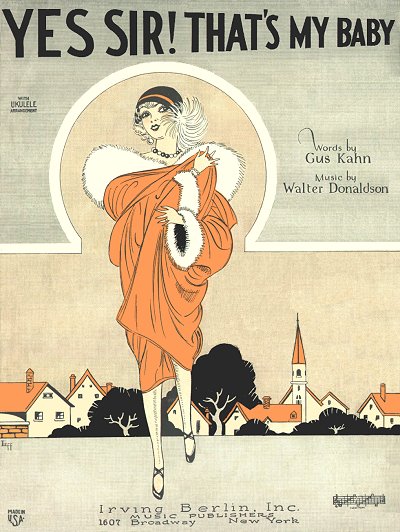
Not really, just goofing off. A few weeks ago I noticed the obit of 104-year-old Sydney Leff, who had a career in drawing the cover illustrations for sheet music during the era when people bought sheet music and brought it home to their pianos. What fun to stumble on this blog, focused on pop songs of the early 20th century, with a nice entry about Mr. Leff. The best part is a link that comes with audio of Fats Waller playing "Ain't Misbehavin'."

that's my baby

Thursday, January 05, 2006

What's your type?

I think it would be hard to grow up around a printing shop, as I did, without an appreciation for typefaces. But what if you grew up as the child of a notable designer and scholar of typefaces? That was the fate of Matthew Carter. His response was to become a designer of typefaces that work on the web as well as they do in print (no small achievement).

It's too bad that Alec Wilkinson's wonderful feature on Carter in the Dec. 5 New Yorker is not online. Here's a clip from a snippet that somebody else posted; it's about the work of coming up with an online typeface for Microsoft.

"The heavy lifting begins when the alphabet is finished," Carter says. "I begin then to see how the letters go together to make words, how they line up next to each other, how they sit on the page or the screen, how they work with the punctuation and the symbols. I print up forty or so pages, and when I first see them I feel suicidal. Nothing is working. If it isn't working, I don't necessarily know why it isn't. It simply looks bad. Then starts the long process of going back and making changes here and there. You change something one day, and the next day you change it back, because you realize it wasn't the problem. Nothing gets better, you despair, until one day you're looking -- you've changed something small -- and you're looking at a typeface."


Here's Microsoft's page about Carter and the typeface called Verdana that he created for the company.

And here's another take on the New Yorker piece, with a link to a classic essay on typography, "The Crystal Goblet, or Printing Should Be Invisible."

All of which is by way of introducing Typographia's favorite fonts of 2005 (part 1).

Trivia question: What was the typeface of Jimmy Carter's 1980 presidential campaign literature?

Bzzzzzzzt.

Answer: Souvenir. I thought it didn't seem serious enough.

Wednesday, January 04, 2006

It can't be precedent. The facts are different.

When Gov. Faubus didn't like the Brown opinion, he simply decided that it was inconsistent with his authority: "The Governor of the State of Arkansas cannot and will not concede that the United States . . . can question his discretion and judgment as chief executive of a sovereign state when he acts in performance of his constitutional duties," he told a federal district court in Aaron v. Cooper. This "interposition" of state authority between the federal courts and the local school boards was a specious doctrine that the Supreme Court put solidly to rest when the same case came to them as Cooper v. Aaron:

In 1803, Chief Justice Marshall, speaking for a unanimous Court, referring to the Constitution as "the fundamental and paramount law of the nation," declared in the notable case of Marbury v. Madison, that "It is emphatically the province and duty of the judicial department to say what the law is." This decision declared the basic principle that the federal judiciary is supreme in the exposition of the law of the Constitution, and that principle has ever since been respected by this Court and the Country as a permanent and indispensable feature of our constitutional system.


If the governor's move was called "interposition," what do you call it when a member of a state Supreme Court recommends against following federal Supreme Court precedent that he believes is wrongheaded?

In a capital case for which he was recused, having been involved in its prosecution before joining the court, Tom Parker of the Alabama Supreme Court claims that his fellow justices should have felt free to ignore Roper v. Simmons, the recent case that declared it unconstitutional to sentence a defendant under the age of 18 to death. Writes Parker in an amazing op-ed (via How Appealing),

I am not surprised that the liberal activists on the U.S. Supreme Court go to such lengths to usurp more political power. I am also not surprised that they use such ridiculous reasoning to try and force foreign legal fads on America. After all, this is the same Court that hs declared state displays of the Ten Commandments to be unconstitutional. [Parker is Roy Moore's stalwart defender; he introduced Moore recently at a conference called "Confronting the Judicial War on Faith."]

But I am surprised, and dismayed, that my colleagues on the Alabama Supreme Court not only gave in to this unconstitutional activism without a word of protest but also became accomplices to it by citing Roper as the basis for their decision to free Adams from death row.


He avoids the nasty little thing called "precedential authority" by raising the philosophical issue of whether the concept of "precedent" works at all:

State supreme courts may decline to follow bad U.S. Supreme Court precedents because those decisions bind only the parties to the particular case.


Maybe realizing that that doesn't quite do it, he continues,

Judges around the country normally follow precedents in similar cases because they know that if those cases go before the Court again they are likely to receive the same verdict. But state supreme court judges should not follow obviously wrong decisions simply because they are "precedents."

It would have been a well-calculated dodge, he predicted, for if the cards were to fall right, the Alabama court would have set in motion the very end of Roper itself:

The proper response to such blatant judicial tyranny would have been for the Alabama Supreme Court to decline to follow Roper in the Adams case. By keeping Adams on death row, our Supreme Court would have defended both the U.S. Constitution and Alabama law (thereby upholding their judicial oaths of office) and, at the same time, provided an occasion for the U.S. Supreme Court, with at least two new members, to reconsider the Roper decision.


But isn't he count his eggs prematurely? Are Chief Justice Roberts and the presumed Justice Alito actually going to overturn Roper?

Maybe not, Parker concedes, while holding his point: "the Alabama Supreme Court would have been none the worse for standing up against judicial activism."

While it might seem unseemly for a sitting supreme court justice to lash out against his colleages in a newspaper column, we should note that he has made the same point from the bench. The first item on his web page is a concurrence in a recent case in which he expressly takes on the statement quoted above from Cooper v. Aaron. In short, he just thinks it's plain wrong.


Monday, January 02, 2006

Vanishing histories

There are 61 state historical markers in Upshur County, Texas, dating from the 1936 centennial celebration to the present day. More than half of them were installed between 1963 and 1969. In Texas, that was the golden age of the roadside marker. The Official Texas Historical Marker Program was started in 1962, and by 1969, 5,000 new markers had been erected. As chair of the Texas State Historical Survey Committee, John Ben Shepperd headed up this ambitious project to document the history of the state by way of battle grounds and burial grounds, old schools and deserted settlements, important institutions and birthplaces. In Upshur County, his first lieutenant was my grandmother, Georgia Laschinger.

Marker dedications were big deals as I remember them, occasions for much speaking and congratulating: the 1882 Greek Revial Alexander Cook house, the site of the Dixon Orphanage, the exotic O'Byrne plantation (the only National Register listing in the county), and on and on.

I don't think my grandmother would ever have imagined that within 40 years these "permanent" markers would begin to disappear. Mostly they're still where she left them, and mostly, I think, the explanations will turn out to be innocent. But a distressing lack of respect for the markers and the histories they report is evident right on the courthouse lawn, where at least two markers are simply no longer there.

One recited a general history of the county as "Civil War supply and activity center." The other marked the place where Sam Houston spoke twice, both times against secession.

yarborough at houston marker
Upshur County Courthouse lawn, September 1964. Ralph Yarborough went on that fall to hold his seat in the U.S. Senate against challenger George H. W. Bush.

upshur courthouse
Upshur County Courthouse lawn, December 2005. Colorful Christmas trees disguise a chain-link fence around some air conditioning equipment.

I've asked County Judge Dean Fowler to invetigate. He shares my hunch that the Houston marker was taken down when the air conditioning equipment was installed many years ago, but he has no idea. Meanwhile he said the county had just received a grant to have the 1930s courthouse restored to its vanishing glory.

upshur courthouse postcard

Sunday, January 01, 2006

"Metropolis now": the audio files

Here are the two remixes of Tucker's that music critic David Menconi writes about in his story in today's News & Observer:

"Monday, December 12"

"Two-hour delay"

The future of television

Via boingboing (thanks Paul), a series of photos from early 1960s ads for Motorola TV. Everything looks like the future, except their own product.

Happy New Year

The "oughts" are rolling by, aren't they? The hysterics of "Y2K" seem like only yesterday, to me anyway. To Tucker--whose technological skills are highlighted in a feature story in the N&O today--it was almost half a lifetime ago.

Here's my new year's discovery: the site of an interesting poet and translator, George Szirtes--and his blog.

Found via wood s lot, who cites Szirtes' 1999 "New Year Canticles":

1.

The new government is the old government,
The new year is the old year in new shoes,
The new testament is the old one reversed,
The new man is the old man newly cursed.

The new poor are the old poor plus a few.
The new itinerant is the old bum.
The new lie is the old lie, and then some.
The new Titanic steams on through old scum.

. . . [go here and scroll down for the whole poem]


Saturday, December 31, 2005

Not playing possum: the real thing

Maybe you're within striking distance to make it up to Cherokee County by 10 p.m. tonight--in time for the 11th annual possum drop. It's a real possum this time, but don't worry, "The opossum is not actually 'dropped,' it is lowered with great care. We treat our little friend with respect, hold him in awe, and do not inflict any injury or traumatize God's creature of the night."

Here's what I had to say about it last year. No, I haven't been. Maybe next year.

Friday, December 30, 2005

Slow reentry (production v. consumption)

We were in Texas for Christmas. Paul flew back on Tuesday; Tucker and I drove back yesterday and today, stopping over in Birmingham, which is halfway. The weather was lovely--wished we'd had our sandals--and thanks to the interstate, there's really nothing to the drive. Especially with 11 hours of Ender's Game on CD.

Santa brought me something I didn't think to ask for: The complete New Yorker DVD. Yes it's a pain not to be able to download the discs to your own hard drive. Yes it's a challenge to navigate. Nevertheless.

I'm reminded of something Bob Bain used to say to his freshman composition students. Dr. Robert Bain was a wonderful UNC English professor. He would say to his students, You are about to go from being consumers (of writing) to producers. But enough already. Being a consumer is enough. More than 4,000 issues, half a million pages of The New Yorker! What more is there to say, and not lamely?

Sunday, December 25, 2005

Saturday, December 24, 2005

Jesus in the schools: Texas showdown

Unfazed by the Dover decision, the school board in Odessa, Texas has followed through on plans to adopt the curriculum of the Greensboro-based National Council on Bible Curriculum in Public Schools. Among other advantages, this curriculum uses the Saint King James version.

Santa tracking

NORAD does it again.

Fifty years of this remarkable service began with a wrong number.

Wednesday, December 21, 2005

Away from home for the holidays

We're traveling south; little or no blogging till new year's. In addition to the great locations on my blogroll (Balkinization is essential reading on the NSA scandal), I recommend that you check out the guest-bloggers at IsThatLegal? --especially the locally famous blogger and talented law student Lance McCord.

Speaking of NSA, the GWU National Security Archive is full of informing information. I expect it's been all over the blogosphere by now, but it's worth noting that the NSA actually warned the Bush II administration that advances in technology were making it harder to ensure 4th Amendment protections. Looks like that bit of well-intentioned advice just gave them ideas.

Tuesday, December 20, 2005

Well, whoever said it, it fits.

A friend told me about a trip to the mall today--said he went mainly for the spectacle, to experience the vast disconnect between the news about our government and the behavior of the governed. "All that is necessary for the triumph of evil is that good men go shopping," was the thought that occurred to him. Or something like that.

Who said that? Burke, wasn't it? Probably not, according to one Martin Porter, who in 2002 made an extensive web-based study. He could find no source for this quotation in any of its variants.

A wild college town

I've heard there are foxes right in my back yard here on Morgan Creek, but I'd never seen one in the wild till last night: in Durham, on Campus Drive, somewhere near the Nasher Museum. We were on our way to the boys choir concert. We saw it cross the road, then we slowed down to watch it on the grassy bank. The car at the T intersection was probably waiting for me to go forward, more so than watching the animal--at least, that's how I took the honk of its horn--but the effect was that this car's headlights put the fox in a freeze, and so we all got to admire each other for a little while.

I'm all for animal-friendly roads, by the way.

Monday, December 19, 2005

Boys Choir at Duke Chapel tonight

This is Tucker's fourth year in the North Carolina Boys Choir. The choir is always wonderful, but never so wonderful as at the annual Christmas concert. For a small-town mom it's purely amazing to have a child that has the gift of being able to perform such beautiful music in such a space as Duke Chapel. If you're in the area and need a boost to your Christmas Holiday spirits, treat yourself to this terrific performance.

Wilmington revisited

Wilmington Nov. 10, 1898

The Wilmington report gets a nice write-up in today's Times. And the News and Observer expresses remorse for founder Josephus Daniels' role in it. What's striking, but not surprising, is how such a horrendous event was almost wiped from memory. One member of the commission that produced the report, a 68-year-old black native, said to the Times, "I didn't even know it happened until I was a grandmother."

Also striking, but not surprising, is the difference between the way the story of the "Wilmington Race Riot" had been told--"oft-repeated local claims that the insurrection was a frantic response to a corrupt and ineffective post-Reconstruction government"--and the stubborn facts that the record reveals. Not content to have won the election of 1898 by stuffing the ballot boxes, a white mob demanded an immediate turnover of power. That's when "Hell jolted loose." Further from the Times:

"The ultimate goal was the resurgence of white rule of the city and state for a handful of men through whatever means necessary," the historian LeRae Umfleet wrote in the report's introduction.

The report concludes that the rioting and coup fully ended black participation in local government until the civil rights era, and was a catalyst for the development of Jim Crow laws in North Carolina.

"Because Wilmington rioters were able to murder blacks in daylight and overthrow Republican government without penalty or federal intervention, everyone in the state, regardless of race, knew that the white supremacy campaign was victorious on all fronts," the report said.


The Wilmington report contributes significantly to a larger effort by historians to come to a more honest reckoning with Reconstruction and its aftermath. It joins recent reappraisals of racial violence in Rosewood, Florida, and Tulsa, Oklahoma, and it adds interesting overtones to my own work on a brutal event in Carrollton, Mississippi.

Eric Foner has been at the forefront of this movement. You can get a taste of his work in this neat digital exhibit/essay.

Foner's new book, which includes illustrated essays by Joshua Brown, Forever Free: The Story of Emancipation and Reconstruction, stresses that the failure of Reconstruction was not because it was misguided and corrupt (though corruption did happen), but because white southerners could not tolerate the thought of blacks in the voting booth. The "what ifs" continue to haunt:

What if the brief flowering of equality in the war's immediate aftermath had been allowed to flourish rather than being brutally suppressed? What if the federal government had upheld the Constitution and upheld the rights of all its citizens? The story is at once poignant and urgent. The complex legacy of Reconstruction is lived every day in America. Until Americans understand that history, we are, as the saying goes, condemned to repeat it.


The North Carolina legislature did a brave and wise thing in setting up the Wilmington commission. Back to the Times: a white member "said he had questions initially about whether the report should have been done at all." Why go there? And yet, he said, "'My opinion changed, and I was surprised to learn the depth of feeling that existed and that it was not that long ago."

Saturday, December 17, 2005

The colorful Depression

Via Jeff Pomerantz, a fascinating Library of Congress exhibition of color photographs taken by photographers for the Farm Security Administration/Office of War Information.

Seeking the long view

President Bush said on TV yesterday that the national security bombshell--the NSA wiretappings, a headline of national and international import--was "not the main story of the day." Only in his dreams.

So this is the way to win the war on terror. The terrorists hate us because of our freedoms. Get rid of our freedoms. Then they won't hate us any more.

It's a sad and scary time to be an American. It would be nice to find solace in our own history and literature, to predict happier times. Harold Bloom tries it, clinging to Whitman in an effort to understand "what seems our national self-destructiveness." His little essay that might have moved toward a misty hope for the United States as "the greatest of poems" rises, in the end, no higher than the grim realities of the present moment.

Friday, December 16, 2005

Thursday, December 15, 2005

Gift ideas

Hot chocolate:

Vosges Oaxaca Bar, dark chocolate with guajillo and pasilla chiles

Dolfin chocolat, milk chocolate with hot masala

Indescribably good.

Going up

Annie Leibovitz documents the construction of Renzo Piano's New York Times office building.

(Via kottke, not boing boing.)

Wilmington report published today

The hundredth anniversary of the 1898 Wilmington Race Riots sparked an interest in coming to terms with what really happened. In 2000, the legislature appointed a commission "to develop a historical record" through detailed examination of source materials as well as interviews of descendants of people involved.

Sometime about now (11 a.m. today), the draft report is being issued. It's online too, which is wonderful. From the news release (.pdf),

The riot took place in an era when similar violent attacks on black communities by white mobs occurred in Atlanta, Tulsa and Rosewood, Fla. In Wilmington, in a move unparalleled in U.S. history, a coup d'etat replaced the city's duly elected officeholders with white supremacists. . . .

"This research demonstrates unequivocally that the Wilmington Race Riot was not a spontaneous event, but was directed by white businessmen and Democratic leaders to regain control of Wilmington," says Dr. Jeffrey Crow, deputy secretary of the N.C. Office of Archives and History.


Surely this study will confirm that to call it a "riot" was, itself, a rhetorical attempt to deny reality. A "riot" suggests an emotional outburst: what happened in Wilmington was coldly calculated.

UPDATE: NYT report.

Another city tries "housing first"

Santa Monica, California, is embarking on a housing first program to deal with its homelessness problem. That's one more example I hope we in Orange County can learn from.

Wednesday, December 14, 2005

Goodbye . . . and good luck.

To the person who found my blog by googling "civil rights term papers," you might try another kind of strategy. It may not be too late to do your own work. It's probably cheaper, too.

Monday, December 12, 2005

Land of the dreamy scenes

I'm worried about New Orleans. Despite what the experts say about modern cities returning from disaster, this one seems unprecedented. For one thing, the barrier islands are gone. For another, yesterday's NYT editorial says "the reconstruction is a rudderless ship."

A few weeks ago, Nick Spitzer, host of the "American Routes" radio show out of New Orleans, gave a talk here at UNC. "Many things are intact visually, but we are decentered in many ways," he said. From the time the storm hit, his show became a site of remembrance and community, a place where those exiled from the city could go to hear the music they needed to hear. And those songs included songs already about floods and disaster--like Randy Newman's "Louisiana 1927." Disaster has always been just around the corner in New Orleans, so when it really happened, there was an oddly comforting body of music to be found.

It struck me that Spitzer, who seemed so insistent that the cultural recovery of New Orleans had to come first, almost before red beans, rice, or housing, was just the right person to be there on the scene making it happen. But what I heard on the way out of the talk was that he was being wooed to relocate at UNC.

Editorials, ink

Romenesko reports that today is "Black Ink Monday," a day of expressive protest by editorial cartoonists upset about the way so many of them are losing their jobs. The News & Observer's own Ted Vaden is linked for his column praising the N&O for keeping its cartoonist on: "the next time [Dwayne] Powell makes you mad, be glad. Love him or hate him, there are not enough of his breed around."

Meanwhile Ed Cone get a nod from Romenesko for speculating on the future of newspapers.

Sunday, December 11, 2005

Under erasure

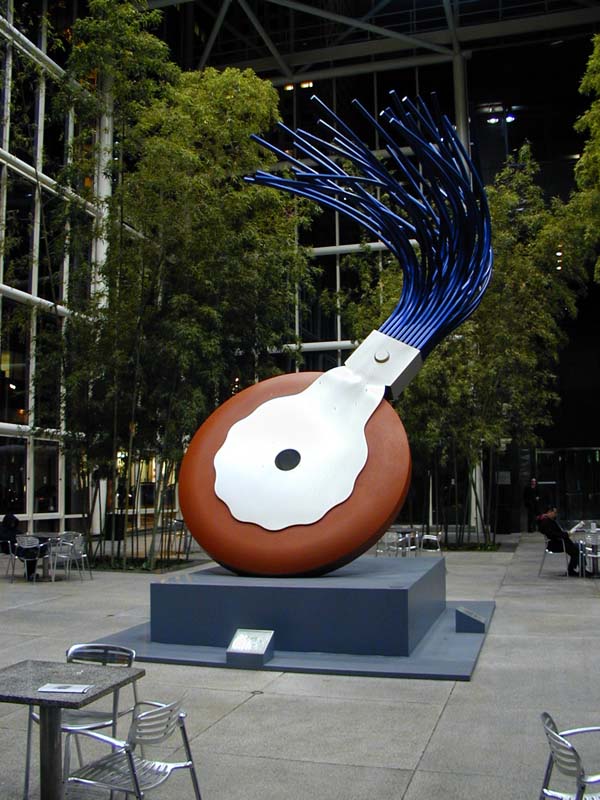
A nice surprise in the atrium of the Nasher Museum is a typewriter eraser by Claes Oldenburg.

nasher museum

One of several versions (including lithograph), it's smaller than the one in the sculpture garden of the National Gallery or at the IBM building in New York.

If you're reading this blog, you're probably old enough to remember typewriter erasers. (Or are you? Remember typewriters?) They weren't wholly successful--typewriter ink being what it was, any success you had in erasing your mistakes was probably offset by a certain loss in the thickness of the paper. With electric typewriters and "correcting" ribbons and the great breakthrough of Liquid Paper, all of that was gladly left behind. But if you grew up around old manual typewriters, as I did, typewriter erasers were always around. I think this was part of the artist's statement--to take a common utilitarian object and defamiliarize it.

Our son Tucker, who is 12, had no idea what it was, of course. What does a giant steel and fiberglass typewriter eraser say to someone who has never seen an everyday one? He can't experience the space of play between the huge permanent fixture and the small insignificant thing itself. Without the familiar, defamiliarizing cannot happen. (Perhaps, in that case, something entirely different happens.)

But if the sculpture has to have a message--and maybe it doesn't, especially one that's this much fun--there's another one that slides into view as the obsolete referent recedes. Something about the ephemerality of technology--and, by extension, well, everything.

Saturday, December 10, 2005

A dash through the Nasher

Janet Kagan and I went to the new Nasher Museum of Modern Art up at Duke yesterday, and here's what we thought.

nasher museum

The building, which is really five rectangular structures arranged in an irregular circle connected by an atrium, is a little smaller than we expected. It is nicely nestled in the woods there along Campus Drive, but once you're inside, there's not enough taking advantage of the views out. Granted, we didn't make the drive from Chapel Hill to look out the window, but we felt that better views could have been had. Although there's lots of natural light from the windows that do exist between the five "pods" and in the ceiling, the building feels massive--Janet sald "cavernous"--rather than light.

springer's point

David Dillon, architecture critic of the Dallas News, calls the ceiling "clunky."

Compared to the sublime lightness of Renzo Piano's vaults in Dallas [he designed the Nasher Sculpture Center], it has all the elegance of a train wreck, with massive intersecting beams and thick mullions, like a floating Mark di Suvero sculpture. It may be the price of a columnless public space below, but the solution lacks precision and refinement.


Dillon is just not a fan of the design at all. About the arrangement of the five rectangular structures, he says they "reach[] out into the landscape like clenched fists." But unless you arrive by helicopter, I don't really see that. I think that within the constraints of the terrain and probably budget, the architect, Rafael Viñoly, came up with a design that serves quite well. Not as successful as his University of Chicago business school project perhaps, where he met the challenge of standing up to Frank Lloyd Wright, but distinctive and functional.

There is only one entrance, via a gently sloping sidewalk, and for now at least, it is graced by one of Patrick Doherty's delightful "environmental sculptures."

The arrangement of the gallery structures around an atrium has one advantage: you don't get lost. This is a manageable museum. Actually only three of the five "pods" are galleries: one is an auditorium, and another, with the gift shop in the front, is I suppose meeting and office space. One gallery tells the story of the Nasher collection, well illustrated with some of their best modern treasures, including Andy Warhol portraits of Mrs. Nasher and the three daughters. Another highlights Duke's permanent collection.

Janet and I found the third exhibit the most interesting. A temporary exhibit, it's called "The Forest: Politics, Poetics and Practice." A whole lot of it--ironically, Janet thought--is photographs of the forest, but they are incredible photographs, some of them enormous cibachrome prints. (Exception: two black-and-whites. They look like the war in Vietnam. In fact, the photos were taken by a Vietnamese woman who was born in 1960; the scene is a Vietnam War reenactment somewhere in the southeastern United States.)

When you walk up to Janet Cardiff's wooden box, seen in this picture, you behold a diorama, an unsophisticated rendering of a small house in the woods. (You've seen better dioramas, which is part of the point.) If you put on the headphones, you hear familiar noises of the night woods, and then you start to hear faint voices as your attention is drawn to the house. You can't make out what's going on through the windows, but you sense that these are voices you would rather not be hearing. A drama unfolds, and in unnerving ways, you are implicated.

Thursday, December 08, 2005

Oral histories online

Paul announces the launching, on Documenting the American South, of the first set of digitally archived oral histories from the Southern Oral History Program.

The 1985 interview with Joe Herzenberg is especially interesting to those of us local folks who now benefit from the Orange Water and Sewer Authority. "His belief in the necessity of Cane Creek seems to frustrate the interviewer. . . ."

Wednesday, December 07, 2005

Brubeck: Take 85

Yesterday, AnonyMoses noted, was Dave Brubeck's 85th birthday. Here are a few free downloads--enough to make you want to dust off your old "Time Out" album (or CD, as the case may be).

The page behind the man behind Rosa Parks

Not being as addicted as some to the NYT opinion pages, I haven't mustered the outrage of some over its decision to designate all of that and much else as a "select" option. Until now. Unless you pay one way or another, you won't be able to see today's important article by Peter Applebome on the story behind that iconic picture of Rosa Parks on the front seat of the bus with an angry-looking white man in the seat behind her.

In the days before "photo-ops," this one was a photo-op. The man, Nicholas C. Chriss, was a UPI reporter. The picture was taken the day after a court order put the Supreme Court's order in the bus desegregation case into effect. Chriss, who died in 1990, wrote in the one brief account he gave,

It was a historic occasion. I was then with the United Press International wire service. A UPI photographer took a picture of Mrs. Parks on the bus. It shows a somber Mrs. Parks seated on the bus looking calmly out the window. Seated just behind her is a hard-eyed white man.

Each anniversary of that day, this photograph is brought out of musty files and used in various publications around the world. But to this day no one has ever made clear that it was a reporter, I, covering this event and sitting behind Mrs. Parks, not some sullen white segregationist! It was a great scoop for me, but Mrs. Parks had little to say. She seemed to want to savor the event alone.


According to historian Douglas Brinkley (writes Applebome), Mrs. Parks was a "reluctant" subject, "but both the journalists and members of the civil rights community wanted an image that would dramatize what had occurred." Dr. King and others took part in photo opportunities on that day as well.

Applebome's story is important because it gets so much right about what really happened. He interviewed 74-year-old Fred Gray, the lawyer who took the case all the way to the Supreme Court. We're reminded, among other things, that Mrs. Parks' refusal to give up her seat was not unprecedented in Montgomery. But as Applebome puts it,

None of that diminishes the achievement of her life, just as, perhaps, the true story of the picture need not detract from its power. It's just a reminder that history is almost always more complicated and surprising than the images that most effectively tell its story.


It's too bad that this story-behind-a-story is so well hidden behind a paywall.

Tuesday, December 06, 2005

Happy New Year

Last night we had the ceremonial meeting marking the transition to a new Town Council. For me it was a time to stop and remember what an honor it is to serve the people of this great place.

Today's Chapel Hill news includes the fact that the town has completed its first on-line auction of surplus goods--and it was a tremendous success! Everything sold for higher than expected: a 1998 Chevy Blazer, valued at $4,350, went for $6,600. A 1988 John Deere Dozer, valued at $10,000, sold for almost twice that, $19,600. And more.

And here are lots of pictures from the Rosa Parks memorial bus ride and rally.

The real shame of Tom DeLay

While Tom DeLay defends himself from charges of money-laundering, he's behind another scandal with distressing and far-reaching implications. The Texas redistricting plan that he orchestrated was deemed by career Justice Department lawyers to violate the Voting Rights Act of 1965. The unanimous opinion of the team of lawyers was very clear about what it found:

[R]elying on a close examination of recent Texas elections, it concluded that the plan would reduce the ability of minority voters to effectively participate in the political process, the test for discriminatory effect under Section 5 [the "preclearance" requirement of the Voting Rights Act, to which Texas among other southern states is subject].

More specifically, according to the memorandum, the plan failed to pass muster under each and every factor the Supreme Court has established for gauging whether or not a redistricting plan will reduce minority electoral opportunity. This was not a close case.


A unanimous recommendation like this would ordinarily have been affirmed by the DOJ's politically appointed higher-ups. But this one wasn't. "The Texas case provides another example of conflict between political appointees and many of the division's career employees," according to the Washington Post. Indeed. As a better Texas politician said to George Wallace in 1965 for his part in the oppressive violence that led to the Voting Rights Act in the first place, "Shame on you," Tom DeLay.

Sunday, December 04, 2005

Yes, Virginia . . .

A newspaper editor was challenged to tell the truth. And so he did.

Blog Against Racism Day

Admittedly I took the easy way out on December 1 by blogging about witnessing against racism by taking a bus ride. On the theory that I often find myself blogging against racism one way or another, I didn't go out of my way. And I'm still not, except by way of directing you to Michael Berube's great post for the occasion.

Saturday, December 03, 2005

When photography was new: DIY postcards

In The Devil in the White City, a dramatically told true story of the 1893 Chicago World's Fair and, at its margins, a shadowy psychopath for whom many young women had a fatal attraction, we see the dawn of the American century: the first apperances of the Ferris wheel, the electric chair, Shredded Wheat, Cracker Jacks, Juicy Fruit gum, and the Kodak camera. The psychopath, Dr. H. H. Holmes, ran a hotel that had a "Kodak room" where you could develop your film. That must have been about as cool as free wireless internet.

Over at The Morning News, Harvey Tulcensky and Laetitia Wolff introduce us to Kodak's 1907 innovation, "real photo postcards" (from their book of the same name). In an interview Tulcensky notes the comparison to flickr.com. But I think he's right about the difference: "The difference is that we are so inundated with images today, that there is no more naïveté in the image-making or choosing. The images that surround us are more often than not tired clichés."

Friday, December 02, 2005

Thursday, December 01, 2005

Be well and happy always.

That is the wish of the Shiwa Monks from the Sera Jay Buddhist Monastery who could be found today in, of all places, University Mall. They'd spent many hours creating a beautiful ritual sand mandala. Today at 5 p.m., to beautiful chanting, they ritually destroyed it and gave the sand back to the earth, via Booker Creek.

mandala 1

mandala 2

mandala 3

mandala 4

mandala 5

mandala 6

Unsung hero: Georgia Gilmore

As I join the bus riders here in Chapel Hill in a little bit, I'm going to be thinking about food, specifically Georgia Gilmore's pound cake. Gilmore and her "Club from Nowhere" helped to keep the Montgomery boycotters well fed for the fight. Gilmore, in fact, was a fighter. She lost her job in a Montgomery restaurant for testifying on behalf of Dr. King in a trial against him during the boycott. That's when her cooking went underground. In a new cookbook called Hidden Kitchens you'll find her story--and her recipe for pound cake. I tried it out for my civil rights seminar students. Delicious.

This book would make a great holiday gift for anyone on your list interested in American history and food.

Rosa Parks rally today

In tribute to Rosa Parks, who was arrested in Montgomery 50 years ago today, the Chapel Hill area NAACP is hosting a bus ride down MLK Boulevard followed by a rally at the old Post Office building. The ride begins at 11 and the rally at noon. Details here. See you there?

Thanks again to Brenda Brown for organizing this event.

And remember that this is Blog Against Racism Day.