Paul says so.
He may be
insincere.
Sunday, December 31, 2006

Saturday, December 30, 2006
Edwards rally in Chapel Hill
As the moon rose over Southern Village, John Edwards gave a rousing stump speech. It's time we were patriotic about something besides the war, he said. Kirk Ross has details and a video clip.
More from Bora; see also Kirk's Daily Kos diary and the report at Blue NC.
More from Bora; see also Kirk's Daily Kos diary and the report at Blue NC.
Spin patrol
When Paul told me that a new study suggested I could cut my risk of breast cancer by vacuuming and doing the dishes, I said the research must have been done by a man. Turns out, maybe only the headline was.
Thursday, December 28, 2006
Chicago: watchtowers and watchdogs
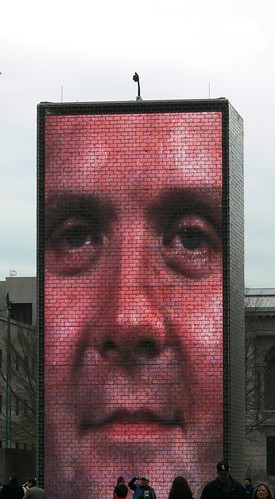
Photo by Looper (Devin Caldwell)
Security cameras that were inartfully placed on top of Jaume Plensa's Crown Fountain in Chicago's Millennium Park were brought down by a couple of blogging "architecture enthusiasts." Photo-blogger Devyn Caldwell and his partner Mike Doyle happened to notice them on Sunday, December 17. "It looks like a Martian sitting there with a little antenna on his head," said Doyle. Caldwell got the attention of Tribune architecture critic Blair Kamin; interviews, investigation, and more blogging followed; on Monday night, December 18, the cameras were felled.
More in today's Times, which reports that Plensa was not informed about the cameras but "was pleased to learn that they had been removed." (Local readers will remember that Plensa was the artist proposed for the recently failed public art project on Fayetteville Street in Raleigh.)
Even with cameras gone, there's something wrong with this picture. The objection was not to the cameras as such: it was the "Orwellian" conjunction of the serious surveillance camera and the playful faces of actual Chicagoans that rankled. The offense was not to the public: it was to art itself. Cameras are all over Chicago. Eight others keep watch over Millennium Park alone. Indeed we learn in the Times that "[t]he cameras were meant to stay atop the towers for only a few months until a permanent fixture could be built nearby." Presumably those fixtures will be built; the friendly faces will bear their "third eyes" more subtly and from oblique angles.
Doesn't it remind you of an old joke? The one about how we know what the lady is: now we are just establishing the price.
The year in planning
A round-up of some great moments in city planning from 2006. For example:
In July, a local council in Rockdale, a suburb of Sydney, Australia, started a six-month trial of playing at high-volumes hits by Barry Manilow and Doris Day to chase away car enthusiasts who were gathering on weekend nights at a local park. The council's deputy mayor reported that, four weeks after the effort, "Barry's our secret weapon. It seems to be working."
Edwards launch
When we got home yesterday evening, we had a robotic phone message from John Edwards inviting us to his rally at Southern Village this Saturday. An hour or so later, Paul and I dialed in to a conference call with a live John Edwards that had been set up for bloggers. By 10 p.m. I got the first of three email messages from John Edwards inviting me to watch a YouTube video of him in New Orleans at the site where he is planning to announce today.
Back in November, I'd had the privilege of having coffee with Elizabeth Edwards and a small group of power geeks and bloggers in Carrboro to talk about internetworking strategies.
The Edwards campaign is on its way to exploiting the resources of the internet in ways never yet seen in a presidential campaign. Political strategist Zack Exley, director of online organizing and communications for Kerry-Edwards in 2004 and, prior to that, one of the creators of MoveOn.org, put it this way back in June:
A continuous stream of emails and YouTubes is not going to do it alone. There's the matter of his message, what he stands for, do we believe him. (Also the matter of reaching the millions not on the internet, as Zack has noted in another context.) I want to believe him. I want to believe he has the courage to stick to his principles when it comes to health care, serious approaches to ending poverty, the whole populist agenda he's promoting, in addition to Iraq and foreign policy. Will he?
On the conference call, previewing the announcement he will make this morning, he said,
My Town Council colleague Mark Kleinschmidt is blogging from New Orleans. I hope he'll weigh in with a live report from Edwards' official launch this morning.
Back in November, I'd had the privilege of having coffee with Elizabeth Edwards and a small group of power geeks and bloggers in Carrboro to talk about internetworking strategies.
The Edwards campaign is on its way to exploiting the resources of the internet in ways never yet seen in a presidential campaign. Political strategist Zack Exley, director of online organizing and communications for Kerry-Edwards in 2004 and, prior to that, one of the creators of MoveOn.org, put it this way back in June:
. . . [Edwards] speaks explicitly to the members of his "online community" as though he knows them -- as though he genuinely appreciates them.I could be cynical and wonder how hard Edwards, the most talented politician in America, has to try not to sound like a politician. But I know from the Kerry campaign that both he and Elizabeth Edwards take this online stuff seriously. I'm convinced that this is a simple case of John Edwards understanding that there is an enthusiastic base out there who supports him and his anti-poverty fight. He seems to genuinely want to reach out, thank them, and let them in on what he's up to.
A continuous stream of emails and YouTubes is not going to do it alone. There's the matter of his message, what he stands for, do we believe him. (Also the matter of reaching the millions not on the internet, as Zack has noted in another context.) I want to believe him. I want to believe he has the courage to stick to his principles when it comes to health care, serious approaches to ending poverty, the whole populist agenda he's promoting, in addition to Iraq and foreign policy. Will he?
On the conference call, previewing the announcement he will make this morning, he said,
This will be a campaign built from the ground up, which means all of you are critical getting this message out. . . . We don’t want this to be a situation where everybody is listening to candidates make promises for two years, [with the hope] that someone will be elected who will bring change. . . . There's everything wrong with that. We shouldn’t wait. That’s what we’ve done in the past and change has not occurred. I want to help lead this grassroots movement to accomplish things starting right now. The idea that some politician is going to come along and save all of us is nonsense to begin with. We have to take charge. I feel very strongly about this. This will be the core message tomorrow. I will of course talk about two Americas, . . . but I’ll go on to say that what I’ve learned from last campaign is that it’s one thing to identify problems but the way to identify change is to take action. "Hopeful" is about tomorrow. We’re about today. We’re about taking action today. You all are critical to that. I appreciate all of you taking time to hear from me directly about this. I’ll be doing it on TV nationwide tomorrow morning. The truth is the net is critical and I want it to be a principal component, not an afterthought.
My Town Council colleague Mark Kleinschmidt is blogging from New Orleans. I hope he'll weigh in with a live report from Edwards' official launch this morning.
Monday, December 25, 2006
Have a magical day.

(Though Mrs. Houdini was in Hollywood, her choice of typeface is Park Avenue, a tired choice by now but hot off the presses in 1935.)
Saturday, December 23, 2006
Dey House undone
A long sad story of the deterioration and of what was said to be one of Chapel Hill's 25 oldest structures has ended with the demolition of the Dey House. The Historic District Commission was able to postpone the demolition for one year, but after that it had no authority. Even the town's recently enacted demolition by neglect ordinance, which would have imposed substial fines for not repairing the property, was something the owner managed to work around.
From M. Ruth Little, The Town and Gown Architecture of Chapel Hill, North Carolina, 1795-1975 (2006).
UPDATE: Chapel Hill News, "Requiem for Dey House": "There are only some two dozen 19th-century houses left in Chapel Hill. One by one they go. With each one that comes down, we lose another little bit of the heritage and character of the town in which we live."
The earliest owner of this house was Dr. William P. Mallette, who supervised the university infirmary. The date when he purchased the property is not known, but he sold the house in 1871 to Methodist minister Joseph Martin. Martin's wife, Clara, ran a boardinghouse here for students. In 1921 Professor William M. Dey, head of the romance languages department, and his wife, Alice, purchased it and made their home here for forty years. At Alice's death in 1965 it was purchased by the Delta Upsilon Fraternity.
The two-story, one-room-deep house has simple features that are characteristic of the mid-nineteenth century--weatherboarded walls, six-over-six pane sash windows, a gable-end brick chimney, and a boxed roof cornice. The front door with fanlight, sidelights, and an arched enrance porch are early-twentieth-century replacements. It is likely that the house originally had a wide porch.
From M. Ruth Little, The Town and Gown Architecture of Chapel Hill, North Carolina, 1795-1975 (2006).
UPDATE: Chapel Hill News, "Requiem for Dey House": "There are only some two dozen 19th-century houses left in Chapel Hill. One by one they go. With each one that comes down, we lose another little bit of the heritage and character of the town in which we live."
Babes in Santaland
Has it really been 14 years since we woke up every morning to a new episode of David Sedaris' "Santaland Diaries"? It's been packaged into theater by now; in the Triangle area it's in two different performances. That's well and good, but I can't imagine it not in Sedaris' voice.
I was pregnant with Tucker when the "Santaland Diaries" first aired. If I ever put him on Santa's lap with innocent thoughts of a perfect Christmas, luckily by now neither of us remembers it. Sedaris puts his finger on what that's all about when he describes his experiences as Santa's "photo elf":
Fortunately, not all parents are so invested in perfection. Some are willing to share photos of their children's perfect horror at being forced to sit on a strange man's lap.
I was pregnant with Tucker when the "Santaland Diaries" first aired. If I ever put him on Santa's lap with innocent thoughts of a perfect Christmas, luckily by now neither of us remembers it. Sedaris puts his finger on what that's all about when he describes his experiences as Santa's "photo elf":
The parents had planned to send these pictures as cards or store them away till the child is grown and can lie, claiming to remember the experience . . . which supposedly means on paper that everything is exactly the way it is supposed to be, that everything is snowy and wonderful. It’s not about the child or Santa or Chirstmas or anything but the parents’ idea of a world they cannot make work for them.
Fortunately, not all parents are so invested in perfection. Some are willing to share photos of their children's perfect horror at being forced to sit on a strange man's lap.
Thursday, December 21, 2006
Changing technologies, timeless Seuss
One of my favorite records (remember LPs?) as a child was a jazzy version of Green Eggs and Ham. It was lost, as things go, by the time Tucker was within the target age. (We could not find it anywhere.) Other musical recordings of the book were out there, but once you've heard Sam's pointed protestations to the sultry pulse of bass fiddle and snare drum, no other version will do.
Finally, a number of years ago by now, I found a vintage copy online! (Thank you, thank you, thank you.) Tucker thinks it's cool, in the campy way that you would hear it if you were 13, but it was his friend Henry, his fellow DJ on the "Teen Spirit" radio show on WCOM, who was inspired to play it on the air.
You can hear a snippet of it here (scroll down).
A couple of the kids in the radio club claimed they'd never seen vinyl before--maybe an exaggeration, but they had a point: to them, it was practically a wax cylinder.
Finally, a number of years ago by now, I found a vintage copy online! (Thank you, thank you, thank you.) Tucker thinks it's cool, in the campy way that you would hear it if you were 13, but it was his friend Henry, his fellow DJ on the "Teen Spirit" radio show on WCOM, who was inspired to play it on the air.
You can hear a snippet of it here (scroll down).
A couple of the kids in the radio club claimed they'd never seen vinyl before--maybe an exaggeration, but they had a point: to them, it was practically a wax cylinder.
Wednesday, December 20, 2006
When old Christmases were new
When a friend of mine was pregnant with child no. 2, she told child no. 1 she had a baby in her tummy. "Get it out!" he shrieked.

The Santa Claus "hiding" in this 1922 Edison wax cylinder recording seems anxious to get out. But his performance was a way of celebrating this amazing new technology, which brought Santa's voice (ever so mysteriously) into your own home.
Santa Claus Hides in Your Phonograph.

Another novelty: a moving picture of Theodore Roosevelt calling on neighbors, Oyster Bay, N.Y., Christmas 1917.
The Santa Claus "hiding" in this 1922 Edison wax cylinder recording seems anxious to get out. But his performance was a way of celebrating this amazing new technology, which brought Santa's voice (ever so mysteriously) into your own home.
Santa Claus Hides in Your Phonograph.
Another novelty: a moving picture of Theodore Roosevelt calling on neighbors, Oyster Bay, N.Y., Christmas 1917.
Tuesday, December 19, 2006
Inside Gertrude Stein
Right now as I am talking to you and as you are being talked
to, without letup, it is becoming clear that gertrude stein has
hijacked me and that this feeling that you are having now as
you read this, that this is what it feels like to be inside
gertrude stein. This is what it feels like to be a huge type--
writer in a dress. Yes, I feel we have gotten inside gertrude
stein, and of course it is dark inside the enormous gertrude, it
is like being locked up in a refrigerator lit only by a smiling
rind of cheese. Being inside gertrude is like being inside a
monument made of a cloud which is always moving across
the sky which is also always moving . . .
more
via wood s lot
Monday, December 18, 2006
Modern cartography
What do the Georgia towns of Poetry Tulip, Due West, Po Biddy Crossroads, Cloudland, and Roosterville have in common?
They all fell off the map.
They all fell off the map.
Sunday, December 17, 2006
Father's day out
Ed Cone beautifully describes the unexpected rewards of being a parent.
What she teaches me goes well beyond the upstreaming of pop-culture knowledge that every generation offers its predecessor, although my grasp of instant-messaging abbreviations is pretty impressive. It comes down to this: Sydney is making me a better person.
Albion Tourgée and Samuel Field Phillips
We learn via Kevin Levin's Civil War Memory blog that there's a biography of Albion Tourgée just out from Oxford. It's about time for an update on this important civil rights figure. Chief architect of the claims brought by Homer Plessy to the Supreme Court, he argued that the Constitution was "color-blind," a notion that Justice Harlan picked up in his vigorous dissent.
Tourgée's stint in Greensboro from 1865 to 1876 as a Union idealist (a/k/a/ "carpetbagger") who became a local judge and civic leader lends his story regional interest; even closer to home is his influence on a Chapel Hill man, Samuel Field Phillps. Phillips was one of Cornelia Phillips Spencer's brothers. Spencer, the woman who famously "rang the bell" in celebration of the reopening of UNC in 1875 after its closing during Reconstruction, is controversial for her part in supporting the Democratic establishment both throughout and after the Civil War. In 2004 a conference was held on the UNC campus to reconsider the Reconstruction period of UNC's history and, more particularly, to revisit the appropriateness of the "Bell Award" given annually in recent years to distinguished UNC women.
Chancellor Moeser subsequently discontinued the Bell Award (conversations with potential winners indicated more trouble ahead: a number of them said they would not accept it). But Spencer Residence Hall remains (so that we might "tell our story better," said the chancellor earlier this year), and Spencer's legacy remains mixed. As Harry Watson said in his remarks at that 2004 conference, "the antebellum University of North Carolina was part of a massively unjust society." It's a common defense of the defenders of the old South, Spencer among them, that they were products of their time, that their culture left them without resources for thinking around or against the racism that chained them so thoroughly.
But as Watson also notes, this defense fails in Spencer's case. It fails by way of her brother's example.
Samuel Phillips started out much like any Southern partisan. A Chapel Hill lawyer and a Whig legislator in the 1850s, he hoped a civil war could be avoided; when it was not, he was as enthusiastic as any for the war. He even supported the prospect of continued fighting after Gettysburg and Vicksburg. But by December 1864 he was aligned with other North Carolina legislators who favored suing for an immediate peace. Even this position, though, was one ultimately aimed to preserve the status quo: it was based in a "belief that negotiated peace would prevent immediate emancipation," writes Robert D. Miller in a 1981 article on Phillips. (A "delusional" belief, as it turned out.)*
At the 1866 constitutional convention Phillips, by then Speaker of the House, worked to enact a strict Black Code that allowed freedmen no political rights but did extend to them certain property rights. When the voters rejected this constitution as too liberal, Phillips, convinced that a less generous approach would invite military intervention, retired, for a time, from public life. (Indeed in 1868 "blacks, scalawags, and carpetbaggers--fulfilling Phillips's prophecy--wrote a remarkably democratic state constitution that included full political rights for blacks.")
By 1868, according to Miller, Phillips "had reassessed the state's relationship to the federal government and had accepted the legitimacy of Congressional Reconstruction." The South had lost; he "acquiesced to the constitutional reality of black suffrage."
Phillips was among North Carolina moderates who actually voted a Republican ticket in 1868 rather than endorse the Democrats' outrageous tactics to keep the black vote in check. But he still viewed black enfranchisement as a matter of expediency rather than justice. The credit for his final transformation belongs to Albion Tourgée, who by 1868 was a superior court judge in Guilford County. Writes Miller, "Tourgée's fine legal mind and his impartiality on the bench in the face of increased Klan hostility enhanced Phillips's admiration for the man and fostered a friendship that would culminate in collaboration on the Plessy case in 1896."
In 1870 Phillips ran as a Republican for state attorney general. He lost, of course, but from his new Republican loyalty "there would be no backsliding." In 1872 President Grant appointed him solicitor general of the United States. As advocate for the federal government's positions he "wrote consistnetly strong briefs . . . based on egalitarian principles."
Plessy v. Ferguson was not the first case in which Phillips' work got Justice Harlan's attention. In the Civil Rights Cases of 1883, his task was to defend the Civil Rights Act of 1875, a law that required equal access to privately owned "public accommodations." Taking the then logical but now inconceivable position that the 13th Amendment's prohibitions of "slavery [and] involuntary servitude" were to be read expansively, he argued that the legislation was protected by it as well as the 14th amendment. Writes Miller,
Phillips was clearly arguing against the grain of the Court and public opinion, but his efforts did not go unnoticed by an old friend. In 1885, by which time he was a private attorney, Tourgée asked him to help with Homer Plessy's case. Again he argued both the 13th and the 14th Amendments as guarantors of the right to travel without discrimination. The combination of his legal theories and Tourgée's powerful rhetoric certainly worked on Justic Harlan, though not, unfortunately, on a majority of the Court.
Philips outlived two wives, living long enough to cheer Booker T. Washington's dinner in the White House with Theodore Roosevelt. He'd traveled a long way from Chapel Hill. It'll be interesting to see what else we can learn about him from the new biography of Albion Tourgée.
*"Samuel Field Phillips: The Odyssey of a Southern Dissenter," North Carolina Historical Review 43 (1981): 263-80, by Robert D. Miller, assistant professor of history, Bennett College, Greensboro, N.C.
Tourgée's stint in Greensboro from 1865 to 1876 as a Union idealist (a/k/a/ "carpetbagger") who became a local judge and civic leader lends his story regional interest; even closer to home is his influence on a Chapel Hill man, Samuel Field Phillps. Phillips was one of Cornelia Phillips Spencer's brothers. Spencer, the woman who famously "rang the bell" in celebration of the reopening of UNC in 1875 after its closing during Reconstruction, is controversial for her part in supporting the Democratic establishment both throughout and after the Civil War. In 2004 a conference was held on the UNC campus to reconsider the Reconstruction period of UNC's history and, more particularly, to revisit the appropriateness of the "Bell Award" given annually in recent years to distinguished UNC women.
Chancellor Moeser subsequently discontinued the Bell Award (conversations with potential winners indicated more trouble ahead: a number of them said they would not accept it). But Spencer Residence Hall remains (so that we might "tell our story better," said the chancellor earlier this year), and Spencer's legacy remains mixed. As Harry Watson said in his remarks at that 2004 conference, "the antebellum University of North Carolina was part of a massively unjust society." It's a common defense of the defenders of the old South, Spencer among them, that they were products of their time, that their culture left them without resources for thinking around or against the racism that chained them so thoroughly.
But as Watson also notes, this defense fails in Spencer's case. It fails by way of her brother's example.
Samuel Phillips started out much like any Southern partisan. A Chapel Hill lawyer and a Whig legislator in the 1850s, he hoped a civil war could be avoided; when it was not, he was as enthusiastic as any for the war. He even supported the prospect of continued fighting after Gettysburg and Vicksburg. But by December 1864 he was aligned with other North Carolina legislators who favored suing for an immediate peace. Even this position, though, was one ultimately aimed to preserve the status quo: it was based in a "belief that negotiated peace would prevent immediate emancipation," writes Robert D. Miller in a 1981 article on Phillips. (A "delusional" belief, as it turned out.)*
At the 1866 constitutional convention Phillips, by then Speaker of the House, worked to enact a strict Black Code that allowed freedmen no political rights but did extend to them certain property rights. When the voters rejected this constitution as too liberal, Phillips, convinced that a less generous approach would invite military intervention, retired, for a time, from public life. (Indeed in 1868 "blacks, scalawags, and carpetbaggers--fulfilling Phillips's prophecy--wrote a remarkably democratic state constitution that included full political rights for blacks.")
By 1868, according to Miller, Phillips "had reassessed the state's relationship to the federal government and had accepted the legitimacy of Congressional Reconstruction." The South had lost; he "acquiesced to the constitutional reality of black suffrage."
Phillips was among North Carolina moderates who actually voted a Republican ticket in 1868 rather than endorse the Democrats' outrageous tactics to keep the black vote in check. But he still viewed black enfranchisement as a matter of expediency rather than justice. The credit for his final transformation belongs to Albion Tourgée, who by 1868 was a superior court judge in Guilford County. Writes Miller, "Tourgée's fine legal mind and his impartiality on the bench in the face of increased Klan hostility enhanced Phillips's admiration for the man and fostered a friendship that would culminate in collaboration on the Plessy case in 1896."
In 1870 Phillips ran as a Republican for state attorney general. He lost, of course, but from his new Republican loyalty "there would be no backsliding." In 1872 President Grant appointed him solicitor general of the United States. As advocate for the federal government's positions he "wrote consistnetly strong briefs . . . based on egalitarian principles."
Plessy v. Ferguson was not the first case in which Phillips' work got Justice Harlan's attention. In the Civil Rights Cases of 1883, his task was to defend the Civil Rights Act of 1875, a law that required equal access to privately owned "public accommodations." Taking the then logical but now inconceivable position that the 13th Amendment's prohibitions of "slavery [and] involuntary servitude" were to be read expansively, he argued that the legislation was protected by it as well as the 14th amendment. Writes Miller,
As Harlan was to do later in his [dissenting] opinion, the North Carolinian returned to Blackstone to argue that the power of locomotion [i.e., mobility] was an essential right of freedom. Slavery had violated that right, and the institution's abolition, therefore, ostensibly freed blacks from impositions on their freedom of movement. Locomotion, however, should not be defined merely as the absence of confinement, Phillips continued, but rather as an expansive right which included mobility on highways, common carriers, and freedom to use public inns. Racially motivated restrictions on such mobility were clear violations of the Thirteenth Amendment, constituting badges of servitude. If mobility were not equally accessible to all citizens, he warned, "the 'pursuit of happiness' will degenerate into a monopoly."
Phillips was clearly arguing against the grain of the Court and public opinion, but his efforts did not go unnoticed by an old friend. In 1885, by which time he was a private attorney, Tourgée asked him to help with Homer Plessy's case. Again he argued both the 13th and the 14th Amendments as guarantors of the right to travel without discrimination. The combination of his legal theories and Tourgée's powerful rhetoric certainly worked on Justic Harlan, though not, unfortunately, on a majority of the Court.
Philips outlived two wives, living long enough to cheer Booker T. Washington's dinner in the White House with Theodore Roosevelt. He'd traveled a long way from Chapel Hill. It'll be interesting to see what else we can learn about him from the new biography of Albion Tourgée.
*"Samuel Field Phillips: The Odyssey of a Southern Dissenter," North Carolina Historical Review 43 (1981): 263-80, by Robert D. Miller, assistant professor of history, Bennett College, Greensboro, N.C.
Friday, December 15, 2006
Post-industrial
I've mentioned before how taken I am with Lisa Scheer's angles on Greensboro. I asked her if she thought her photos were more in the nature of the aesthetic or the political. She replied that the political can't be ignored--"there's a documentary impulse at work"--but she also said she edits out context when a shape strikes her.
This recent one is titled "urban abstract." She's been shooting like crazy lately, and she seems to be challenging herself in the direction of abstraction. The results are riveting.

This recent one is titled "urban abstract." She's been shooting like crazy lately, and she seems to be challenging herself in the direction of abstraction. The results are riveting.
Thursday, December 14, 2006
Chronicling Shakespeare
Toward the end of her persuasive Manifesto for Literary Studies, as part of her argument for the distinctiveness of literature as literature, apart from (while deeply invested in) history and culture, Marjorie Garber turns to Shakespeare. For the proposition that it doesn't matter who he really was, she quotes Emerson, the great Romantic:
To which Garber adds, "Not knowing Shakespeare's history is what gives Emerson his Shakespeare."
Not everyone is so quick to agree. There are those who think, for example, that Hamlet would be better understood, perhaps as Freudian drama, if we knew something about the author's relationship with his own father. In my experience, though, it's not the English professors who worry so much about who the man was: it's professionals of a more fact-based turn of mind, say lawyers.
Almost twenty years ago, in September 1987, a three-judge panel of the United States Supreme Court heard the case of de Vere v. Shakespeare--the challenger being Edward de Vere, the 17th Earl of Oxford, considered the most credible of the many contenders to the name. Successfully defending Shakespeare before Justices Brennan, Blackmun, and Stevens was a bright young law professor named James Boyle, whose talents I've recently noted.
Asked whether it had been a tough case, Justice Brennan said (as reported in the New York Times) it had been "an impossible one." But, he added, at least no one had declared "All's well that ends well."
Despite the unanimous ruling from the Court, Boyle has not been able to lay the question to rest in his own mind. He has written The Shakespeare Chronicles, a comic novel about an English professor possessed by the quest for the real Shakespeare. Like many a novel in the picaresque tradition, it is being published serially--on his web site. Or you can buy the whole thing in hardback or as an ebook.
In connection with the novel, Boyle has made a portion of his Supreme Court argument available on YouTube. The final exchange with Justice Stevens is easily worth five minutes of your time.
Can any biography shed light on the localities into which the Midsummer Night's Dream admits me? Did Shakespeare confide to any notary or parish recorder, sacristan, or surrogate, in Stratford, the genesis of that delicate creation? The forest of Arden, the noble air of Scone Castle, the moonlight of Portia's villa, "the antres vast and desarts idle" of Othello's captivity--where is the third cousin, or grand-nephew, the chancellor's file of accounts, or priavte letter, that has kept one word of those transcendent secrets?
To which Garber adds, "Not knowing Shakespeare's history is what gives Emerson his Shakespeare."
Not everyone is so quick to agree. There are those who think, for example, that Hamlet would be better understood, perhaps as Freudian drama, if we knew something about the author's relationship with his own father. In my experience, though, it's not the English professors who worry so much about who the man was: it's professionals of a more fact-based turn of mind, say lawyers.
Almost twenty years ago, in September 1987, a three-judge panel of the United States Supreme Court heard the case of de Vere v. Shakespeare--the challenger being Edward de Vere, the 17th Earl of Oxford, considered the most credible of the many contenders to the name. Successfully defending Shakespeare before Justices Brennan, Blackmun, and Stevens was a bright young law professor named James Boyle, whose talents I've recently noted.
Asked whether it had been a tough case, Justice Brennan said (as reported in the New York Times) it had been "an impossible one." But, he added, at least no one had declared "All's well that ends well."
Despite the unanimous ruling from the Court, Boyle has not been able to lay the question to rest in his own mind. He has written The Shakespeare Chronicles, a comic novel about an English professor possessed by the quest for the real Shakespeare. Like many a novel in the picaresque tradition, it is being published serially--on his web site. Or you can buy the whole thing in hardback or as an ebook.
In connection with the novel, Boyle has made a portion of his Supreme Court argument available on YouTube. The final exchange with Justice Stevens is easily worth five minutes of your time.
Wednesday, December 13, 2006
In a Los Angeles garage, "a hoarder with a vision"
"[P]robably the finest collection of African American literature, manuscripts, film and ephemera in private hands" was amassed by a librarian in Los Angeles. Her son is in the process of finding a better home for it than a musty old garage.
Tuesday, December 12, 2006
Upcoming exhibit on student protest in Chapel Hill
UNC's Southern Historical Collection and University Archives are sponsoring an upcoming exhibit called "I Raised My Hand to Volunteer: Student Protests in 1960s Chapel Hill." The exhibit, which will be in the Manuscripts Department of Wilson Library, opens Tuesday, January 23, with a talk by history professor Peter Filene. On three subsequent Tuesday evenings, panel discussions are planned: on the desegregation sit-ins of 1963-64, the speaker ban controversy, and the foodworkers' strike of 1969.
When Tim West asked me to moderate the first of these panels, the one on the sit-ins, it was very clear to me why he should think of a Town Council member. In the tumultuous period before the passage of the 1964 Civil Rights Act, which banned discrimination in public accommodations, the demonstrators had the audacity to ask the Chapel Hill Board of Aldermen to pass a local public accommodations ordinance. At a crucial public meeting that followed much back-and-forth among members of the Board, alderman Adelaide Walters gave a passionate explanation of her intention to vote in favor of the ordinance:
The ordinance was not even voted upon. Rather, alderman Roland Giduz made a substitute motion to set up a group of community leaders "to serve as a mediation committee to resolve racial differences that currently beset this town and to which complaints of racial discrimination could be brought." That motion carried 6-2, with Hubert Robinson (Chapel Hill's first black alderman) joining Walters in opposing it. Mayor Sandy McClamroch, who had no vote under the system in place (except as a tie-breaker), went out of his way to express his opposition to the passing of an ordinance.*
The town's leaders, in other words, did not lead.
This exhibit will provide a welcome opportunity to revisit that period. It'll be my honor to moderate a panel that includes three people who were among the student activists--Quinton Baker, Karen Parker, Braxton Foushee--and a current UNC student political leader, Erika Stallings.
*All of this information comes from John Ehle's invaluable 1965 book The Free Men, a book that ought to be required reading in Chapel Hill public schools. It is out of print.
When Tim West asked me to moderate the first of these panels, the one on the sit-ins, it was very clear to me why he should think of a Town Council member. In the tumultuous period before the passage of the 1964 Civil Rights Act, which banned discrimination in public accommodations, the demonstrators had the audacity to ask the Chapel Hill Board of Aldermen to pass a local public accommodations ordinance. At a crucial public meeting that followed much back-and-forth among members of the Board, alderman Adelaide Walters gave a passionate explanation of her intention to vote in favor of the ordinance:
The underlying idea of a Public Accommodations Law is so simple that it was expressed in one sentence by the President of the United States, Lyndon Johnson, in his State of the Union message on January 9 [1964]: "all members of the public should be given equal access to facilities open to the public." This statement seems reasonable to most people in Chapel Hill, since this is a university town where freedom flavors the spirit of a great university.
It is likewise not surprising that Chapel Hillians are concerned that our Negro citizens often suffer personal embarrassment and shame from treatment in some public places here.
We are aware that some 90 percent of our merchants subscribe to the principle of public accommodation. Indeed, the Merchants Association itself has gone on record in favor of open business for all citizens.
Why, then, is a Public Accommodations Law necessary? Why was the commandment "Thou shall not kill" ever put into law? It seems regrettable that we need legislation to enforce a plain truth. But because the bigotry of a few is poisoning the peace and harmony of community relationships, we are impelled to take action.
The Human Relations Committee set up by the Board of Aldermen and appointed by the Mayor, the Ministerial Association, as well as many individuals, have urged us to pass a Public Accommodations ordinance.
Some say that such an ordinance is an invasion of private property rights. Others point out that such rights have always been subject to the laws of the land--laws of ownership, sale, inheritance, zoning, sanitation, eminent domain.
For these reasons and many more, it is my hope that the Board of Aldermen will pass a Public Accommodations ordinance and thus in part restore the damaged public image of what I believe is an enlightened community.
The ordinance was not even voted upon. Rather, alderman Roland Giduz made a substitute motion to set up a group of community leaders "to serve as a mediation committee to resolve racial differences that currently beset this town and to which complaints of racial discrimination could be brought." That motion carried 6-2, with Hubert Robinson (Chapel Hill's first black alderman) joining Walters in opposing it. Mayor Sandy McClamroch, who had no vote under the system in place (except as a tie-breaker), went out of his way to express his opposition to the passing of an ordinance.*
The town's leaders, in other words, did not lead.
This exhibit will provide a welcome opportunity to revisit that period. It'll be my honor to moderate a panel that includes three people who were among the student activists--Quinton Baker, Karen Parker, Braxton Foushee--and a current UNC student political leader, Erika Stallings.
*All of this information comes from John Ehle's invaluable 1965 book The Free Men, a book that ought to be required reading in Chapel Hill public schools. It is out of print.
Sunday, December 10, 2006
Bright ideas
We already knew that our neighbor Maeda's son Adam Galinsky was a bright guy, but it's nice to see it confirmed in today's New York Times Magazine.
Low Starting Prices Lead to High Auction Sales.
More eBay advice from Adam: look for misspellings, and don't assume you have to see a photo.
Low Starting Prices Lead to High Auction Sales.
Why does this happen? For starters, as the researchers explained in the June 2006 issue of The Journal of Personality and Social Psychology, low starting prices reduce barriers to entry, tempting even idle browsers to place bids. The increased traffic then generates higher final prices as more buyers bid against one another. Psychological forces play into it as well. Low starting prices entice bidders to invest time and energy in the auction, and while every M.B.A. student knows it’s dumb to base decisions on sunk costs, the eBay bidders did just that, escalating their commitments to their previous bids.
More eBay advice from Adam: look for misspellings, and don't assume you have to see a photo.
Subscribe to:
Posts (Atom)