Ever wonder what philosophers joke about?
They have lightbulb jokes.
They have chicken crossing the road jokes.
They do satire.
Some of their jokes, are, in truth, hard to get unless you are a philosopher. To understand how much not a philosopher you are (unless you are one), take a look at the "causes of deaths of philosophers" and tell me honestly how many of them you get.
But for the one that takes the cake, I urge you to see this trick and try to match it in your own field.
All this and a good deal more here.
Thursday, August 31, 2006

Wednesday, August 30, 2006
On photography
When I bought my first house I took to decorating it with art on the cheap. In a sale bin at the Library of Congress I found a print that fascinated me. I chose it for the kitchen.

I loved the symmetries and the ironies, also the mysteries: who lived in these houses? What did women walking down the sidewalk think of these billboards? (Touche to Ruby for best feminist comeback of the week.) It wasn't till sometime in the last year or two, when I got a postcard from Chapel Hill's Ann Stewart with this image on it, announcing the sale of it and others in much better quality in the Martson Hill digital editions, that I learned it was a Walker Evans. What strikes me now is that even though I didn't know it was a Walker Evans, Evans had trained me to see this image as the work of art that it is, for I was certainly, by then, familiar with his defamiliarizing style.
The Martson Hill prints are the subject of an exhibition on display at the UBS Art Gallery in New York. The NYT reviewer, Michael Kimmelman, has an issue with the liberties taken with Evans' originals. I don't know, though. As long as the new photographers are clear that they are playing with his work--and they are clear--I don't see the problem. Photography is all about mechanical reproduction, and that was true before the digital age. The genie of "originality" is well out of the bottle.
I'm more interested in the question of how to read these photographs: which do we weigh more heavily, the symmetry or the irony? It's an old question: the relationship of art and politics. Evans worked for the Farm Security Administration during the Depression, so it is hard not to see them as political. And yet, as the twentieth century lumbered along, photography of the deliberate intensity that Evans applied could not help being seen as art, a thing detached from its moment. Susan Sontag had something to do with this. "Photographs, which package the world, seem to invite packaging," she wrote in On Photography (1977). She commented on the "aggression" that the act of photography represented:
Burdened by his own "self-consciousness," in Sontag's view, the photographer became a producer of art.
But Sontag lived long enough to change her mind about photography: see her essay on the torture at Abu Ghraib. Prior to that essay, in 2003, she had published Regarding the Pain of Others. Here she says that her earlier position had "universaliz[ed] the viewing habits of a small, educated population living in the rich part of the world." She had been to Sarajevo in the 1990s (where she directed a production of Waiting for Godot). She had witnessed the pain of others from very close angles. She now understood the political power of photographs, their ability to stir the emotions and even to stir one to action. She opens the book with a discusison of Virginia Woolf's use of photogaphy in Three Guineas, an extended essay addressed to an imagined man who has asked her advice on how to stop war. With the Spanish Civil War in the background, Woolf had these observations:
Sontag is quick to note that no one today believes that war can be stopped, "not even pacifists"--while adding that in the aftermath of World War I, it might not have seemed such an outlandish idea. What Woolf offered, in Sontag's view, was "the originality (which made this the least well received of all her books) of focusing on what was regarded as too obvious or inapposite to be mentioned, much less brooded over: that war is a man's game--that the killing machine has a gender, and it is male." She understands what Woolf is trying to do: to get her hypothetical male reader to identify with war's victims. "Look, the photographs say, this is what it's like. This is what war does. And that, that is what war does, too. War tears, rends. War rips open, eviscerates. War scorches. War dismembers. War ruins."

I loved the symmetries and the ironies, also the mysteries: who lived in these houses? What did women walking down the sidewalk think of these billboards? (Touche to Ruby for best feminist comeback of the week.) It wasn't till sometime in the last year or two, when I got a postcard from Chapel Hill's Ann Stewart with this image on it, announcing the sale of it and others in much better quality in the Martson Hill digital editions, that I learned it was a Walker Evans. What strikes me now is that even though I didn't know it was a Walker Evans, Evans had trained me to see this image as the work of art that it is, for I was certainly, by then, familiar with his defamiliarizing style.
The Martson Hill prints are the subject of an exhibition on display at the UBS Art Gallery in New York. The NYT reviewer, Michael Kimmelman, has an issue with the liberties taken with Evans' originals. I don't know, though. As long as the new photographers are clear that they are playing with his work--and they are clear--I don't see the problem. Photography is all about mechanical reproduction, and that was true before the digital age. The genie of "originality" is well out of the bottle.
I'm more interested in the question of how to read these photographs: which do we weigh more heavily, the symmetry or the irony? It's an old question: the relationship of art and politics. Evans worked for the Farm Security Administration during the Depression, so it is hard not to see them as political. And yet, as the twentieth century lumbered along, photography of the deliberate intensity that Evans applied could not help being seen as art, a thing detached from its moment. Susan Sontag had something to do with this. "Photographs, which package the world, seem to invite packaging," she wrote in On Photography (1977). She commented on the "aggression" that the act of photography represented:
The immensely gifted members of the Farm Security Administration photographic project of the late 1930s (among them Walker Evans, Dorthea Lange, Ben Shahn, Russell Lee) would take dozens of frontal pictures of one of their sharecropper subjects until satisfied that they had gotten the right look on film -- the precise expression on the subject's face that supported their own notions about poverty, light, dignity, texture, exploitation and geometry. In deciding how a picture should look, in preferring one exposure to another, photographers are always imposing standards on their subjects. Although there is a sense in which the camera does indeed capture reality, not just interpret it, photographs are as much an interpretation of the world as paintings and drawings are. Those occasions when the taking of photographs is relatively undiscriminating, promiscuous, or self-effacing do not lessen the didacticism of the whole enterprise. This very passivity -- and ubiquity -- of the photograph record is photography's "message," its aggression.
Burdened by his own "self-consciousness," in Sontag's view, the photographer became a producer of art.
But Sontag lived long enough to change her mind about photography: see her essay on the torture at Abu Ghraib. Prior to that essay, in 2003, she had published Regarding the Pain of Others. Here she says that her earlier position had "universaliz[ed] the viewing habits of a small, educated population living in the rich part of the world." She had been to Sarajevo in the 1990s (where she directed a production of Waiting for Godot). She had witnessed the pain of others from very close angles. She now understood the political power of photographs, their ability to stir the emotions and even to stir one to action. She opens the book with a discusison of Virginia Woolf's use of photogaphy in Three Guineas, an extended essay addressed to an imagined man who has asked her advice on how to stop war. With the Spanish Civil War in the background, Woolf had these observations:
This morning’s collection contains the photograph of what might be a man’s body, or a woman’s; it is so mutilated that it might, on the other hand, be the body of a pig. But those certainly are dead children, and that undoubtedly is the section of a house. A bomb has torn open the side; there is still a birdcage hanging in what was presumably the sitting-room, but the rest of the house looks like nothing so much as a bunch of spillikins suspended in mid air. Those photographs are not an argument; they are simply a crude statement of fact addressed to the eye. But the eye is connected with the brain; the brain with the nervous system. That system sends its messages in a flash through every past memory and present feeling. When we look at those photographs some fusion takes place within us; however different the education, the traditions behind us, our sensations are the same; and they are violent. You, Sir, call them ‘horror and disgust’. We also call them horror and disgust. And the same words rise to our lips. War, you say, is an abomination; a barbarity; war must be stopped at whatever cost. And we echo your words. War is an abomination; a barbarity; war must be stopped. For now at last we are looking at the same picture; we are seeing with you the same dead bodies, the same ruined houses.
Sontag is quick to note that no one today believes that war can be stopped, "not even pacifists"--while adding that in the aftermath of World War I, it might not have seemed such an outlandish idea. What Woolf offered, in Sontag's view, was "the originality (which made this the least well received of all her books) of focusing on what was regarded as too obvious or inapposite to be mentioned, much less brooded over: that war is a man's game--that the killing machine has a gender, and it is male." She understands what Woolf is trying to do: to get her hypothetical male reader to identify with war's victims. "Look, the photographs say, this is what it's like. This is what war does. And that, that is what war does, too. War tears, rends. War rips open, eviscerates. War scorches. War dismembers. War ruins."
North Carolina: the weight of things
"A national report Tuesday fingered North Carolina as one of 31 states where residents are getting rounder -- the same day state officials launched an ambitious but unfunded new strategy to turn the tide." North Carolina is the 14th fattest state.
A dramatic interactive map of obesity trends nationally, 1985-2004 (via Paul & BoingBoing).
A dramatic interactive map of obesity trends nationally, 1985-2004 (via Paul & BoingBoing).
Tuesday, August 29, 2006
Dylan: Somewhere there's music
Today's the day John's been waiting for: Dylan's "Modern Times" is in the stores. Reviews are very positive.
Here's an endearing profile of Dylan in 1964 by Nat Hentoff, published in the New Yorker.
Here's an endearing profile of Dylan in 1964 by Nat Hentoff, published in the New Yorker.
Monday, August 28, 2006
Data points
Austin is the fifth drunkest city, but only the 81st angriest.
Charlotte is the 15th angriest; Durham is the 23rd; Raleigh the 47th. A key indicator is percentage of men with high blood pressure.
ON SECOND THOUGHT: Maybe Charlotte isn't all that angry. If blood pressure is the measure, maybe it's just men spending too long at jobs they hate (although that could make them angry).
Charlotte is the 15th angriest; Durham is the 23rd; Raleigh the 47th. A key indicator is percentage of men with high blood pressure.
ON SECOND THOUGHT: Maybe Charlotte isn't all that angry. If blood pressure is the measure, maybe it's just men spending too long at jobs they hate (although that could make them angry).
Stories from New Orleans
A year after Katrina, I'm wondering what happened to Abram Himelstein, the New Orleans writer, schoolteacher, and activist who, last I had heard, was "In Exile" in Houston. His blog hasn't been updated since January. By then he was back in New Orleans with his wife, trying to put their home and their lives back together. He was happy that his student-authors from the Neighborhood Story Project were also finding their way back. Two days before the hurricane, plans were being set for a big party to celebrate one of the five books in the series, Ebony Bolding's Before and After North Dorgenois. The party, alas, was not to be: the food, the drinks, the cars, the houses themselves were swept away. Even the books were swept away, several thousand of them; but the computer they were printed from was not. After the hurricane, the project turned to looking for a new publisher, one that could work with their lack of cash.
Soft Skull Press took them on. (Soft Skull being known in these parts for its part in the documentary Horns and Halos, by Chapel Hill native Michael Galinsky and his wife Suki Hawley.)
This summer, Himelstein and his co-director in the story project, Rachel Breunlin, apparently were artists in residence at the Headlands Center for the Arts, California. (Along with Durham sculptor/installation artist Bryant Holsenbeck.) We'll look forward to seeing what they do next.
Soft Skull Press took them on. (Soft Skull being known in these parts for its part in the documentary Horns and Halos, by Chapel Hill native Michael Galinsky and his wife Suki Hawley.)
This summer, Himelstein and his co-director in the story project, Rachel Breunlin, apparently were artists in residence at the Headlands Center for the Arts, California. (Along with Durham sculptor/installation artist Bryant Holsenbeck.) We'll look forward to seeing what they do next.
Sunday, August 27, 2006
Button up, button down.
I don't typically look at the NYT women's fashion magazine, but when today's issue, almost a half-inch thick, fell vertically on my foot, it got my attention. At least long enough to read a little talk-back piece to the Merryl Streep movie that I haven't seen. In "The Devil Knows Nada," Eric Wilson takes issue with the movie's assumption that fashion flows from the top down: "The bald truth is that for 20 years, the direction of fashion has been inverted: it now stomps its way up from the street; from athletes and celebrities to designers."
Sixty percent of the world's buttons are made in Qiaotou, China, according to an NPR report earlier this week. Fashion has everything to do with what the buttons are made of: plastic, shell, wooden, metal? Copper buttons are currently in high demand, but the profit margin is low because copper is a commodity whose price, worldwide, has gone up--thanks to Chinese consumption. And sure enough, trends in buttons aren't entirely dictated by the top designers: "These fashions are formed far away on Italian catwalks or even perhaps on the streets of Iran. That's where buyer Asham Bastou [ph] and his partners sell most of their buttons." Mr. Bastou has an interesting political theory about buttons: "the more closed a society, the better buttons sell there. More open societies, he says, favor zippers and Velcro fastenings. But buttons sell particularly well in places where women wear the chador, a full-length black robe that buttons up the front."
Sixty percent of the world's buttons are made in Qiaotou, China, according to an NPR report earlier this week. Fashion has everything to do with what the buttons are made of: plastic, shell, wooden, metal? Copper buttons are currently in high demand, but the profit margin is low because copper is a commodity whose price, worldwide, has gone up--thanks to Chinese consumption. And sure enough, trends in buttons aren't entirely dictated by the top designers: "These fashions are formed far away on Italian catwalks or even perhaps on the streets of Iran. That's where buyer Asham Bastou [ph] and his partners sell most of their buttons." Mr. Bastou has an interesting political theory about buttons: "the more closed a society, the better buttons sell there. More open societies, he says, favor zippers and Velcro fastenings. But buttons sell particularly well in places where women wear the chador, a full-length black robe that buttons up the front."
Saturday, August 26, 2006
Gazpacho through thick and thin
The details vary, but histories of gazpacho, the Spanish soup, converge on a few ingredients: stale bread, olive oil, water, a few handy vegetables. It was a catch as catch can kind of thing, which, in a way, it has remained. (Like tiramisu, gazpacho seems more of a suggestion than a recipe.) Tomatoes were not involved until after the Columbian Exchange. Although American foodies like to point out that the recipe showed up in The Virginia House-Wife in 1824, it really didn't take off here till the 1960s.
A few weeks ago the New York Times revisited the version Craig Claiborne offered in 1968, reprinting the recipe straight up; then it gave a version with a 21st-century twist. Since the latter involved exotic cucumber vinegar as well as a food processor, I confined my interest to the old one.
(This is the fifth installment in the cookbook series.)
The 1968 version is smooth and creamy, relying on both tomatoes and bread. It called for fresh white bread but I used stale sourdough, that being a staple at our house. The main shopping event was to get the tomatoes--German Johnsons from the Carrboro Farmers Market (preferred by Paul, who is picky about tomatoes). Great tomatoes of course are essential, at least if you are following a post-Columbian Exchange recipe.
For comparison purposes, and really for the point of the whole exercise, I pulled down Somethin's Cookin' in the Mountains: A Cookbook Guidebook to Northeast Georgia (1984) and turned to the only recipe I believe I've ever made in it: "White Gazpacho." Not white in the sense of tomato-free: white in that the base is made of white wine, stock, and lemon juice. No bread. Essentially, it's chopped tomatoes, cucumbers, scallions, and parsley swimming around in the juice.
2 c dry white wine
4 c chicken broth [vegetable]
1/2 c lemon juice, freshly squeezed
1 bunch scallions [green onions]
1 bunch parsley [Italian]
3 large cucumbers [the Japanese from the farmer's market had very few seeds]
3 medium tomatoes [or fewer if your tomatoes are very large!]
Dash [splash] Tabasco
Salt to taste [omitted]
1/2 t. white pepper [forgot]
Bring the wine, chicken broth and lemon juice to a boil. Chill several hours or overnight. Chop scallions and parsley Slice cucumbers and roughly chop tomatoes. Combine all ingredients with chilled soup. Taste for seasonings. Yield: 6 servings.
Both were delicious--different, not to be judged against each other, rather enjoyed for what they are. I notice this time around that the Georgia recipe comes from the Pleasant Peasant in Atlanta, still in business. (Check it out, John, OK?)

I may never make another thing out of my Northeast Georgia cookbook. Mostly reflecting the pre-Alice Waters period, it has a high percentage of cream of chicken soup casseroles and Jello dishes. Should I photocopy this one recipe and ditch the book? Probably not. It's not valuable (even though signed by the editor); the gazpacho page is tomato-stained. But I vaguely remember Northeast Georgia trip that I bought it on, and it conjures up vague good feelings.
A few weeks ago the New York Times revisited the version Craig Claiborne offered in 1968, reprinting the recipe straight up; then it gave a version with a 21st-century twist. Since the latter involved exotic cucumber vinegar as well as a food processor, I confined my interest to the old one.
(This is the fifth installment in the cookbook series.)
The 1968 version is smooth and creamy, relying on both tomatoes and bread. It called for fresh white bread but I used stale sourdough, that being a staple at our house. The main shopping event was to get the tomatoes--German Johnsons from the Carrboro Farmers Market (preferred by Paul, who is picky about tomatoes). Great tomatoes of course are essential, at least if you are following a post-Columbian Exchange recipe.
For comparison purposes, and really for the point of the whole exercise, I pulled down Somethin's Cookin' in the Mountains: A Cookbook Guidebook to Northeast Georgia (1984) and turned to the only recipe I believe I've ever made in it: "White Gazpacho." Not white in the sense of tomato-free: white in that the base is made of white wine, stock, and lemon juice. No bread. Essentially, it's chopped tomatoes, cucumbers, scallions, and parsley swimming around in the juice.
2 c dry white wine
4 c chicken broth [vegetable]
1/2 c lemon juice, freshly squeezed
1 bunch scallions [green onions]
1 bunch parsley [Italian]
3 large cucumbers [the Japanese from the farmer's market had very few seeds]
3 medium tomatoes [or fewer if your tomatoes are very large!]
Dash [splash] Tabasco
Salt to taste [omitted]
1/2 t. white pepper [forgot]
Bring the wine, chicken broth and lemon juice to a boil. Chill several hours or overnight. Chop scallions and parsley Slice cucumbers and roughly chop tomatoes. Combine all ingredients with chilled soup. Taste for seasonings. Yield: 6 servings.
Both were delicious--different, not to be judged against each other, rather enjoyed for what they are. I notice this time around that the Georgia recipe comes from the Pleasant Peasant in Atlanta, still in business. (Check it out, John, OK?)
I may never make another thing out of my Northeast Georgia cookbook. Mostly reflecting the pre-Alice Waters period, it has a high percentage of cream of chicken soup casseroles and Jello dishes. Should I photocopy this one recipe and ditch the book? Probably not. It's not valuable (even though signed by the editor); the gazpacho page is tomato-stained. But I vaguely remember Northeast Georgia trip that I bought it on, and it conjures up vague good feelings.
Friday, August 25, 2006
Carroll County revisited
A little over a year ago, I blogged about a field trip I'd made to Carrollton, Mississippi, site of a historical event--a mass murder in the courthouse--that I've spent a good bit of time thinking and writing about. That blog entry gets a steady stream of traffic from google searches and occasionally a nibble of interest. The other day, for example, a man in Tennessee, from a Carrollton family, wrote appreciatively of the story, with special thanks for the photo I'd taken of the Confederate monument on the courthouse lawn. By dumb coincidence I'd taken it at exactly the same angle as a historic photo that's posted at a Carroll County genealogy site, and my photo helped to identify it as the marker in Carrollton, not the one in nearby Vaiden. (To be sure, there was a generic quality about them, as Dennis Montagna has suggested.)


That's the thing about blogs. You never know what will lead to what.
My article on the Carrollton Massacre and its part in a wonderful novel by Elizabeth Spencer, "Spencer's Voice at the Back Door and the Legacy of Reconstruction," will be published in the spring/summer 2007 issue of the Mississippi Quarterly. OnSeptember 26 September 27, I'm giving a talk from the article in the "Centering the South" series sponsored by the UNC Center for the Study of the American South. Y'all come.
UPDATE: Date changed. Time and place remain the same.
That's the thing about blogs. You never know what will lead to what.
My article on the Carrollton Massacre and its part in a wonderful novel by Elizabeth Spencer, "Spencer's Voice at the Back Door and the Legacy of Reconstruction," will be published in the spring/summer 2007 issue of the Mississippi Quarterly. On
UPDATE: Date changed. Time and place remain the same.
Happy Trails Indeed.
Thanks again to Sally for letting me sit-in at Greenespace these past two weeks; it's been a lot of fun. I am excited to have Sally back! Thanks to her, and to you, dear readers, for putting up with me and my posts.
As a modest going away present of sorts, I am posting an mp3 podcast entitled "An Evolutionary History of Country Music." I put this together back in 1997, shortly after purchasing the Smithsonian Institution's History of American Country Music, which was released in the 1990s and featured fantastic the fantastic liner notes of country music historian Sam Malone. This is a "best of" that box set (which clocked in at 6 discs, I believe), but is still quite an enjoyable listen, especially on a sunny Friday. I have broken it into two volumes, 1 and 2, due to the size of these mp3 files (approximately 45 minutes each).
The problem with the phrase "country music" is that it conjures up Toby Keith and Karl Rove and Hummers-- but that style is actually "modern country." This, on the other hand, is "classic country," also known as "roots music"; in fact, Smithsonian probably could have chosen a different name for its collection. This is the "good stuff," the music that is part of what writer Greil Marcus famously called the "old weird America," featuring old timey groups like the Louvin Brothers and W. Lee O'Daniel and his Light Crust Doughboys. It is "country" music, but if you are looking for Alan Jackson, look elsewhere-- most of this stuff was written or recorded in the 30s, 40s, 50s, and 60s.
The tracklist appears below, as does a link to download Volumes 1 and 2. I hope you enjoy it, Greenespace readers, and like Jimmie Davis says, remember to keep on the sunny side!
THE TRACKLIST:
Hard Travelin'-- Woodie Guthrie
Sylvie-- Leadbelly
Blue Moon of Kentucky-- Bill Monroe and his Bluegrass Boys
Hesitation Blues-- Dave Von Ronk
Freight Train-- Elizabeth Cotten
Have a feast here tonight-- Bill Monroe and Doc Watson
Wildwood Flower-- The Carter Family
Waiting on a Train-- Jimmie Rodgers
Just Because-- The Shelton Brothers
My Mary-- W. Lee O'Daniel and His Light Crust Doughboys
South of the Border-- Gene Autry
Walking the Floor Over You-- Ernest Tubb
Born to Lose-- Ted Daffan's Texans
You are my sunshine-- Jimmie Davis
Cattle Call-- Eddie Arnold
Philadelphia Lawyer-- The Maddox Brothers and Rose
It's mighty dark to travel-- Bill Monroe and his Bluegrass Boys
Randy Lynn Ragg-- Flatt and Scruggs
I walk the line-- Johnny Cash
Faded Love-- Patsy Cline
When I stop dreaming-- The Louvin Brothers
Folsom Prison Blues-- Johnny Cash
Mama Tried-- Merle Haggard
El Paso-- Marty Robbins
Kneeling Drunkard's Plea-- The Louvin Brothers
Boulder to Birmingham-- Emmylou Harris
King of the Road-- Roger Miller
Rocky Top-- The Osborne Brothers
The Great Atomic Power-- The Louvin Brothers
Raised by the Railroad Line-- The Seldom Scene
Driftin too far from the shore-- The Seldom Scene
I'm so lonesome I could cry-- The Cowboy Junkies
Download Volume 1:
http://www.yousendit.com/transfer.php?action=download&ufid=B52E763051384E87&rcpt=johnmoye@gmail.com
Download Volume 2:
http://www.yousendit.com/transfer.php?action=download&ufid=8D1906FB58882DB6&rcpt=johnmoye@gmail.com
N.C. Women's Prison Repertory returns to Chapel Hill
A year and a half ago, in the Carrboro Century Center, I saw the most amazing performance: the North Carolina Women's Prison Repertory Company, founded by Judith Reitman. As I blogged it at the time, this project, which involves writing as well as performing, is a lifeline for these women--women who have done terrible things and are paying the price, but who are not beyond hope of redemption. Rather, they desperately need constructive tools for finding their way back through remorse and redemption to wholeness. Ordinary prison life doesn't give them that: far from it.
In the comments to my blog entry, a reader wondered if I was suggesting that they did not deserve their punishment. Not at all, and that's not what I heard them say either. But I do believe that a person can do a terrible thing and be genuinely sorry and that society has an obligation to help such a person on that journey through atonement to forgiveness. As I said in that comment thread, it's as if we've forgotten the root of the word "penitentiary." I realize it's not a view universally held.
You can catch the Women's Prison Reportory Company tomorrow night at the ArtsCenter. You won't be sorry.
In the comments to my blog entry, a reader wondered if I was suggesting that they did not deserve their punishment. Not at all, and that's not what I heard them say either. But I do believe that a person can do a terrible thing and be genuinely sorry and that society has an obligation to help such a person on that journey through atonement to forgiveness. As I said in that comment thread, it's as if we've forgotten the root of the word "penitentiary." I realize it's not a view universally held.
You can catch the Women's Prison Reportory Company tomorrow night at the ArtsCenter. You won't be sorry.
Adios, John
So we have John Moye and Bob Dylan riding off into the sunset together. Don't know what Dylan's up to, but it's a cinch that John is off to a great year honing his legal skills within the corridors of the 11th Circuit Court of Appeals. Better yet, he has a job in Raleigh waiting for him when the year is over, so he's only off on a frolic. Happy trails, John, and thanks for the great blogging! Come back to the Carolina Brewery when you get lonely.
Wednesday, August 23, 2006
6 Days and Counting...

...until the new Bob Dylan record. I am, um, excited about this record. Very excited.
In connection with the forthcoming release, this morning Rolling Stone updated its website and provided an excerpt of its exclusive interview with Dylan, which will be released in full in the September 7 issue of the magazine. The piece is written by Jonathan Lethem, a die-hard Dylan fan who also happens to be a fantastic novelist in his own right. His book, "The Fortress of Solitude," remains-- hands down-- the best work of fiction I have read in the last 10 years. If you're looking for some summer fiction, this is the book to read. It's a novel about, coincidentally, rock n' roll, adolescence, aging, Brooklyn, race relations, and superheroes. The NY Times this summer mentioned in passing that it just barely missed its reader's list of its top 25 works of fiction of the last 25 years. (The prize went to Toni Morrison, who probably deserved it). Not a bad near-miss for Lethem, who is only in his mid-30s...
Anyway, back to the Dylan. It comes out Tuesday and I am eager to hear it. My sole concern at this point is that none of the writers who are publishing articles about the new record seem to be talking about the music itself: does it sound like 2001's "Love and Theft?" Does it have some of the same schmaltzy ragtime that a lot of tracks on that record had? Or is it strictly blues-based? The critics seem to spend all their verbiage waxing poetic about Dylan's iconic, near-God-like status (Lethem included-- witness his line about how Dylan's is "the voice of a rogue ageless in decrepitude"), but not a lot of time describing the actual sound of his new record.
Is that because these critics haven't heard much of it? (Dylan is notorious about keeping his new records top secret). Or is that because there isn't that much to say about it?
Guiliani in '08?
The Atlantic Monthly's Hannah Rosin finds Rudy Guiliani speaking in subtle "evangelese" in an attempt to court the GOP faithful and (perhaps) run for president in 2008. It's an interesting article, definitely worth a read (if, alas, you have an Atlantic subscription)....
I personally remain skeptical about the viability of his candidacy as the GOP nominee in 2008-- "evangelese" or not. I guess I could almost foresee that his exemplary conduct on 9-11 could have such a resonance with the American people that it overshadows his support for gay marriage, abortion, stem cell research, etc.-- especially if, between now and then, there's another terrorist attack on Bush's watch, such that people find themselves longing for a leader with some actual competence and compassion.
But even if you give him 9-11 and his conduct in its wake, Rudy has some flaws as a viable candiate. As Rosin notes, the "old" Rudy (that is, the pre-911, Mayor Guiliani) had a well-deserved tendency to be acerbic, cocky, spiteful, and to harangue those who disagreed with his hammerheaded policies. He's also a brash New Yorker, a divorcee who openly had an affair while his marriage was imploding-- and a Roman Catholic to boot! [Gasp.]
Personally, I don't see the evangelical Christian, Nascar-loving, Red-state GOP faithful falling for him and awarding him the nomination in 2008. But I could be wrong.
I personally remain skeptical about the viability of his candidacy as the GOP nominee in 2008-- "evangelese" or not. I guess I could almost foresee that his exemplary conduct on 9-11 could have such a resonance with the American people that it overshadows his support for gay marriage, abortion, stem cell research, etc.-- especially if, between now and then, there's another terrorist attack on Bush's watch, such that people find themselves longing for a leader with some actual competence and compassion.
But even if you give him 9-11 and his conduct in its wake, Rudy has some flaws as a viable candiate. As Rosin notes, the "old" Rudy (that is, the pre-911, Mayor Guiliani) had a well-deserved tendency to be acerbic, cocky, spiteful, and to harangue those who disagreed with his hammerheaded policies. He's also a brash New Yorker, a divorcee who openly had an affair while his marriage was imploding-- and a Roman Catholic to boot! [Gasp.]
Personally, I don't see the evangelical Christian, Nascar-loving, Red-state GOP faithful falling for him and awarding him the nomination in 2008. But I could be wrong.
Monday, August 21, 2006
Federal Judge Anna Diggs Taylor is Not Having a Very Good Week.
Her recent decision in the eavesdropping case was a headline-grabber, to be sure, but these aren't the kind of headlines that judges like to get. Yikes.
I have only read excerpts of the opinion, so I can't speak to the whole thing, but I did find it odd, as an initial fact, that she based her decision the First Amendment and the theory that eavesdropping could "chill free speech" among those suspected of being terrorists. There seemed like so many other ways to challenge the president's conduct, so I am not sure why she focused on the 1st Amendment-- to the apparent exclusion of the FISA statute and precedent interpreting it...
I have only read excerpts of the opinion, so I can't speak to the whole thing, but I did find it odd, as an initial fact, that she based her decision the First Amendment and the theory that eavesdropping could "chill free speech" among those suspected of being terrorists. There seemed like so many other ways to challenge the president's conduct, so I am not sure why she focused on the 1st Amendment-- to the apparent exclusion of the FISA statute and precedent interpreting it...
Friday, August 18, 2006
Flying today.

Not looking forward to it. Not at all.
It would be enough stressful anyway, what with all the bad stuff out there in the world these days, and I suspect will be even moreso given that my travel involves two of the most evil, soulless forces in the modern world: 1) the dreaded Delta Air Lines; and 2) Hartsfield Airport, which is also known as the seventh circle of hell. Both #1 and #2 above make me question from time to time the existence of a benevolent deity.
As to the new liquid restrictions: I have left my shampoo, my toothpaste, my cologne, my hair gel, my mouthwash, my suntan lotion, my liquid benadryl, and my breast milk at home.
I also was forced to leave my flask of Captain Morgan's Spiced Rum, which I suspect is the one item that could actually make the flying experience somewhat more tolerable today.
Joementum?
Last week, in this post, I wondered aloud whether Lieberman might wind up handily winning the Senate seat in November as an Independent, despite losing to Democrat Ned Lamont in the primary. I quoted a few "political commentators" who seemed to think that Joe could win, even by losing.
This post from the Washington Post's Chris Cillizza [full disclosure: he's a friend of mine], in which Chris parses the latest polling out of Connecticut, seems to bolster that theory:
A new Quinnipiac University poll of likely voters in Connecticut shows incumbent Sen. Joe Lieberman (D/I) leading businessman Ned Lamont (D) and former state Rep. Alan Schlesinger. Lieberman won the support of 53 percent of those surveyed. Lamont had 41 percent, while Schlesinger took an amazingly low four percent.
The poll seems to show that Lieberman, who lost the Aug. 8 Democratic primary to Lamont, has become the de facto Republican candidate in the race, scoring incredibly high with GOPers in the state. Lieberman recieved 75 percent among Republicans in the sample as compared to 13 percent for Lamont and 10 percent for Schlesinger. Democrats supported Lamont by a 63 percent to 35 percent margin (Schlesinger did not even receive one percent support). Lieberman also won Independents by a 58 percent to 36 percent margin over Lamont. Schlesinger clocked in at three percent.
Those head-to-head numbers tracked with other measurements of support for the three men in the poll. Overall, 53 percent of likely voters thought Lieberman deserved re-election while 40 percent did not. A whopping 80 percent of Republicans said the incumbent deserved another term compared with just 32 percent of Democrats. Independents favored another term for Lieberman by a 57 percent to 35 percent margin.
What a crazy race this is turning out to be.
This post from the Washington Post's Chris Cillizza [full disclosure: he's a friend of mine], in which Chris parses the latest polling out of Connecticut, seems to bolster that theory:
A new Quinnipiac University poll of likely voters in Connecticut shows incumbent Sen. Joe Lieberman (D/I) leading businessman Ned Lamont (D) and former state Rep. Alan Schlesinger. Lieberman won the support of 53 percent of those surveyed. Lamont had 41 percent, while Schlesinger took an amazingly low four percent.
The poll seems to show that Lieberman, who lost the Aug. 8 Democratic primary to Lamont, has become the de facto Republican candidate in the race, scoring incredibly high with GOPers in the state. Lieberman recieved 75 percent among Republicans in the sample as compared to 13 percent for Lamont and 10 percent for Schlesinger. Democrats supported Lamont by a 63 percent to 35 percent margin (Schlesinger did not even receive one percent support). Lieberman also won Independents by a 58 percent to 36 percent margin over Lamont. Schlesinger clocked in at three percent.
Those head-to-head numbers tracked with other measurements of support for the three men in the poll. Overall, 53 percent of likely voters thought Lieberman deserved re-election while 40 percent did not. A whopping 80 percent of Republicans said the incumbent deserved another term compared with just 32 percent of Democrats. Independents favored another term for Lieberman by a 57 percent to 35 percent margin.
What a crazy race this is turning out to be.
Wednesday, August 16, 2006
Tuesday, August 15, 2006
#4562 of the things I will miss during my year away from Chapel Hill...
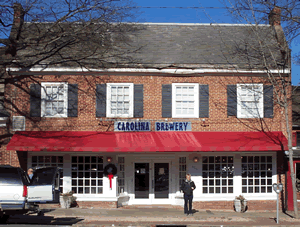
Enough vitriol-- on a lighter note, I present to you: #4562 of the things I will miss during my one year stint away from Chapel Hill, the place where my wee daughter was born, where my dad proposed to my mom in 1970, and where my great-grandpa used to play baseball as a Tarheel.
Drumroll, please....#4562:
The Carolina Brewery-- specifically its seasonal summer brew the Firecracker Pale Ale, which was added to the lineup in June and (according to the bartenders, who I have been grilling about it constantly) will run out sometime in September. The Firecracker is a light pale ale, somewhere between Sierra Nevada and sweet tea, and it's perfect for hot weather and bar exam stress. (Take it from one who knows). It's so good that I have started accruing 1 gallon growlers of the stuff, which I plan to transport with me in a giant cooler when I make the drive from Chapel Hill to Atlanta next week. (Tear, tear.).
As Prince might have said, nothing compares 2 this beer. Chapel Hill natives would be well advised to investigate further.
Subscribe to:
Posts (Atom)