Lynn Boggess is a great painter and a pretty good carpenter too. Blogging about our visit to his opening at Tyndall Galleries on Saturday night, Paul talks about his use of the trowel as his instrument of choice, as well as his amazing homemade easel (one of several). Folded up, it looks like a shallow wooden crate. With a few turns of a power screw in reverse, it transforms into a three-legged construction capable of accommodating a canvas in rugged terrains.
The paint on Boggess' works is so thick it takes about ten years to dry out fully, he speculates.
You don't have to know all that to appreciate his art, but it really does make you appreciate the work that goes into it.
Tuesday, April 29, 2008

Tuesday, April 22, 2008
When is organic worth the premium?
With prices of organic foods high and higher, it's hard to know when they are worth the money. Pesticides are toxic, but does that mean that all foods treated with pesticides are equally bad?
Here's a chart that sorts it out. Doesn't it seem that strawberries with all their squishy little pores would be the worst? They're not.
Here's a chart that sorts it out. Doesn't it seem that strawberries with all their squishy little pores would be the worst? They're not.
Thursday, April 17, 2008

Monday, April 14, 2008
Life against the overgrown
Public Art 360, the regional/national symposium that Janet Kagan & co. successfully pulled off this weekend in Chapel Hill, looks to have been a great success! Wish I could have attended more than just the one session on landscape architecture--but that one was pretty amazing.
Walter Hood, who grew up in Charlotte, is an artist, an architect, and a landscape architect; he's been called "one of the nation's rising stars of landscape architecture." His work is worthy of all those titles, and his mission is to show that the lines of separation are artificial. Given the character of some of his "interventions," I'd say he's a bit of a social worker and an activist as well. According to Metropolis magazine (July 2005),
I was particularly taken by his work in the Phillips community near Charleston, South Carolina, where he helped the residents defeat a proposal to widen a road. The project would have cut the community in two. This achievement was won through the concept of "the overgrown." Imagine a well-manicured suburban back yard at the edge of an undeveloped tract: you are peering across civilization into the overgrown. The overgrown can be used as shield or sword. You can clear your landscape to enjoy using it and perhaps to enjoy the proximity to your neighbor; or, say, you aren't that friendly with your neighbor: you might "let the overgrown take care of it."
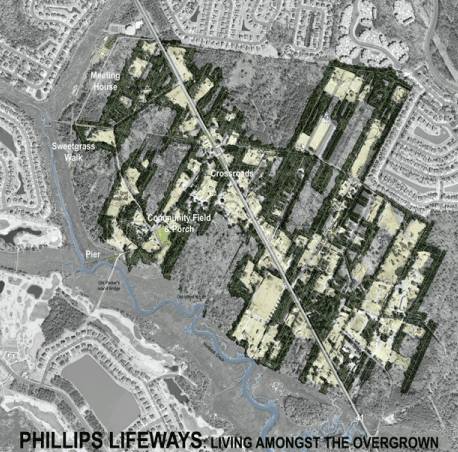
Through an aggressive use of the concept of the overgrown--including actual use of plant material to expand the vegetation in key corridors--Hood helped the community persuade the relevant officials that the widening of the road would be an assault upon the community.
(In some back yards, the line between civilization and the overgrown is under constant negotiation.)
Walter Hood, who grew up in Charlotte, is an artist, an architect, and a landscape architect; he's been called "one of the nation's rising stars of landscape architecture." His work is worthy of all those titles, and his mission is to show that the lines of separation are artificial. Given the character of some of his "interventions," I'd say he's a bit of a social worker and an activist as well. According to Metropolis magazine (July 2005),
At 46, Hood is now one of landscape architecture's leading public intellectuals: former chair of the department of Landscape Architecture and Environmental Planning at Berkeley, Pentagon memorial competition juror, and constant lecturer. As an African American in a profession with seemingly none and an urbanist in a discipline just barely breaking free of the pastoral, he's something of a phenomenon. His faculty position has given Hood the ability to pick and choose projects, a luxury he has exercised carefully and often polemically, working nearly exclusively in the public realm, and often in the inner city.
I was particularly taken by his work in the Phillips community near Charleston, South Carolina, where he helped the residents defeat a proposal to widen a road. The project would have cut the community in two. This achievement was won through the concept of "the overgrown." Imagine a well-manicured suburban back yard at the edge of an undeveloped tract: you are peering across civilization into the overgrown. The overgrown can be used as shield or sword. You can clear your landscape to enjoy using it and perhaps to enjoy the proximity to your neighbor; or, say, you aren't that friendly with your neighbor: you might "let the overgrown take care of it."
Through an aggressive use of the concept of the overgrown--including actual use of plant material to expand the vegetation in key corridors--Hood helped the community persuade the relevant officials that the widening of the road would be an assault upon the community.
(In some back yards, the line between civilization and the overgrown is under constant negotiation.)
Sunday, April 13, 2008
The very long civil rights movement
Ken Zogry already had a fine career established in public history by 1998: he had completed two books, both of which would end up winning awards, The Best the Country Affords: Vermont Furniture, 1765-1850 (The Bennington Museum: 1995), and The University’s Living Room: A History of the Carolina Inn (UNC: 1999). Then, something happened that changed his life. He was asked to take a look at an endangered house in downtown Raleigh, a house built in 1901 by Dr. Manassa Thomas Pope. Dr. Pope, a graduate of the medical school at Shaw University, was the first licensed African American doctor in North Carolina. His daughters lived in the house until into the 1990s.
In 1998, Zogry prepared a National Register nomination for the house, which by then was surrounded by parking lots. He ended up involved in a 10-year struggle to save the house and to turn it into the first house museum of an African American family in North Carolina. It's not yet open to the public, but there are great plans, and Zogry is the executive director of the Pope House Museum Foundation.
About 1,800 of the documents Zogry found in the house at the outset are now in the Southern Historical Collection at UNC. What especially piqued his interest was a 1906 voter registration card issued to Dr. Pope. "Everything I had learned said this should not exist," he said as he began his talk on Saturday morning at a conference on New Perspectives in African American History and Culture. The discovery launched him on an investigation into a fascinating and little-known story about black male political resistance to white supremacy in the first two decades of the twentieth century--in Raleigh. The result is his UNC dissertation, which he has just recently defended.
What Zogry has discovered is that Dr. Pope's action in registering to vote was part of a concerted voter registration effort that went on around 1906; then it stopped, to pick up again in 1916. Many questions remain unanswered, including why the 10-year hiatus, but it is clear that there was a strong movement among African Americans to participate in politics even as Jim Crow laws were tightening and the conservative Democrats were shoring up their power after retaking the government in 1898.
In 1919, Dr. Pope actually ran for mayor of Raleigh. He was joined on the ballot by African American candidates for commissioner of safety and commissioner of public works. With no hope of a chance, these men were making a statement: "the strongest possible public action that black leaders could take against disenfranchisement," according to Zogry.
The election was lost, but all was not lost. A student named Ella Baker was attending Shaw in 1918. According to Zogry, the election of 1919 was "a formative experience" for her. After graduation she moved to Harlem and began her life's work--which included becoming "a guiding force" behind both the Southern Christian Leadership Conference and the Student Nonviolent Coordinating Committee. In fact, said Zogry, it was no accident that SNCC was formed at Shaw: Baker could have taken it to any major black school, but Shaw provided "a strong connection to history."
Commenting on Zogry's paper, Fitz Brundgage called Dr. Pope's mayoral election campaign significant because of its threat to the "appearance of hegemony." It was significant "because it underscores the persistence of a commitment to black political action that extends far back," back before the 1950s, back before the 1930s (which is sometimes what we think of as the outer edge of the civil rights movement), back to within the very height of the Jim Crow period. And Brundage would even take it farther back. Rather than read Dr. Pope's story as a predecessor to what was to come later in the twentieth century, he "would read it backward and talk about a continuous black struggle for equality, with varying tactics, but a continuity of struggle," one that has never let up: These various episodes of civil rights activities should not be seen as separate events that just happened, but rather as a long steady march, by actors conscious of their own history from one generation to the next.
In 1998, Zogry prepared a National Register nomination for the house, which by then was surrounded by parking lots. He ended up involved in a 10-year struggle to save the house and to turn it into the first house museum of an African American family in North Carolina. It's not yet open to the public, but there are great plans, and Zogry is the executive director of the Pope House Museum Foundation.
About 1,800 of the documents Zogry found in the house at the outset are now in the Southern Historical Collection at UNC. What especially piqued his interest was a 1906 voter registration card issued to Dr. Pope. "Everything I had learned said this should not exist," he said as he began his talk on Saturday morning at a conference on New Perspectives in African American History and Culture. The discovery launched him on an investigation into a fascinating and little-known story about black male political resistance to white supremacy in the first two decades of the twentieth century--in Raleigh. The result is his UNC dissertation, which he has just recently defended.
What Zogry has discovered is that Dr. Pope's action in registering to vote was part of a concerted voter registration effort that went on around 1906; then it stopped, to pick up again in 1916. Many questions remain unanswered, including why the 10-year hiatus, but it is clear that there was a strong movement among African Americans to participate in politics even as Jim Crow laws were tightening and the conservative Democrats were shoring up their power after retaking the government in 1898.
In 1919, Dr. Pope actually ran for mayor of Raleigh. He was joined on the ballot by African American candidates for commissioner of safety and commissioner of public works. With no hope of a chance, these men were making a statement: "the strongest possible public action that black leaders could take against disenfranchisement," according to Zogry.
The election was lost, but all was not lost. A student named Ella Baker was attending Shaw in 1918. According to Zogry, the election of 1919 was "a formative experience" for her. After graduation she moved to Harlem and began her life's work--which included becoming "a guiding force" behind both the Southern Christian Leadership Conference and the Student Nonviolent Coordinating Committee. In fact, said Zogry, it was no accident that SNCC was formed at Shaw: Baker could have taken it to any major black school, but Shaw provided "a strong connection to history."
Commenting on Zogry's paper, Fitz Brundgage called Dr. Pope's mayoral election campaign significant because of its threat to the "appearance of hegemony." It was significant "because it underscores the persistence of a commitment to black political action that extends far back," back before the 1950s, back before the 1930s (which is sometimes what we think of as the outer edge of the civil rights movement), back to within the very height of the Jim Crow period. And Brundage would even take it farther back. Rather than read Dr. Pope's story as a predecessor to what was to come later in the twentieth century, he "would read it backward and talk about a continuous black struggle for equality, with varying tactics, but a continuity of struggle," one that has never let up: These various episodes of civil rights activities should not be seen as separate events that just happened, but rather as a long steady march, by actors conscious of their own history from one generation to the next.
Friday, April 11, 2008
Denis Cosgrove
My friend David Lowenthal has written a beautiful obituary in The Independent of London about a friend of his, Denis Cosgrove, who died too young, at 57. It surely would have been a pleasure to have known Professor Cosgrove.
Prizing geography's traditional mélange of nature and culture, Cosgrove had little affinity with either the abstract positivism of spatial science or the radical activism of post-colonial social critique. Happy in 16th-century Italy, he recalled that at home and at his Jesuit school, Rome had always been more important than London. Like Renaissance humanists, he saw the fulfilled life as a balance between the vita activa and the vita contemplativa; for himself he chose contemplation, self-reflection, thoughtful critical converse. His vocation was less about changing the world than changing oneself. Whereas policy-driven social science was blind to the liberating and consoling power of beauty, dismissing it as veneer and distraction, Cosgrove's aesthetic concern reflected his conviction that beauty was inseparable from goodness and truth. In common with Stoics and Jesuits, he told an interviewer, he valued education as "something that feeds the soul and the mind and the body together, posing questions like 'Who are we in relation to the world? How should we live our lives in a way that is fulfilling and morally proper?' "
In that quest, he was eminently successful. His warmth, humour, kindness, delight in children, theirs in him, and intellectual challenge, charmed and dazzled all who knew him.
Thursday, April 10, 2008
Bill Ferris-fest, and much more this weekend
There's too much going on in Chapel Hill this week for one person to possibly take in. Last night, Bill Ferris presented some of his rare and wonderful documentary films of Mississippi blues artists that he started making in the late 1960s. Today, this Renaissance southern scholar was on The State of Things on another subject: the 100th anniversary of the birth of Richard Wright, which is being celebrated at UNC this weekend in a big way. That conference begins on Saturday night with a staged reading of Paul Green's dramatic adaptation of Native Son. It culminates Sunday night in an event in Memorial Hall featuring Wright's daughter Julia Wright.
Meanwhile on Friday and Saturday, you could go to the conference on New Perspectives in African American History and Culture, sponsored by UNC's African American History Working Group.
Also on Friday and Saturday, you could experience Public Art 360: Symposium from Seven Perspectives. Kudos to Janet Kagan for working so hard to bring this conference together--it will gather public art professionals and interested folks from across the Southeast.
On Saturday and Sunday, you could delight yourself on the Chapel Hill Spring Garden Tour, visiting gardens in the Oaks and Meadowmont, including the gardens of the historic DuBose home.
On Sunday and Monday, you could go Beyond the Sunbelt: Southern Economic Development in a Global Context.
Don't know how many of these riches I can absorb. I'll start tomorrow with a summit on affordable housing in Chatham County, where I'm a panelist. Good to see they are thinking in this direction.
Meanwhile on Friday and Saturday, you could go to the conference on New Perspectives in African American History and Culture, sponsored by UNC's African American History Working Group.
Also on Friday and Saturday, you could experience Public Art 360: Symposium from Seven Perspectives. Kudos to Janet Kagan for working so hard to bring this conference together--it will gather public art professionals and interested folks from across the Southeast.
On Saturday and Sunday, you could delight yourself on the Chapel Hill Spring Garden Tour, visiting gardens in the Oaks and Meadowmont, including the gardens of the historic DuBose home.
On Sunday and Monday, you could go Beyond the Sunbelt: Southern Economic Development in a Global Context.
Don't know how many of these riches I can absorb. I'll start tomorrow with a summit on affordable housing in Chatham County, where I'm a panelist. Good to see they are thinking in this direction.
Wednesday, April 09, 2008
Good question: Why don't we celebrate April 9?
On this day in 1865, Robert E. Lee surrendered. The nightmare of the civil war was officially ended; the Union would be one again. Why, then, asks Kevin Levin at Civil War Memory, is this day not celebrated?
Kevin is being cagey here. As he knows better than most, whole books have been written to explain that after the war, what happened was a massive "reconciliation." The Confederacy was not treated like a defeated nation: President Andrew Johnson would not honor the promise of 40 acres and a mule to freed slaves. Eventually even ex-Confederate soldiers and their widows received pensions from the United States government. Our men died, your men died, it was awful: let's get over it and get on with things--so went the rhetoric of reconciliation as cities and towns on both sides of the Mason-Dixon Line ushered in Jim Crow. It's kind of as if the war didn't happen, or at least that it was all a big mistake. President Wilson spoke at the 50th anniversary of Gettysburg--where Union and Confederate veterans gallantly shook hands--without once mentioning emancipation. So it's little wonder that this day of the great achievement of the Union victory goes unnoticed.
At a Civil War symposium on the UNC campus a couple of weeks ago, Gary Gallagher gave an interesting interpretation of the various ways in which the war was conceived and remembered. Talking from his new book, Causes Won, Lost, and Forgotten: How Hollywood and Popular Art Shape What We Know about the Civil War (UNC Press), he outlined four dominant narrative traditions that have shaped our understanding of the war.
A celebration of Grant's victory over Lee on April 9, 1865 would fit within the "Union Cause" narrative. And yet, as Gallagher persuasively argues at least as to the way the Civil War has been presented in movies since the movie "Glory" in 1989, the "Union Cause" narrative in our own time is supremely unpopular. In movie after movie--fourteen or so that he discussed--Union soldiers are depicted as ugly, violent, dishonest characters. There is no celebration of the United States as a great nation worthy of victory and respect. Yet as Gallagher further detailed, the goal of preserving the Union for the sake of its own preservation was a dominant narrative just before and during the Civil War itself. How would it look to European countries if this fragile experiment in democracy could not survive even 100 years?
What happened to the positive narrative of saving the Union for its own sake--the cause that Lincoln, among so many others, so fervently believed in? Even slaveholding southerners, at least those of a certain class, were reluctant to let the idea of one nation go for the sake of the rebel cause. Said North Carolina Judge Thomas Ruffin at a peace conference held in Washington in 1861, "I was born before the Constitution was adopted. May God grant that I not outlive it."
The more powerful narrative of reconciliation overcame it, in part; the narrative of the Lost Cause held on for a long time and survives in some quarters; the narrative of emancipation has reemerged since the civil rights movement, coming to fruition in movies like "Glory." But even when emancipation is celebrated, the Union soldiers come off as complete jerks. Why is that?
Gallagher's theory is that Hollywood is speaking to our time, as it always does speak to its own time, always in the interest of box office returns. And that in our time, whether you are on the left or the right, the federal government is not the good guy.
Kevin is being cagey here. As he knows better than most, whole books have been written to explain that after the war, what happened was a massive "reconciliation." The Confederacy was not treated like a defeated nation: President Andrew Johnson would not honor the promise of 40 acres and a mule to freed slaves. Eventually even ex-Confederate soldiers and their widows received pensions from the United States government. Our men died, your men died, it was awful: let's get over it and get on with things--so went the rhetoric of reconciliation as cities and towns on both sides of the Mason-Dixon Line ushered in Jim Crow. It's kind of as if the war didn't happen, or at least that it was all a big mistake. President Wilson spoke at the 50th anniversary of Gettysburg--where Union and Confederate veterans gallantly shook hands--without once mentioning emancipation. So it's little wonder that this day of the great achievement of the Union victory goes unnoticed.
At a Civil War symposium on the UNC campus a couple of weeks ago, Gary Gallagher gave an interesting interpretation of the various ways in which the war was conceived and remembered. Talking from his new book, Causes Won, Lost, and Forgotten: How Hollywood and Popular Art Shape What We Know about the Civil War (UNC Press), he outlined four dominant narrative traditions that have shaped our understanding of the war.
Gallagher argues that popular understandings of the war have been shaped by four traditions that arose in the nineteenth century and continue to the present: the Lost Cause, in which Confederates are seen as having waged an admirable struggle against hopeless odds; the Union Cause, which frames the war as an effort to maintain a viable republic in the face of secessionist actions; the Emancipation Cause, in which the war is viewed as a struggle to liberate 4 million slaves and eliminate a cancerous influence on American society; and the Reconciliation Cause, which represents attempts by northern and southern whites to extol "American" virtues and mute the role of African Americans.
A celebration of Grant's victory over Lee on April 9, 1865 would fit within the "Union Cause" narrative. And yet, as Gallagher persuasively argues at least as to the way the Civil War has been presented in movies since the movie "Glory" in 1989, the "Union Cause" narrative in our own time is supremely unpopular. In movie after movie--fourteen or so that he discussed--Union soldiers are depicted as ugly, violent, dishonest characters. There is no celebration of the United States as a great nation worthy of victory and respect. Yet as Gallagher further detailed, the goal of preserving the Union for the sake of its own preservation was a dominant narrative just before and during the Civil War itself. How would it look to European countries if this fragile experiment in democracy could not survive even 100 years?
What happened to the positive narrative of saving the Union for its own sake--the cause that Lincoln, among so many others, so fervently believed in? Even slaveholding southerners, at least those of a certain class, were reluctant to let the idea of one nation go for the sake of the rebel cause. Said North Carolina Judge Thomas Ruffin at a peace conference held in Washington in 1861, "I was born before the Constitution was adopted. May God grant that I not outlive it."
The more powerful narrative of reconciliation overcame it, in part; the narrative of the Lost Cause held on for a long time and survives in some quarters; the narrative of emancipation has reemerged since the civil rights movement, coming to fruition in movies like "Glory." But even when emancipation is celebrated, the Union soldiers come off as complete jerks. Why is that?
Gallagher's theory is that Hollywood is speaking to our time, as it always does speak to its own time, always in the interest of box office returns. And that in our time, whether you are on the left or the right, the federal government is not the good guy.
Friday, April 04, 2008
MLK anniversary resources
Legal History Blog has a nice roundup of remembrances on the 40th anniversary of Dr. King's assassination, including a link to the remarkable speech by Robert Kennedy Jr.
Law and Humanities Blog takes the opportunity to compile a list of movies featuring minority characters and civil rights themes.
North Carolina Miscellany documents a peaceful march in Burlington, North Carolina on April 8, 1968.
Events in Raleigh were less than peaceful.
Law and Humanities Blog takes the opportunity to compile a list of movies featuring minority characters and civil rights themes.
North Carolina Miscellany documents a peaceful march in Burlington, North Carolina on April 8, 1968.
Events in Raleigh were less than peaceful.
Thursday, April 03, 2008
Combating sex trafficking: UNC conference
Today I've been in another world. I've been to central southern Nigeria, a region so poor, where the future is so bleak, that families send their daughters into sexual slavery. Many of them end up in Italy, where they are sold to madams, Nigerian women who too have done their time in enforced prostitution. In elaborate juju ceremonies they are sworn never to reveal the identities of their traffickers: "If they betray this, they and their family are going to suffer some kind of unidentified horrid thing," said Esohe Aghatise, a lawyer and activist working to support these women.
Through Dorchen Liedholdt I've gotten acquainted with Sigma Huda, a Bangladeshi lawyer and United Nations Special Rapporteur on Trafficking in Persons, whose work is so threatening that her government has put her in detention.
I've met Jeanette, a 13-year-old runaway at a bus station in Boston, and watched her become seduced by Billy, an "entrepreneur" who cons her into joining his "family" of working girls.
All of these stories and much more are being told at an international conference taking place at the Friday Center, sponsored by the Carolina Women's Center at UNC: "Combating Sex Trafficking: Prevention and Intervention in North Carolina and Worldwide." Tomorrow I'm on as moderator of a panel on legal advocacy.
Through Dorchen Liedholdt I've gotten acquainted with Sigma Huda, a Bangladeshi lawyer and United Nations Special Rapporteur on Trafficking in Persons, whose work is so threatening that her government has put her in detention.
I've met Jeanette, a 13-year-old runaway at a bus station in Boston, and watched her become seduced by Billy, an "entrepreneur" who cons her into joining his "family" of working girls.
All of these stories and much more are being told at an international conference taking place at the Friday Center, sponsored by the Carolina Women's Center at UNC: "Combating Sex Trafficking: Prevention and Intervention in North Carolina and Worldwide." Tomorrow I'm on as moderator of a panel on legal advocacy.
Wednesday, April 02, 2008
Introducing Carson Dean
Tonight at the monthly meeting of the executive team for the Partnership to End Homelessness in Orange County, we welcomed Carson Dean into the staff position of coordinator for the plan. He comes to us from Raleigh, where he has been executive director of the South Wilmington Street shelter, Wake County's largest emergency and transitional shelter for homeless men. He has a wealth of experience relevant to the work of our ten-year plan. He helped to create an draft Wake County's ten-year plan. He was planning committee co-chair of Wake County's 2007 Project Homeless Connect.
During his time at South Wilmington Street he implemented a housing first program. Additionally, he secured a grant from Triangle United Way to start a program to find employment for chronically homeless men.
Earlier, Dean was a program director at Haven House Services, a nonprofit in Wake County that serves young people: runaways, homeless and trouble youth. There he implemented an innovative street outreach program.
We are very fortunate to have him in the position of coordinating our efforts! I look forward to working with him.
During his time at South Wilmington Street he implemented a housing first program. Additionally, he secured a grant from Triangle United Way to start a program to find employment for chronically homeless men.
Earlier, Dean was a program director at Haven House Services, a nonprofit in Wake County that serves young people: runaways, homeless and trouble youth. There he implemented an innovative street outreach program.
We are very fortunate to have him in the position of coordinating our efforts! I look forward to working with him.
Subscribe to:
Posts (Atom)