According to the Boston Globe, Meredith College in Raleigh is one of the venues vying for all or part of the Somerville Gates.
(Via Kottke.)
Sunday, February 27, 2005

Historic Watergate

This past week, the Watergate entered history as a modernist landmark, in a move that saved it from a dramatic redesign/redevelopment.
The scale and mixed-use program of Watergate required the formation of Washington's first private-initiative Planned Unit Development, a new and largely untested idea in urban planning. The building is a master work of prominent European Modernist Luigi Moretti, one of the most important twentieth-century Italian architects, and represents the only example of the architect's work in the United States. . . .
Furthermore, execution of the complex, curvilinear design exhibited at Watergate precipitated the use of a computer to efficiently calculate measurements of building elements, making Watergate one of the earliest known examples of computer-aided design in the country.
Evidently the D.C. Historic Preservation Review Board was comfortable making this designation even though it lacked one crucial piece of historical information: the identity of Deep Throat.
Saturday, February 26, 2005
Ending homelessness
Here are two stories about yesterday's announcement by Orange and Durham Counties of a commitment to end chronic homelessness in 10 years.

Craig Chancellor, Triangle United Way; Sen. Ellie Kinnaird; Philip Mangano, U.S. Interagency Council on Homelessness; Martha Are, N.C. Interagency Council for Coordinating Homelessness Programs.

Orange County Commissioner Moses Carey; Philip Mangano; Durham Mayor Bill Bell; Chapel Hill Mayor Kevin Foy; Durham Mayor Pro Tem Cora Cole-McFadden; Craig Chancellor.
Philip Mangano, head of the federal homelessness initiative, is an impressive voice for the voiceless. (I didn't take notes, but here's a representative stump speech.) For twenty years, he said, the community response to homelessness has been to manage it, to contain (or hide) people as best it could be done, with the hope that the problem would go away. But something has changed:
That's right, he's an abolitionist, and he embraces the obvious comparison.
Billie Guthrie, chair of the Orange County Community Initiative to End Homelessness, reported the results of the annual homeless count just conducted.
We have our work cut out for us. There's reason to be skeptical, with the Bush administration slashing one useful program after another (Section 8 housing vouchers for example). But there are also real reasons for hope.
Craig Chancellor, Triangle United Way; Sen. Ellie Kinnaird; Philip Mangano, U.S. Interagency Council on Homelessness; Martha Are, N.C. Interagency Council for Coordinating Homelessness Programs.
Orange County Commissioner Moses Carey; Philip Mangano; Durham Mayor Bill Bell; Chapel Hill Mayor Kevin Foy; Durham Mayor Pro Tem Cora Cole-McFadden; Craig Chancellor.
Philip Mangano, head of the federal homelessness initiative, is an impressive voice for the voiceless. (I didn't take notes, but here's a representative stump speech.) For twenty years, he said, the community response to homelessness has been to manage it, to contain (or hide) people as best it could be done, with the hope that the problem would go away. But something has changed:
We're no longer satisfied with managing the problem, maintenancing the effort, or accommodating the response. We have a new standard. Abolishing homelessness.
That's right, he's an abolitionist, and he embraces the obvious comparison.
Billie Guthrie, chair of the Orange County Community Initiative to End Homelessness, reported the results of the annual homeless count just conducted.
Total Number of Homeless People Counted in January 2005: 230
Homeless people in families: 59
--Homeless families with children are among the fastest growing segments of the homeless population. Indeed, in one year in Orange County, there has been a 40% growth in this population.
Homeless individuals: 171
Homeless children: 38
--Represents 16.5% of our total population.
Homeless people with a history of domestic violence: 48
--Battered women who live in poverty are often forced to choose between abusive relationships and homelessness. This population represents 21% of our total homeless population.
Chronically homeless people: 70
--Most startling and most telling statistic is that the chronic homeless now represent 30% of our total population, well above the national average of 10%. These folks are disabled individuals who remain continuously homeless or constantly cycling in and out of homelessness. Research shows they are also very hard to serve and consume a disproportionately large amount of costly community resources (i.e. emergency shelter resources, police and EMS resources and hospital visits).
We have our work cut out for us. There's reason to be skeptical, with the Bush administration slashing one useful program after another (Section 8 housing vouchers for example). But there are also real reasons for hope.
Friday, February 25, 2005
Labors lost (liminal thoughts)
The 20th century is over. Y2K hysteria is a distant memory; whether the century ended on Dec. 31, 1999, or a year later is irrelevant. Besides, as surely as history tells us that the 16th century ended with the death of Queen Elizabeth in 1603, and that the 19th century ended with the death of Queen Victoria in 1901,

we know that the 20th century ended with the deaths of thousands on September 11, 2001.
The first book that I've read that looks upon the 20th century steadily and whole, as a completed whole, is Passed On, Karla Holloway's fascinating investigation of African American mourning rituals. This book is worth reading for lots of reasons, but what interests me here is that simple fact. For it was, frankly, a little unnerving, accurate though it was: the 20th century as told in the past tense.
If you have any doubt that the 20th century is over, LostLabor, a collection of photos of American factory workers 1900-1980, will set you straight.

I'm showing my age, I know. Virginia Woolf was born in 1882. She and her sister Vanessa delighted in leaving the 19th century behind. They were children of the new century! But I'm in a mid-century cohort--old enough to remember when the next turn of the century was unimaginably far off. I'm betwixt and between, wandering between two worlds. And unlike Paul, I'm not immune from Social Security "reform."
Children born in 1982 and after--the "millennial generation," they've been called--are already catching the vibes of the new century: they learn differently, they're "more hands-on, more experiential (and) more comfortable working in teams." Our child of the 1990s fits the description. I want to think it's a hopeful picture.
we know that the 20th century ended with the deaths of thousands on September 11, 2001.
The first book that I've read that looks upon the 20th century steadily and whole, as a completed whole, is Passed On, Karla Holloway's fascinating investigation of African American mourning rituals. This book is worth reading for lots of reasons, but what interests me here is that simple fact. For it was, frankly, a little unnerving, accurate though it was: the 20th century as told in the past tense.
If you have any doubt that the 20th century is over, LostLabor, a collection of photos of American factory workers 1900-1980, will set you straight.
I'm showing my age, I know. Virginia Woolf was born in 1882. She and her sister Vanessa delighted in leaving the 19th century behind. They were children of the new century! But I'm in a mid-century cohort--old enough to remember when the next turn of the century was unimaginably far off. I'm betwixt and between, wandering between two worlds. And unlike Paul, I'm not immune from Social Security "reform."
Children born in 1982 and after--the "millennial generation," they've been called--are already catching the vibes of the new century: they learn differently, they're "more hands-on, more experiential (and) more comfortable working in teams." Our child of the 1990s fits the description. I want to think it's a hopeful picture.
Thursday, February 24, 2005
Homelessness initiative in Orange County
Tomorrow morning I'll be taking part in a joint press conference to announce the launch of a 10-year program to end chronic homelessness in Orange County. The announcement will take place at Project Homestart, the Inter-Faith Council's shelter for women and children.
Philip Mangano, executive director of the Interagency Council on Homelessness, will be with us to talk about how what we are about to do fits within state and national contexts.
In many ways, the thought of ending homelessness in these Dickensian times sounds like a pipe dream. But maybe it isn't. Architect Sam Davis shows that people elsewhere are making progress in ways we can learn from. They're doing it through broad, creative approaches that go far beyond emergency bed and board--for example Dome Village in L.A.
A Chapel Hill resident who has been homeless in his time tells me how important it is to have access to tools and a secure place to store them. I suspect there are lots of ideas like this that we should hear as we ponder the whole continuum of care.
Philip Mangano, executive director of the Interagency Council on Homelessness, will be with us to talk about how what we are about to do fits within state and national contexts.
In many ways, the thought of ending homelessness in these Dickensian times sounds like a pipe dream. But maybe it isn't. Architect Sam Davis shows that people elsewhere are making progress in ways we can learn from. They're doing it through broad, creative approaches that go far beyond emergency bed and board--for example Dome Village in L.A.
A Chapel Hill resident who has been homeless in his time tells me how important it is to have access to tools and a secure place to store them. I suspect there are lots of ideas like this that we should hear as we ponder the whole continuum of care.
Duke conference on internet and agency decisionmaking
Blogger-law professor Michael Froomkin will be up from Florida tomorrow for the Duke Law Journal Thirty-Fifth Annual Administrative Law Conference, along with others including Zephyr Teachout (a former editor-in-chief of the Duke Law Journal).
The goal of this conference will be to examine, from empirical, legal, and practical perspectives, the effect of the Internet on agency decisionmaking. Specifically, the conference will consider the following questions:
- Is this another area in which the influence of the Internet has been overhyped?
- Does the rise of the Internet pose new challenges and opportunities to public agencies?
- Can the Internet help solve the collective action problem?
- Do e-mail campaigns reflect true grassroots activism?
Wednesday, February 23, 2005
Royalty
The news of Prince Charles' betrothal to Camilla Parker Bowles ("transformed" of late "from dowdy, outdoorsy aristocrat to classy royal consort") has put me in mind of an essay by Virginia Woolf.
Royalty to begin with, merely as an experiment in the breeding of human nature, is of great psychological interest. For centuries a certain family has been segregated; bred with a care only lavished upon race-horses; splendidly housed, clothed, and fed; abnormally stimulated in some ways, suppressed in others; worshipped, stared at, and kept shut up, as lions and tigers are kept, in a beautiful brightly lit room behind bars. The psychological effect upon them must be profound; and the effect upon us is as remarkable. Sane men and women as we are, we cannot rid ourselves of the superstition that there is something miraculous about these people shut up in their cage. Common sense may deny it; but take common sense for a walk through the streets of London on the Duke of Kent's wedding-day. Not only will he find himself in a minority, but as the gold coach passes and the bride bows, his hand will rise to his head; off will come his hat, or on the contrary it will be rammed firmly on his head. In either case he will recognize the divinity of royalty.
Tuesday, February 22, 2005
The opposite of homed
As I remarked last fall at our homelessness roundtable (quoting authorities better versed in it all than I), to call someone "homeless" is distinctive and telling. To be homeless is to be defined by a lack, the lack of a home. In prior times the same person might have been called a bum, a drifter, a tramp, a vagabond. (Carl Sandburg was once, by his own account, a hobo.) Perhaps these terms became disreputable on their own terms, and so all that was left was a negative identity. We don't know what to call them, but we know what they are not, what crucial thing they do not have: a home. No fixed address.
If you have no address, where do get your mail? Will your letter to the editor be published? (The one time I had a letter published in the Washington Post, they called me at home to verify that I was for real.) If you live out of a van, where can you send your child to school? Where can you register to vote? (If you are interested.) Without firm grounding, what position of authority can you claim?
Having your own household is the beginning of autonomy--this was Aristotle's belief, and it became worked out in English common law. The private sphere, the enjoyment of the privacy of your own home, was a positive asset: the home as refuge from the regulated public sphere, from the authority of the sovereign. It is one half of Shakespeare's "local habitation and a name."
Home is a powerful metaphor. Bring your point home. You're home free. And of course, your home page.
The Homeless Guy has a home page. I understand he makes good use of the Nashville Public Library. Is he unusual? He is unusually articulate, but he may not be that unusual. He's a man without a home, for particular reasons, and he would be happer if he had one (an apartment would do).
In the same way that no one knows you're a dog, on the internet no one has to know you are homeless. You can look for work. You can offer to do work. There is much potential here it seems.
So I asked in the Chapel Hill Public Library about their policy on offering internet services to persons with no fixed address. The woman at the reference desk was not exactly sure. She found out that in order to register to use the internet--and you do have to give information about yourself--you do not have to give an address, not even the address of the homeless shelter. But if you want to check out a book, ah, that is a different question.
If you have no address, where do get your mail? Will your letter to the editor be published? (The one time I had a letter published in the Washington Post, they called me at home to verify that I was for real.) If you live out of a van, where can you send your child to school? Where can you register to vote? (If you are interested.) Without firm grounding, what position of authority can you claim?
Having your own household is the beginning of autonomy--this was Aristotle's belief, and it became worked out in English common law. The private sphere, the enjoyment of the privacy of your own home, was a positive asset: the home as refuge from the regulated public sphere, from the authority of the sovereign. It is one half of Shakespeare's "local habitation and a name."
Home is a powerful metaphor. Bring your point home. You're home free. And of course, your home page.
The Homeless Guy has a home page. I understand he makes good use of the Nashville Public Library. Is he unusual? He is unusually articulate, but he may not be that unusual. He's a man without a home, for particular reasons, and he would be happer if he had one (an apartment would do).
In the same way that no one knows you're a dog, on the internet no one has to know you are homeless. You can look for work. You can offer to do work. There is much potential here it seems.
So I asked in the Chapel Hill Public Library about their policy on offering internet services to persons with no fixed address. The woman at the reference desk was not exactly sure. She found out that in order to register to use the internet--and you do have to give information about yourself--you do not have to give an address, not even the address of the homeless shelter. But if you want to check out a book, ah, that is a different question.
Monday, February 21, 2005
The Oranging of America
The clock is ticking on The Gates, but there's still time for The Somerville Gates (via Ed Cone) and The Crackers (via Majikthise).
Pace Max Apple.
Pace Max Apple.
Just beautiful
From Gilead, a novel:
In writing this, I notice the care it costs me not to use certain words more than I ought to. I am thinking about the word "just." I almost wish I could have written that the sun just shone and the tree just glistened, and the water just poured out of it and the girl just laughed--when it's used that way it does indicate a stress on the word that follows it, and also a particular pitch of the voice. People talk that way when they want to call attention to a thing existing in excess of itself, so to speak, a sort of purity or lavishness, at any rate something ordinary in kind but exceptional in degree. So it seems to me at the moment. There is something real signified by that word "just" that proper language won't acknowledge. It's a little like the German ge-. I regret that I must deprive myself of it. It takes half the point out of telling the story.
And now having finished this lovely meditative novel, I note that toward the end, the narrator does use the intensifier "just" on a couple of occasions, just lets himself go I suppose. It made me smile. There've been lots of reviews of the book, none better than the one at The Revealer.
In writing this, I notice the care it costs me not to use certain words more than I ought to. I am thinking about the word "just." I almost wish I could have written that the sun just shone and the tree just glistened, and the water just poured out of it and the girl just laughed--when it's used that way it does indicate a stress on the word that follows it, and also a particular pitch of the voice. People talk that way when they want to call attention to a thing existing in excess of itself, so to speak, a sort of purity or lavishness, at any rate something ordinary in kind but exceptional in degree. So it seems to me at the moment. There is something real signified by that word "just" that proper language won't acknowledge. It's a little like the German ge-. I regret that I must deprive myself of it. It takes half the point out of telling the story.
And now having finished this lovely meditative novel, I note that toward the end, the narrator does use the intensifier "just" on a couple of occasions, just lets himself go I suppose. It made me smile. There've been lots of reviews of the book, none better than the one at The Revealer.
Princeville: back from the brink
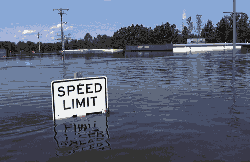
Princeville, N.C., Sept. 1999 (U.S. Army)
After the destruction of Hurricane Floyd in 1999, residents of Princeville did a courageous thing: they refused a federal buyout. Then they worked hard to make sure it was the right decision.

Princeville Town Hall
The bet paid off. A thriving Princeville celebrated its 120th anniversary on Feb. 17. Jonathan Tilove, a Newhouse reporter about whom I've written before, came down and wrote a really nice story about it:
In September 1999, Hurricane Floyd brought what they call the Great Flood to this poor little town along the banks of the Tar River. For 10 days Princeville, the nation's first town chartered by blacks, was under water. Even the ancestors, it seemed, were bailing out--161 caskets dislodged from their final resting place were floating in eerie eddies.
More . . .
Sunday, February 20, 2005
Altitude with attitude
Asheville is full of stories like this:
The transformative concentration of vortices and power spots around Asheville--"beneficial earth energies," all--has been noted.
Comes now documentary proof. Interviewed in The Guardian about a recent film about him, Robert Moog, who lives in Asheville, offers a theory of conscious energy shared between man and machine:
Skeptical? See for yourself.
I met an attractive woman at a Unity Sunday service, an active participant in the new community who moved here a few years ago. She, like many others I have chatted with over the past four years gave a story: "Everywhere I looked, I saw something about Asheville. Word on the 'metaphysical street' hinted that Asheville was fast becoming the new spiritual Mecca," she shared.
The transformative concentration of vortices and power spots around Asheville--"beneficial earth energies," all--has been noted.
Comes now documentary proof. Interviewed in The Guardian about a recent film about him, Robert Moog, who lives in Asheville, offers a theory of conscious energy shared between man and machine:
.
On the telephone from North Carolina, Moog struggles to put into words how he feels he has an organic connection with the circuitry [of his musical instruments], rather like a violinst has with wood. Then the dam bursts.
"Look, my wife is a retired philosophy lecturer, and she says that the notion that machinery doesn't have consciousness is a crock of shit. Everything has some consciousness, and we tap into that. It's about that energy at its most basic level.
There are confirmed stories of people who can break instruments and cause them to fail by walking in a room. I'm the opposite--I can walk into a room and something will work better than it is supposed to.
Skeptical? See for yourself.
Saturday, February 19, 2005
raleighpolitics.anonymouscowards.org
The News & Observer reports today on a self-identified progressive political blog in Raleigh . . . whose authors use pseudonyms. C'mon out, y'all, it can't be that bad.
A type for everyone
My great-grandfather was a 19th c. newspaperman who set his own type by hand. Well into my childhood (till the offset revolution of the 1960s), The Gilmer Mirror was set in hot type from Linotype machines (which my mother wanted to learn how to operate, but her parents forbade).

All my life I've been fascinated with typefaces. It delights and amazes me that new ones are invented all the time.
All my life I've been fascinated with typefaces. It delights and amazes me that new ones are invented all the time.
Tobacco through the ages
Interesting and musical blogger "Melinama," who I "met" from across the room at the Triangle Bloggers Conference, reflects diachronically on a recent trip down east.
Friday, February 18, 2005
Fundamental revisionism
Wish I'd been in Buffalo today to hear Paul Finkelman, a legal scholar I'm more used to hearing from on the slavery law listserv, on the Ten Commandments cases. He was an expert witness in case against Judge Roy Moore.
The case against Moore's massive monument was easy. As a lower court judge he kept a wooden plaque of the Ten Commandments at his bench and routinely invited prayer sessions. He ran for Alabama Supreme Court on a platform "to restore the moral foundation of law." Once elected, he installed in the rotunda of the court building, under cover of darkness, a 5,280 pound granite Decalogue. The installation was filmed by an evangelical group in anticipation of using funds from the film to underwrite Moore's legal bills. At the public unveiling, the judge made a grand speech about the moral foundation of law. "In closing, he told the audience that they would 'find no documents surrounding the Ten Commandments because they stand alone as an acknowledgment of that God that's contained in our pledge, contained in our motto, and contained in our oath.'" (Glassroth v. Moore, 11th Cir. 2003.) And it's precisely there that his case came apart--as if it hadn't already.
In what must have been someone's attempt to lend him a semblance of legality, he was asked if he'd allow two companion displays: one Dr. King's "I Have a Dream" speech and the other an atheist group's display of a symbol of atheism. He said no to both. He eventually did concede to a line from Dr. King's "Letter from a Birmingham Jail" regarding God's moral laws and a God-approving quote from Frederick Douglass. But he still lost, and the Supreme Court refused to hear the appeal.
The two cases coming before the Court in a couple of weeks are not quite so blatant. McCreary County v. ACLU of Kentucky is an appeal of a 6th Cir. decision finding that displays of the Ten Commandments in two county courthouses and a public school were unconstitutional. Van Orden v. Texas is an appeal from a 5th Cir. opinion declaring it constitutional for a stone Decalogue to stand, with various other monuments, on the grounds of the Texas Capitol.
The Commandment-backers in these cases try to say that the display is simply a part of a secular historical context (a claim that drives Baptists into the arms of atheists). No matter how hard they try, though, they can't construct an accurate history that puts their document at the center of the American story. In the Kentucky case, they tried very hard--even reminding the court that Ronald Reagan declared 1983 "The Year of the Bible." But "[t]he fact that the Ten Commandments appear in a historical governmental publication, such as the Congressional Record," the 6th Circuit Court said, "does not 'secularize' the Ten Commandments."
Finkelman and other legal historians make these points in an amicus brief (.pdf). "[T]here is no historical basis for singling out the Ten Commandments as seminal in the foundation of American law," they write.
The case against Moore's massive monument was easy. As a lower court judge he kept a wooden plaque of the Ten Commandments at his bench and routinely invited prayer sessions. He ran for Alabama Supreme Court on a platform "to restore the moral foundation of law." Once elected, he installed in the rotunda of the court building, under cover of darkness, a 5,280 pound granite Decalogue. The installation was filmed by an evangelical group in anticipation of using funds from the film to underwrite Moore's legal bills. At the public unveiling, the judge made a grand speech about the moral foundation of law. "In closing, he told the audience that they would 'find no documents surrounding the Ten Commandments because they stand alone as an acknowledgment of that God that's contained in our pledge, contained in our motto, and contained in our oath.'" (Glassroth v. Moore, 11th Cir. 2003.) And it's precisely there that his case came apart--as if it hadn't already.
In what must have been someone's attempt to lend him a semblance of legality, he was asked if he'd allow two companion displays: one Dr. King's "I Have a Dream" speech and the other an atheist group's display of a symbol of atheism. He said no to both. He eventually did concede to a line from Dr. King's "Letter from a Birmingham Jail" regarding God's moral laws and a God-approving quote from Frederick Douglass. But he still lost, and the Supreme Court refused to hear the appeal.
The two cases coming before the Court in a couple of weeks are not quite so blatant. McCreary County v. ACLU of Kentucky is an appeal of a 6th Cir. decision finding that displays of the Ten Commandments in two county courthouses and a public school were unconstitutional. Van Orden v. Texas is an appeal from a 5th Cir. opinion declaring it constitutional for a stone Decalogue to stand, with various other monuments, on the grounds of the Texas Capitol.
The Commandment-backers in these cases try to say that the display is simply a part of a secular historical context (a claim that drives Baptists into the arms of atheists). No matter how hard they try, though, they can't construct an accurate history that puts their document at the center of the American story. In the Kentucky case, they tried very hard--even reminding the court that Ronald Reagan declared 1983 "The Year of the Bible." But "[t]he fact that the Ten Commandments appear in a historical governmental publication, such as the Congressional Record," the 6th Circuit Court said, "does not 'secularize' the Ten Commandments."
To be sure, "the fact that the Founding Fathers believed devotedly that there was a God and that the unalienable rights of man were rooted in Him is clearly evidenced in their writings, from the Mayflower Compact to the Constitution itself." . . . There is by no means a consensus, however, that the source of Thomas Jefferson's belief in divinely-bestowed, unalienable rights, to the extent this belief inspired the writing of the Declaration, was the Ten Commandments or even the Bible. . . .
Although this Court has neither the ability nor the authority to determine the "correct" view of American history, it is our role to recognize that (a) Defendants' displays provided the viewer with no analytical or historical connection between the Ten Commandments and the other historical documents; and (b) Defendants have made no attempt in this litigation to support the displays' historical assertions with relevant and credible evidence.
Finkelman and other legal historians make these points in an amicus brief (.pdf). "[T]here is no historical basis for singling out the Ten Commandments as seminal in the foundation of American law," they write.
Moonscape

Jeff Pomerantz tells how this picture of Titan, taken by the Huygens space probe, came to be--and what it has to do with the new media revolution.
Thursday, February 17, 2005
Blogging homelessness
Thanks to Terri for pointing out the column in today's Daily Tar Heel on an up-close encounter with a few homeless people. "It was the best lunch I had ever had with people I had never met before," writes Lauren Craig. Once again a real encounter demolishes a stereotype.
There's a thriving blogger community in Nashville (Greensboro envy). Among them is a homeless guy.
There's a thriving blogger community in Nashville (Greensboro envy). Among them is a homeless guy.
Censored
Maybe it's happened to you too. You're surfing the net and without warning they find you: pictures of bodies blown to pieces, arms and legs in pools of blood, unrecognizable heaps on the asphalt. Images of war. And yet we are not even supposed to see the caskets coming home.
"What role should patriotism play in war reporting?" "None," says Walter Cronkite.
"What role should patriotism play in war reporting?" "None," says Walter Cronkite.
Subscribe to:
Posts (Atom)