Maybe you're within striking distance to make it up to Cherokee County by 10 p.m. tonight--in time for the 11th annual possum drop. It's a real possum this time, but don't worry, "The opossum is not actually 'dropped,' it is lowered with great care. We treat our little friend with respect, hold him in awe, and do not inflict any injury or traumatize God's creature of the night."
Here's what I had to say about it last year. No, I haven't been. Maybe next year.
Saturday, December 31, 2005

Friday, December 30, 2005
Slow reentry (production v. consumption)
We were in Texas for Christmas. Paul flew back on Tuesday; Tucker and I drove back yesterday and today, stopping over in Birmingham, which is halfway. The weather was lovely--wished we'd had our sandals--and thanks to the interstate, there's really nothing to the drive. Especially with 11 hours of Ender's Game on CD.
Santa brought me something I didn't think to ask for: The complete New Yorker DVD. Yes it's a pain not to be able to download the discs to your own hard drive. Yes it's a challenge to navigate. Nevertheless.
I'm reminded of something Bob Bain used to say to his freshman composition students. Dr. Robert Bain was a wonderful UNC English professor. He would say to his students, You are about to go from being consumers (of writing) to producers. But enough already. Being a consumer is enough. More than 4,000 issues, half a million pages of The New Yorker! What more is there to say, and not lamely?
Santa brought me something I didn't think to ask for: The complete New Yorker DVD. Yes it's a pain not to be able to download the discs to your own hard drive. Yes it's a challenge to navigate. Nevertheless.
I'm reminded of something Bob Bain used to say to his freshman composition students. Dr. Robert Bain was a wonderful UNC English professor. He would say to his students, You are about to go from being consumers (of writing) to producers. But enough already. Being a consumer is enough. More than 4,000 issues, half a million pages of The New Yorker! What more is there to say, and not lamely?
Sunday, December 25, 2005

Saturday, December 24, 2005
Jesus in the schools: Texas showdown
Unfazed by the Dover decision, the school board in Odessa, Texas has followed through on plans to adopt the curriculum of the Greensboro-based National Council on Bible Curriculum in Public Schools. Among other advantages, this curriculum uses the Saint King James version.
Wednesday, December 21, 2005
Away from home for the holidays
We're traveling south; little or no blogging till new year's. In addition to the great locations on my blogroll (Balkinization is essential reading on the NSA scandal), I recommend that you check out the guest-bloggers at IsThatLegal? --especially the locally famous blogger and talented law student Lance McCord.
Speaking of NSA, the GWU National Security Archive is full of informing information. I expect it's been all over the blogosphere by now, but it's worth noting that the NSA actually warned the Bush II administration that advances in technology were making it harder to ensure 4th Amendment protections. Looks like that bit of well-intentioned advice just gave them ideas.
Speaking of NSA, the GWU National Security Archive is full of informing information. I expect it's been all over the blogosphere by now, but it's worth noting that the NSA actually warned the Bush II administration that advances in technology were making it harder to ensure 4th Amendment protections. Looks like that bit of well-intentioned advice just gave them ideas.
Tuesday, December 20, 2005
Well, whoever said it, it fits.
A friend told me about a trip to the mall today--said he went mainly for the spectacle, to experience the vast disconnect between the news about our government and the behavior of the governed. "All that is necessary for the triumph of evil is that good men go shopping," was the thought that occurred to him. Or something like that.
Who said that? Burke, wasn't it? Probably not, according to one Martin Porter, who in 2002 made an extensive web-based study. He could find no source for this quotation in any of its variants.
Who said that? Burke, wasn't it? Probably not, according to one Martin Porter, who in 2002 made an extensive web-based study. He could find no source for this quotation in any of its variants.
A wild college town
I've heard there are foxes right in my back yard here on Morgan Creek, but I'd never seen one in the wild till last night: in Durham, on Campus Drive, somewhere near the Nasher Museum. We were on our way to the boys choir concert. We saw it cross the road, then we slowed down to watch it on the grassy bank. The car at the T intersection was probably waiting for me to go forward, more so than watching the animal--at least, that's how I took the honk of its horn--but the effect was that this car's headlights put the fox in a freeze, and so we all got to admire each other for a little while.
I'm all for animal-friendly roads, by the way.
I'm all for animal-friendly roads, by the way.
Monday, December 19, 2005
Boys Choir at Duke Chapel tonight
This is Tucker's fourth year in the North Carolina Boys Choir. The choir is always wonderful, but never so wonderful as at the annual Christmas concert. For a small-town mom it's purely amazing to have a child that has the gift of being able to perform such beautiful music in such a space as Duke Chapel. If you're in the area and need a boost to your Christmas Holiday spirits, treat yourself to this terrific performance.
Wilmington revisited

The Wilmington report gets a nice write-up in today's Times. And the News and Observer expresses remorse for founder Josephus Daniels' role in it. What's striking, but not surprising, is how such a horrendous event was almost wiped from memory. One member of the commission that produced the report, a 68-year-old black native, said to the Times, "I didn't even know it happened until I was a grandmother."
Also striking, but not surprising, is the difference between the way the story of the "Wilmington Race Riot" had been told--"oft-repeated local claims that the insurrection was a frantic response to a corrupt and ineffective post-Reconstruction government"--and the stubborn facts that the record reveals. Not content to have won the election of 1898 by stuffing the ballot boxes, a white mob demanded an immediate turnover of power. That's when "Hell jolted loose." Further from the Times:
"The ultimate goal was the resurgence of white rule of the city and state for a handful of men through whatever means necessary," the historian LeRae Umfleet wrote in the report's introduction.
The report concludes that the rioting and coup fully ended black participation in local government until the civil rights era, and was a catalyst for the development of Jim Crow laws in North Carolina.
"Because Wilmington rioters were able to murder blacks in daylight and overthrow Republican government without penalty or federal intervention, everyone in the state, regardless of race, knew that the white supremacy campaign was victorious on all fronts," the report said.
The Wilmington report contributes significantly to a larger effort by historians to come to a more honest reckoning with Reconstruction and its aftermath. It joins recent reappraisals of racial violence in Rosewood, Florida, and Tulsa, Oklahoma, and it adds interesting overtones to my own work on a brutal event in Carrollton, Mississippi.
Eric Foner has been at the forefront of this movement. You can get a taste of his work in this neat digital exhibit/essay.
Foner's new book, which includes illustrated essays by Joshua Brown, Forever Free: The Story of Emancipation and Reconstruction, stresses that the failure of Reconstruction was not because it was misguided and corrupt (though corruption did happen), but because white southerners could not tolerate the thought of blacks in the voting booth. The "what ifs" continue to haunt:
What if the brief flowering of equality in the war's immediate aftermath had been allowed to flourish rather than being brutally suppressed? What if the federal government had upheld the Constitution and upheld the rights of all its citizens? The story is at once poignant and urgent. The complex legacy of Reconstruction is lived every day in America. Until Americans understand that history, we are, as the saying goes, condemned to repeat it.
The North Carolina legislature did a brave and wise thing in setting up the Wilmington commission. Back to the Times: a white member "said he had questions initially about whether the report should have been done at all." Why go there? And yet, he said, "'My opinion changed, and I was surprised to learn the depth of feeling that existed and that it was not that long ago."
Saturday, December 17, 2005
The colorful Depression
Via Jeff Pomerantz, a fascinating Library of Congress exhibition of color photographs taken by photographers for the Farm Security Administration/Office of War Information.
Seeking the long view
President Bush said on TV yesterday that the national security bombshell--the NSA wiretappings, a headline of national and international import--was "not the main story of the day." Only in his dreams.
So this is the way to win the war on terror. The terrorists hate us because of our freedoms. Get rid of our freedoms. Then they won't hate us any more.
It's a sad and scary time to be an American. It would be nice to find solace in our own history and literature, to predict happier times. Harold Bloom tries it, clinging to Whitman in an effort to understand "what seems our national self-destructiveness." His little essay that might have moved toward a misty hope for the United States as "the greatest of poems" rises, in the end, no higher than the grim realities of the present moment.
So this is the way to win the war on terror. The terrorists hate us because of our freedoms. Get rid of our freedoms. Then they won't hate us any more.
It's a sad and scary time to be an American. It would be nice to find solace in our own history and literature, to predict happier times. Harold Bloom tries it, clinging to Whitman in an effort to understand "what seems our national self-destructiveness." His little essay that might have moved toward a misty hope for the United States as "the greatest of poems" rises, in the end, no higher than the grim realities of the present moment.
Friday, December 16, 2005
Thursday, December 15, 2005
Gift ideas
Hot chocolate:
Vosges Oaxaca Bar, dark chocolate with guajillo and pasilla chiles
Dolfin chocolat, milk chocolate with hot masala
Indescribably good.
Vosges Oaxaca Bar, dark chocolate with guajillo and pasilla chiles
Dolfin chocolat, milk chocolate with hot masala
Indescribably good.
Going up
Annie Leibovitz documents the construction of Renzo Piano's New York Times office building.
(Via kottke, not boing boing.)
(Via kottke, not boing boing.)
Wilmington report published today
The hundredth anniversary of the 1898 Wilmington Race Riots sparked an interest in coming to terms with what really happened. In 2000, the legislature appointed a commission "to develop a historical record" through detailed examination of source materials as well as interviews of descendants of people involved.
Sometime about now (11 a.m. today), the draft report is being issued. It's online too, which is wonderful. From the news release (.pdf),
Surely this study will confirm that to call it a "riot" was, itself, a rhetorical attempt to deny reality. A "riot" suggests an emotional outburst: what happened in Wilmington was coldly calculated.
UPDATE: NYT report.
Sometime about now (11 a.m. today), the draft report is being issued. It's online too, which is wonderful. From the news release (.pdf),
The riot took place in an era when similar violent attacks on black communities by white mobs occurred in Atlanta, Tulsa and Rosewood, Fla. In Wilmington, in a move unparalleled in U.S. history, a coup d'etat replaced the city's duly elected officeholders with white supremacists. . . .
"This research demonstrates unequivocally that the Wilmington Race Riot was not a spontaneous event, but was directed by white businessmen and Democratic leaders to regain control of Wilmington," says Dr. Jeffrey Crow, deputy secretary of the N.C. Office of Archives and History.
Surely this study will confirm that to call it a "riot" was, itself, a rhetorical attempt to deny reality. A "riot" suggests an emotional outburst: what happened in Wilmington was coldly calculated.
UPDATE: NYT report.
Another city tries "housing first"
Santa Monica, California, is embarking on a housing first program to deal with its homelessness problem. That's one more example I hope we in Orange County can learn from.
Wednesday, December 14, 2005
Goodbye . . . and good luck.
To the person who found my blog by googling "civil rights term papers," you might try another kind of strategy. It may not be too late to do your own work. It's probably cheaper, too.
Monday, December 12, 2005
Land of the dreamy scenes
I'm worried about New Orleans. Despite what the experts say about modern cities returning from disaster, this one seems unprecedented. For one thing, the barrier islands are gone. For another, yesterday's NYT editorial says "the reconstruction is a rudderless ship."
A few weeks ago, Nick Spitzer, host of the "American Routes" radio show out of New Orleans, gave a talk here at UNC. "Many things are intact visually, but we are decentered in many ways," he said. From the time the storm hit, his show became a site of remembrance and community, a place where those exiled from the city could go to hear the music they needed to hear. And those songs included songs already about floods and disaster--like Randy Newman's "Louisiana 1927." Disaster has always been just around the corner in New Orleans, so when it really happened, there was an oddly comforting body of music to be found.
It struck me that Spitzer, who seemed so insistent that the cultural recovery of New Orleans had to come first, almost before red beans, rice, or housing, was just the right person to be there on the scene making it happen. But what I heard on the way out of the talk was that he was being wooed to relocate at UNC.
A few weeks ago, Nick Spitzer, host of the "American Routes" radio show out of New Orleans, gave a talk here at UNC. "Many things are intact visually, but we are decentered in many ways," he said. From the time the storm hit, his show became a site of remembrance and community, a place where those exiled from the city could go to hear the music they needed to hear. And those songs included songs already about floods and disaster--like Randy Newman's "Louisiana 1927." Disaster has always been just around the corner in New Orleans, so when it really happened, there was an oddly comforting body of music to be found.
It struck me that Spitzer, who seemed so insistent that the cultural recovery of New Orleans had to come first, almost before red beans, rice, or housing, was just the right person to be there on the scene making it happen. But what I heard on the way out of the talk was that he was being wooed to relocate at UNC.
Editorials, ink
Romenesko reports that today is "Black Ink Monday," a day of expressive protest by editorial cartoonists upset about the way so many of them are losing their jobs. The News & Observer's own Ted Vaden is linked for his column praising the N&O for keeping its cartoonist on: "the next time [Dwayne] Powell makes you mad, be glad. Love him or hate him, there are not enough of his breed around."
Meanwhile Ed Cone get a nod from Romenesko for speculating on the future of newspapers.
Meanwhile Ed Cone get a nod from Romenesko for speculating on the future of newspapers.
Sunday, December 11, 2005
Under erasure
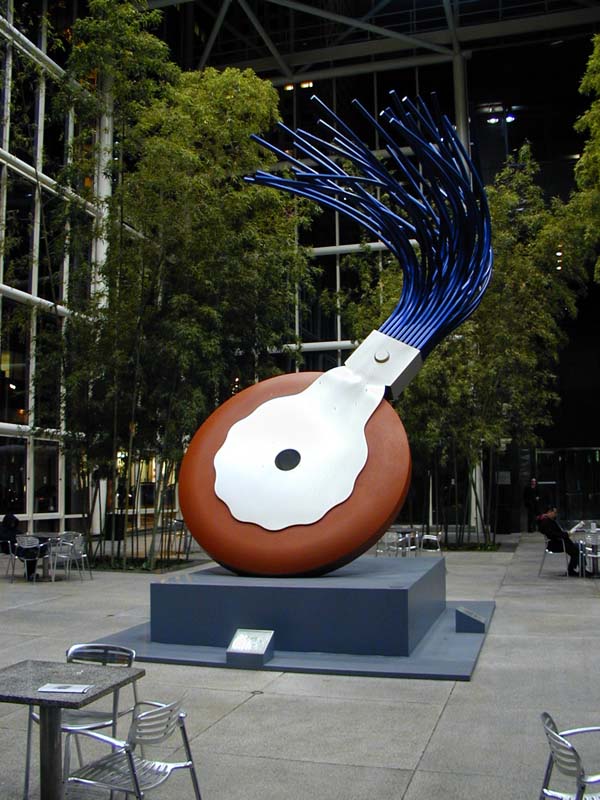
A nice surprise in the atrium of the Nasher Museum is a typewriter eraser by Claes Oldenburg.

One of several versions (including lithograph), it's smaller than the one in the sculpture garden of the National Gallery or at the IBM building in New York.
If you're reading this blog, you're probably old enough to remember typewriter erasers. (Or are you? Remember typewriters?) They weren't wholly successful--typewriter ink being what it was, any success you had in erasing your mistakes was probably offset by a certain loss in the thickness of the paper. With electric typewriters and "correcting" ribbons and the great breakthrough of Liquid Paper, all of that was gladly left behind. But if you grew up around old manual typewriters, as I did, typewriter erasers were always around. I think this was part of the artist's statement--to take a common utilitarian object and defamiliarize it.
Our son Tucker, who is 12, had no idea what it was, of course. What does a giant steel and fiberglass typewriter eraser say to someone who has never seen an everyday one? He can't experience the space of play between the huge permanent fixture and the small insignificant thing itself. Without the familiar, defamiliarizing cannot happen. (Perhaps, in that case, something entirely different happens.)
But if the sculpture has to have a message--and maybe it doesn't, especially one that's this much fun--there's another one that slides into view as the obsolete referent recedes. Something about the ephemerality of technology--and, by extension, well, everything.
One of several versions (including lithograph), it's smaller than the one in the sculpture garden of the National Gallery or at the IBM building in New York.
If you're reading this blog, you're probably old enough to remember typewriter erasers. (Or are you? Remember typewriters?) They weren't wholly successful--typewriter ink being what it was, any success you had in erasing your mistakes was probably offset by a certain loss in the thickness of the paper. With electric typewriters and "correcting" ribbons and the great breakthrough of Liquid Paper, all of that was gladly left behind. But if you grew up around old manual typewriters, as I did, typewriter erasers were always around. I think this was part of the artist's statement--to take a common utilitarian object and defamiliarize it.

Our son Tucker, who is 12, had no idea what it was, of course. What does a giant steel and fiberglass typewriter eraser say to someone who has never seen an everyday one? He can't experience the space of play between the huge permanent fixture and the small insignificant thing itself. Without the familiar, defamiliarizing cannot happen. (Perhaps, in that case, something entirely different happens.)
But if the sculpture has to have a message--and maybe it doesn't, especially one that's this much fun--there's another one that slides into view as the obsolete referent recedes. Something about the ephemerality of technology--and, by extension, well, everything.
Saturday, December 10, 2005
A dash through the Nasher
Janet Kagan and I went to the new Nasher Museum of Modern Art up at Duke yesterday, and here's what we thought.

The building, which is really five rectangular structures arranged in an irregular circle connected by an atrium, is a little smaller than we expected. It is nicely nestled in the woods there along Campus Drive, but once you're inside, there's not enough taking advantage of the views out. Granted, we didn't make the drive from Chapel Hill to look out the window, but we felt that better views could have been had. Although there's lots of natural light from the windows that do exist between the five "pods" and in the ceiling, the building feels massive--Janet sald "cavernous"--rather than light.

David Dillon, architecture critic of the Dallas News, calls the ceiling "clunky."
Dillon is just not a fan of the design at all. About the arrangement of the five rectangular structures, he says they "reach[] out into the landscape like clenched fists." But unless you arrive by helicopter, I don't really see that. I think that within the constraints of the terrain and probably budget, the architect, Rafael Viñoly, came up with a design that serves quite well. Not as successful as his University of Chicago business school project perhaps, where he met the challenge of standing up to Frank Lloyd Wright, but distinctive and functional.
There is only one entrance, via a gently sloping sidewalk, and for now at least, it is graced by one of Patrick Doherty's delightful "environmental sculptures."
The arrangement of the gallery structures around an atrium has one advantage: you don't get lost. This is a manageable museum. Actually only three of the five "pods" are galleries: one is an auditorium, and another, with the gift shop in the front, is I suppose meeting and office space. One gallery tells the story of the Nasher collection, well illustrated with some of their best modern treasures, including Andy Warhol portraits of Mrs. Nasher and the three daughters. Another highlights Duke's permanent collection.
Janet and I found the third exhibit the most interesting. A temporary exhibit, it's called "The Forest: Politics, Poetics and Practice." A whole lot of it--ironically, Janet thought--is photographs of the forest, but they are incredible photographs, some of them enormous cibachrome prints. (Exception: two black-and-whites. They look like the war in Vietnam. In fact, the photos were taken by a Vietnamese woman who was born in 1960; the scene is a Vietnam War reenactment somewhere in the southeastern United States.)
When you walk up to Janet Cardiff's wooden box, seen in this picture, you behold a diorama, an unsophisticated rendering of a small house in the woods. (You've seen better dioramas, which is part of the point.) If you put on the headphones, you hear familiar noises of the night woods, and then you start to hear faint voices as your attention is drawn to the house. You can't make out what's going on through the windows, but you sense that these are voices you would rather not be hearing. A drama unfolds, and in unnerving ways, you are implicated.
The building, which is really five rectangular structures arranged in an irregular circle connected by an atrium, is a little smaller than we expected. It is nicely nestled in the woods there along Campus Drive, but once you're inside, there's not enough taking advantage of the views out. Granted, we didn't make the drive from Chapel Hill to look out the window, but we felt that better views could have been had. Although there's lots of natural light from the windows that do exist between the five "pods" and in the ceiling, the building feels massive--Janet sald "cavernous"--rather than light.
David Dillon, architecture critic of the Dallas News, calls the ceiling "clunky."
Compared to the sublime lightness of Renzo Piano's vaults in Dallas [he designed the Nasher Sculpture Center], it has all the elegance of a train wreck, with massive intersecting beams and thick mullions, like a floating Mark di Suvero sculpture. It may be the price of a columnless public space below, but the solution lacks precision and refinement.
Dillon is just not a fan of the design at all. About the arrangement of the five rectangular structures, he says they "reach[] out into the landscape like clenched fists." But unless you arrive by helicopter, I don't really see that. I think that within the constraints of the terrain and probably budget, the architect, Rafael Viñoly, came up with a design that serves quite well. Not as successful as his University of Chicago business school project perhaps, where he met the challenge of standing up to Frank Lloyd Wright, but distinctive and functional.
There is only one entrance, via a gently sloping sidewalk, and for now at least, it is graced by one of Patrick Doherty's delightful "environmental sculptures."

The arrangement of the gallery structures around an atrium has one advantage: you don't get lost. This is a manageable museum. Actually only three of the five "pods" are galleries: one is an auditorium, and another, with the gift shop in the front, is I suppose meeting and office space. One gallery tells the story of the Nasher collection, well illustrated with some of their best modern treasures, including Andy Warhol portraits of Mrs. Nasher and the three daughters. Another highlights Duke's permanent collection.
Janet and I found the third exhibit the most interesting. A temporary exhibit, it's called "The Forest: Politics, Poetics and Practice." A whole lot of it--ironically, Janet thought--is photographs of the forest, but they are incredible photographs, some of them enormous cibachrome prints. (Exception: two black-and-whites. They look like the war in Vietnam. In fact, the photos were taken by a Vietnamese woman who was born in 1960; the scene is a Vietnam War reenactment somewhere in the southeastern United States.)
When you walk up to Janet Cardiff's wooden box, seen in this picture, you behold a diorama, an unsophisticated rendering of a small house in the woods. (You've seen better dioramas, which is part of the point.) If you put on the headphones, you hear familiar noises of the night woods, and then you start to hear faint voices as your attention is drawn to the house. You can't make out what's going on through the windows, but you sense that these are voices you would rather not be hearing. A drama unfolds, and in unnerving ways, you are implicated.

Thursday, December 08, 2005
Oral histories online
Paul announces the launching, on Documenting the American South, of the first set of digitally archived oral histories from the Southern Oral History Program.
The 1985 interview with Joe Herzenberg is especially interesting to those of us local folks who now benefit from the Orange Water and Sewer Authority. "His belief in the necessity of Cane Creek seems to frustrate the interviewer. . . ."
The 1985 interview with Joe Herzenberg is especially interesting to those of us local folks who now benefit from the Orange Water and Sewer Authority. "His belief in the necessity of Cane Creek seems to frustrate the interviewer. . . ."
Wednesday, December 07, 2005
Brubeck: Take 85
Yesterday, AnonyMoses noted, was Dave Brubeck's 85th birthday. Here are a few free downloads--enough to make you want to dust off your old "Time Out" album (or CD, as the case may be).
The page behind the man behind Rosa Parks
Not being as addicted as some to the NYT opinion pages, I haven't mustered the outrage of some over its decision to designate all of that and much else as a "select" option. Until now. Unless you pay one way or another, you won't be able to see today's important article by Peter Applebome on the story behind that iconic picture of Rosa Parks on the front seat of the bus with an angry-looking white man in the seat behind her.
In the days before "photo-ops," this one was a photo-op. The man, Nicholas C. Chriss, was a UPI reporter. The picture was taken the day after a court order put the Supreme Court's order in the bus desegregation case into effect. Chriss, who died in 1990, wrote in the one brief account he gave,
According to historian Douglas Brinkley (writes Applebome), Mrs. Parks was a "reluctant" subject, "but both the journalists and members of the civil rights community wanted an image that would dramatize what had occurred." Dr. King and others took part in photo opportunities on that day as well.
Applebome's story is important because it gets so much right about what really happened. He interviewed 74-year-old Fred Gray, the lawyer who took the case all the way to the Supreme Court. We're reminded, among other things, that Mrs. Parks' refusal to give up her seat was not unprecedented in Montgomery. But as Applebome puts it,
It's too bad that this story-behind-a-story is so well hidden behind a paywall.
In the days before "photo-ops," this one was a photo-op. The man, Nicholas C. Chriss, was a UPI reporter. The picture was taken the day after a court order put the Supreme Court's order in the bus desegregation case into effect. Chriss, who died in 1990, wrote in the one brief account he gave,
It was a historic occasion. I was then with the United Press International wire service. A UPI photographer took a picture of Mrs. Parks on the bus. It shows a somber Mrs. Parks seated on the bus looking calmly out the window. Seated just behind her is a hard-eyed white man.
Each anniversary of that day, this photograph is brought out of musty files and used in various publications around the world. But to this day no one has ever made clear that it was a reporter, I, covering this event and sitting behind Mrs. Parks, not some sullen white segregationist! It was a great scoop for me, but Mrs. Parks had little to say. She seemed to want to savor the event alone.
According to historian Douglas Brinkley (writes Applebome), Mrs. Parks was a "reluctant" subject, "but both the journalists and members of the civil rights community wanted an image that would dramatize what had occurred." Dr. King and others took part in photo opportunities on that day as well.
Applebome's story is important because it gets so much right about what really happened. He interviewed 74-year-old Fred Gray, the lawyer who took the case all the way to the Supreme Court. We're reminded, among other things, that Mrs. Parks' refusal to give up her seat was not unprecedented in Montgomery. But as Applebome puts it,
None of that diminishes the achievement of her life, just as, perhaps, the true story of the picture need not detract from its power. It's just a reminder that history is almost always more complicated and surprising than the images that most effectively tell its story.
It's too bad that this story-behind-a-story is so well hidden behind a paywall.
Tuesday, December 06, 2005
Happy New Year
Last night we had the ceremonial meeting marking the transition to a new Town Council. For me it was a time to stop and remember what an honor it is to serve the people of this great place.
Today's Chapel Hill news includes the fact that the town has completed its first on-line auction of surplus goods--and it was a tremendous success! Everything sold for higher than expected: a 1998 Chevy Blazer, valued at $4,350, went for $6,600. A 1988 John Deere Dozer, valued at $10,000, sold for almost twice that, $19,600. And more.
And here are lots of pictures from the Rosa Parks memorial bus ride and rally.

Today's Chapel Hill news includes the fact that the town has completed its first on-line auction of surplus goods--and it was a tremendous success! Everything sold for higher than expected: a 1998 Chevy Blazer, valued at $4,350, went for $6,600. A 1988 John Deere Dozer, valued at $10,000, sold for almost twice that, $19,600. And more.
And here are lots of pictures from the Rosa Parks memorial bus ride and rally.
The real shame of Tom DeLay
While Tom DeLay defends himself from charges of money-laundering, he's behind another scandal with distressing and far-reaching implications. The Texas redistricting plan that he orchestrated was deemed by career Justice Department lawyers to violate the Voting Rights Act of 1965. The unanimous opinion of the team of lawyers was very clear about what it found:
[R]elying on a close examination of recent Texas elections, it concluded that the plan would reduce the ability of minority voters to effectively participate in the political process, the test for discriminatory effect under Section 5 [the "preclearance" requirement of the Voting Rights Act, to which Texas among other southern states is subject].
More specifically, according to the memorandum, the plan failed to pass muster under each and every factor the Supreme Court has established for gauging whether or not a redistricting plan will reduce minority electoral opportunity. This was not a close case.
A unanimous recommendation like this would ordinarily have been affirmed by the DOJ's politically appointed higher-ups. But this one wasn't. "The Texas case provides another example of conflict between political appointees and many of the division's career employees," according to the Washington Post. Indeed. As a better Texas politician said to George Wallace in 1965 for his part in the oppressive violence that led to the Voting Rights Act in the first place, "Shame on you," Tom DeLay.
Sunday, December 04, 2005
Blog Against Racism Day
Admittedly I took the easy way out on December 1 by blogging about witnessing against racism by taking a bus ride. On the theory that I often find myself blogging against racism one way or another, I didn't go out of my way. And I'm still not, except by way of directing you to Michael Berube's great post for the occasion.
Saturday, December 03, 2005
When photography was new: DIY postcards
In The Devil in the White City, a dramatically told true story of the 1893 Chicago World's Fair and, at its margins, a shadowy psychopath for whom many young women had a fatal attraction, we see the dawn of the American century: the first apperances of the Ferris wheel, the electric chair, Shredded Wheat, Cracker Jacks, Juicy Fruit gum, and the Kodak camera. The psychopath, Dr. H. H. Holmes, ran a hotel that had a "Kodak room" where you could develop your film. That must have been about as cool as free wireless internet.
Over at The Morning News, Harvey Tulcensky and Laetitia Wolff introduce us to Kodak's 1907 innovation, "real photo postcards" (from their book of the same name). In an interview Tulcensky notes the comparison to flickr.com. But I think he's right about the difference: "The difference is that we are so inundated with images today, that there is no more naïveté in the image-making or choosing. The images that surround us are more often than not tired clichés."
Over at The Morning News, Harvey Tulcensky and Laetitia Wolff introduce us to Kodak's 1907 innovation, "real photo postcards" (from their book of the same name). In an interview Tulcensky notes the comparison to flickr.com. But I think he's right about the difference: "The difference is that we are so inundated with images today, that there is no more naïveté in the image-making or choosing. The images that surround us are more often than not tired clichés."
Friday, December 02, 2005
Speaker ban film coming Sunday
An award-winning documentary on the UNC speaker ban episode will be shown at 1 p.m. this Sunday at the Varsity Theater here in Chapel Hill.
Thursday, December 01, 2005
Be well and happy always.
That is the wish of the Shiwa Monks from the Sera Jay Buddhist Monastery who could be found today in, of all places, University Mall. They'd spent many hours creating a beautiful ritual sand mandala. Today at 5 p.m., to beautiful chanting, they ritually destroyed it and gave the sand back to the earth, via Booker Creek.


Unsung hero: Georgia Gilmore
As I join the bus riders here in Chapel Hill in a little bit, I'm going to be thinking about food, specifically Georgia Gilmore's pound cake. Gilmore and her "Club from Nowhere" helped to keep the Montgomery boycotters well fed for the fight. Gilmore, in fact, was a fighter. She lost her job in a Montgomery restaurant for testifying on behalf of Dr. King in a trial against him during the boycott. That's when her cooking went underground. In a new cookbook called Hidden Kitchens you'll find her story--and her recipe for pound cake. I tried it out for my civil rights seminar students. Delicious.
This book would make a great holiday gift for anyone on your list interested in American history and food.
This book would make a great holiday gift for anyone on your list interested in American history and food.
Rosa Parks rally today
In tribute to Rosa Parks, who was arrested in Montgomery 50 years ago today, the Chapel Hill area NAACP is hosting a bus ride down MLK Boulevard followed by a rally at the old Post Office building. The ride begins at 11 and the rally at noon. Details here. See you there?
Thanks again to Brenda Brown for organizing this event.
And remember that this is Blog Against Racism Day.
Thanks again to Brenda Brown for organizing this event.
And remember that this is Blog Against Racism Day.
Subscribe to:
Posts (Atom)